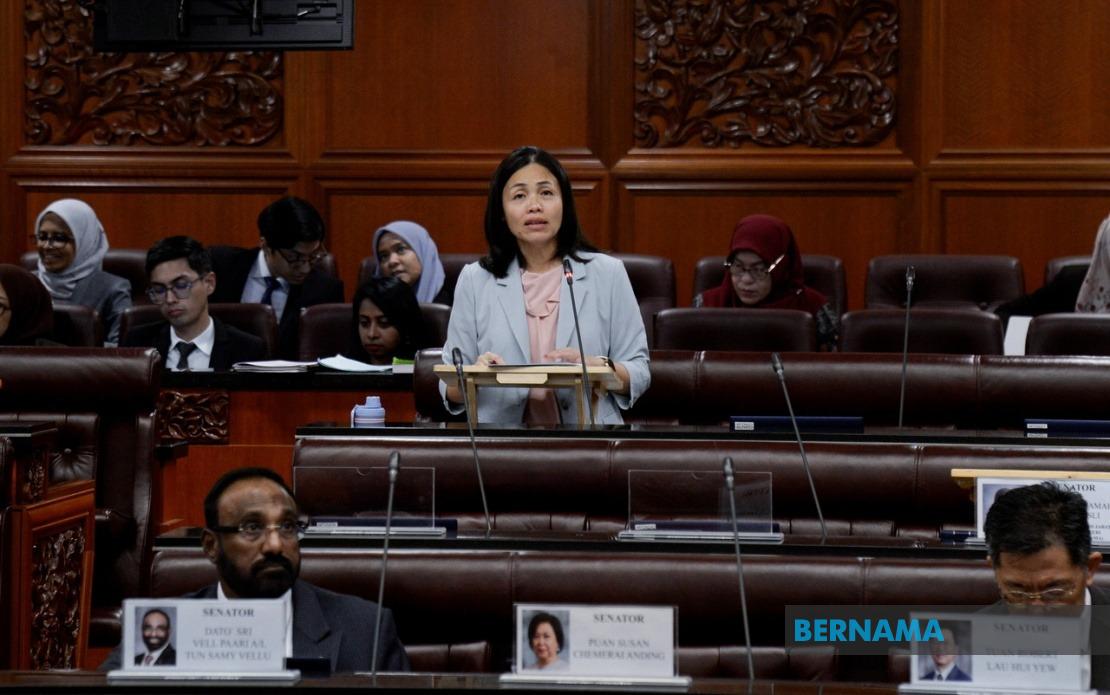
Malaysia's upper house approved legislation on August 3 to fundamentally reshape the governance and enforcement powers of the Communications and Multimedia Commission, marking a significant step toward insulating the country's media regulator from political influence. The Dewan Negara passed the Communications and Multimedia Commission (Amendment) Bill 2026 by majority vote after deliberation among eleven senators, following the Dewan Rakyat's endorsement on July 15. The 17-clause bill addresses governance independence, regulatory function, operational capacity, and digital infrastructure oversight for an industry that lawmakers increasingly recognise as critical national infrastructure rather than merely an economic sector.
The amendment introduces a structural barrier to political control by explicitly prohibiting Members of Parliament and state assemblymen from serving as commission chairman. Deputy Minister of Communications Teo Nie Ching explained that the revised legislation also constrains ministerial appointment discretion, requiring demonstrated qualifications rather than allowing patronage-based selection. This governance reform responds to concerns that prior appointment mechanisms allowed political actors to exercise undue leverage over regulatory decisions affecting media licensing, content standards, and platform accountability—issues of heightened sensitivity in Southeast Asia's politically contested media landscape.
Beyond institutional reform, the amendment strengthens the regulator's capacity for digital enforcement, particularly against online gambling operations that exploit Malaysia's digital infrastructure. According to Teo, the Malaysian Communications and Multimedia Authority removed more than 222,000 items of gambling-related content during the first seven months of 2026, demonstrating exponential growth in enforcement activity. The trajectory reveals intensifying digital takedown operations: platforms removed merely two pieces of such content in 2022, escalating to 18,814 in 2023, 189,484 in 2024, and 289,486 in 2025. Complementing content removal, authorities have blocked approximately 6,982 gambling websites between 2022 and July 31, 2026, through collaborative action between the commission and internet service providers.
The regulatory framework distinguishes operational roles: the Royal Malaysia Police retains primary jurisdiction over gambling investigations and enforcement, while the commission provides technical assistance, digital forensic analysis, and access blocking at the request of law enforcement agencies. This division of labour reflects the complexity of addressing cybercrime in a jurisdiction where gambling operates as a substantial illicit economy, with digital platforms enabling remote wagering and cross-border transactions that traditional policing struggles to intercept. The commission's expanded technical mandate acknowledges that content removal and infrastructure blocking require specialist capabilities that generalised law enforcement agencies may lack.
Senator Datuk Abdul Halim Suleiman articulated the strategic rationale underlying the amendment, characterising communications and multimedia infrastructure as having transcended sectoral economic importance to become essential national infrastructure comparable to utilities or defence systems. He cautioned, however, that statutory empowerment alone proves insufficient; effective protection of public interests depends on the commission's capacity to execute functions with professional rigour, transparent procedures, and demonstrable accountability. His framing reflects regional debates about digital governance, where policymakers confront the tension between regulatory authority needed to address harms—from misinformation to illegal commerce—and the risk that broad powers concentrate in institutions vulnerable to political abuse.
Senator Muhammad Hasbie Muda reinforced this concern, emphasising that governance reform must prioritise merit-based appointment and competence rather than simply expanding institutional mandate. He contended that reform divorced from mechanisms ensuring transparent implementation, effective execution, and public accountability risks reproducing the pathologies that motivated institutional restructuring in the first instance. His intervention suggests the amendment's passage represents consensus across the upper house that the previous governance model, regardless of prior commissioners' individual rectitude, created structural incentives for political interference incompatible with the regulator's societal role.
The bill's 17 clauses include substantive revisions to Section 16 of the parent statute governing the commission. These amendments clarify the regulator's expanded function in developing and establishing digital infrastructure and platform standards, moving beyond traditional broadcast and telecommunication regulation toward comprehensive digital governance. This broadened mandate reflects the obsolescence of sector-based regulatory categories in an environment where content distribution, data processing, and communications occur across platforms combining elements formerly classified as telecommunications, broadcasting, and information technology services.
For Malaysian stakeholders, the amendment addresses practical governance challenges that have accumulated as digital platforms consolidated control over public discourse and commerce. The regulator's prior framework proved inadequate for managing phenomena including the coordinated spread of false information across messaging applications, the proliferation of fraudulent online gambling operations, and the transnational character of digital harms that ignore regulatory jurisdiction defined by territorial boundaries. The amendment attempts to furnish the commission with statutory tools and structural independence to navigate these challenges more effectively than previous arrangements permitted.
The reform also carries implications for Malaysia's standing in international digital governance discussions, where developed economies increasingly scrutinise how nations regulate online content and platform conduct. By institutionalising political insulation and merit-based governance, Malaysia signals commitment to regulatory approaches grounded in professional expertise rather than governmental instrumental use of regulatory authority. This positioning proves relevant for technology companies considering operational decisions in the region and for international bodies evaluating Malaysia's regulatory maturity.
The amendment's passage suggests that Malaysian policymakers recognise the necessity of constraining executive and legislative branches' direct control over digital regulation, even as they expand substantive regulatory authority. This architectural choice—paradoxically strengthening institutional mandate while limiting political access—reflects accumulated regional and international experience suggesting that unconstrained political influence over media and digital regulators produces regulatory capture, inconsistent enforcement, and public distrust. Whether the reformed commission translates statutory independence into demonstrably neutral, competent regulation will depend on appointment decisions, resource allocation, and institutional culture in the period ahead.
The amendment takes effect as Malaysia confronts mounting digital governance challenges, from artificial intelligence deployment to platform liability for user content. The institutional foundation established through governance reform provides structural preconditions for the regulator to address these emerging issues with technical sophistication and democratic legitimacy. Implementation will reveal whether statutory innovation translates into regulatory practice that earns public confidence and professional respect.

