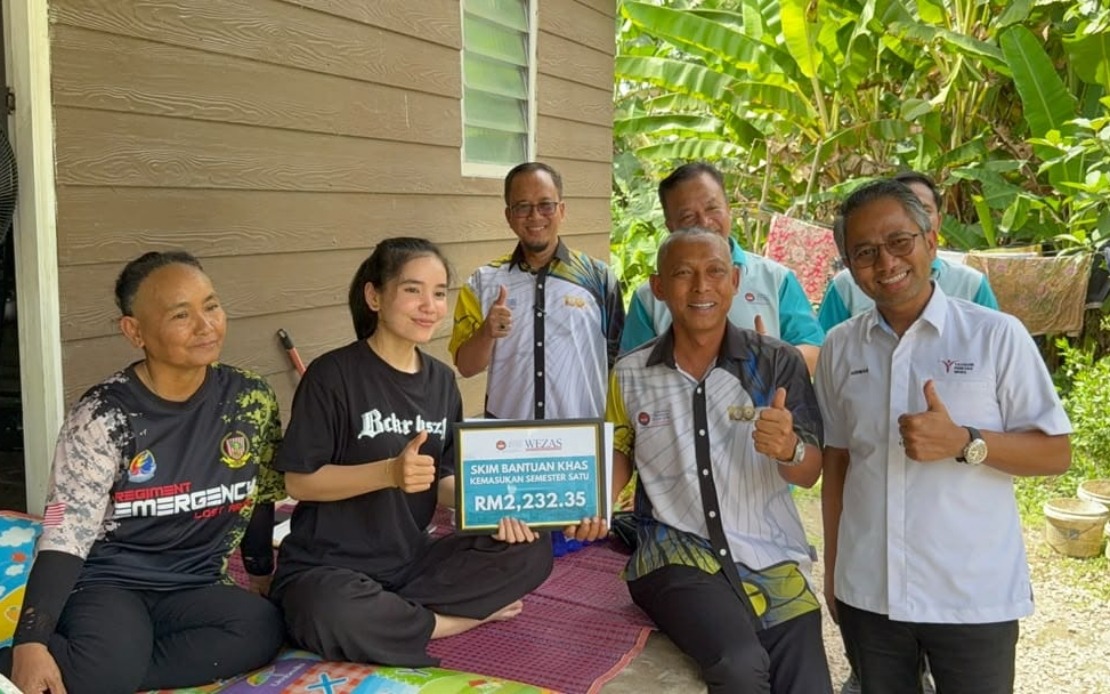
When Lovely Sabana Augustine's appeal for help covering her university registration fees circulated on social media, it sparked a swift response from Sultan Idris Education University (UPSI) and government agencies committed to ensuring that financial hardship does not derail promising students' educational aspirations. The STPM high achiever, who had secured a place at UPSI's Faculty of Human Sciences for the 2026/2027 academic year, exemplifies a broader challenge facing Malaysian higher education: talented individuals from economically disadvantaged backgrounds frequently encounter barriers that threaten to prevent them from advancing their studies.
The intervention on behalf of Lovely Sabana also extended to two other prospective students facing similar circumstances. Siti Nurdianis Nordin, admitted to the Faculty of Management and Economics, and Muhamad Ilias Danish, set to study at the Faculty of Languages and Communication, each received the same level of support. Together, the three students received RM1,500 apiece to assist with immediate costs including registration fees and essential materials required before their scheduled enrolment on September 13.
The funding structure reveals the collaborative nature of Malaysia's safety net for disadvantaged students. UPSI's Centre for Waqf, Endowment, Zakat, Khairat, and Sadaqah (WEZAS) contributed RM500 per student, while Yayasan Perkasa Siswa (YPS) provided the remaining RM1,000 to each recipient. This partnership model demonstrates how Islamic charitable mechanisms and dedicated student welfare foundations can work alongside university infrastructure to address immediate financial crises that might otherwise force capable students to abandon their educational pursuits.
Lovely Sabana's personal circumstances underscore the genuine deprivation that many Malaysian families navigate daily. Living in Tumpat, Kelantan, with her mother Mek Kenui, who earns approximately RM800 monthly as a school cleaner while serving with the Malaysian Volunteer Corps Department (RELA), she represents the youngest of four siblings in a single-parent household. Her father, a retired soldier, passed away in 2017, removing the family's primary earner and leaving her mother as the sole breadwinner. Such family structures are not uncommon across Malaysia's lower-income communities, where maternal wages from service-sector employment often fall significantly below the poverty line.
The other two beneficiaries similarly encountered unstable household finances and personal tragedy. Siti Nurdianis comes from a family where her mother relies entirely on daily-wage work without stable employment contracts or benefits, creating perpetual income uncertainty. Muhamad Ilias Danish experienced the loss of his father, his family's primary breadwinner, placing him in the position of contributing to household expenses while pursuing his own education. These narratives reflect patterns of economic vulnerability that extend across rural and semi-urban Malaysia, where single parents, informal-sector workers, and families coping with bereavement represent a significant proportion of households unable to finance higher education without external support.
From the Malaysian government's perspective, the intervention signals MOHE's policy commitment to preventing talent from being wasted due to poverty. Hirman Awang, director of the Department of Higher Education's Student Affairs Division, framed the assistance within the broader mandate of ensuring that capable students do not face exclusion from tertiary education because of financial constraints. His statement emphasised that Yayasan Perkasa Siswa remains positioned as a frontline mechanism for safeguarding university student welfare, with the RM1,000 contribution designed both to provide immediate material relief and to bolster psychological confidence as students prepare for campus life.
UPSI's institutional response demonstrates how universities can proactively identify and support vulnerable prospective students rather than waiting for individuals to fall through the cracks. Prof Dr Norkhalid Salimin, the university's deputy vice-chancellor for Student Affairs and Alumni, characterised the assistance as part of a broader commitment to recognising difficulties faced by economically constrained students beginning their academic journeys. He highlighted that UPSI's Student Affairs and Alumni Department (JHEPA) and WEZAS maintain systematic approaches to identifying students requiring early intervention, framing support not merely as financial transactions but as demonstrations of institutional commitment to students' complete welfare and long-term success.
The incident's emergence through social media reflects contemporary Malaysian realities: many economically disadvantaged students lack established channels through which to communicate their needs to educational authorities, and their struggles gain visibility and response only when individual stories achieve viral attention online. While the outcome was positive in this instance, the underlying issue suggests that many other capable students facing identical or worse circumstances may never benefit from such visibility or intervention, remaining unknown to university support systems.
For Malaysian policymakers and educational administrators, this case illustrates the ongoing need for proactive, systematic approaches to identifying and supporting students from low-income households before they reach crisis points. The three-party collaboration involving UPSI, YPS, and government agencies demonstrates feasible models, but scaling such interventions requires sustained funding, institutional capacity, and perhaps most importantly, sophisticated systems for identifying eligible students early in the application process rather than responding reactively to individual appeals.
The implications extend beyond these three individuals. Malaysia's economic development increasingly depends on mobilising talent from across all socioeconomic strata, and allowing financial barriers to exclude capable students represents a form of human capital loss that constrains long-term productivity and competitiveness. As UPSI and the Higher Education Ministry pursue such initiatives, they contribute incrementally toward a higher education system that functions genuinely as a vehicle for social mobility rather than as an exclusive pathway reserved for students whose families already possess financial resources.
Looking forward, the strategic collaboration between UPSI, YPS, and the Department of Higher Education established for supporting these three students offers a template worth expanding. Whether through enhanced screening mechanisms for prospective students, larger funding allocations to student welfare foundations, or formal agreements between universities and philanthropic organisations to identify vulnerable applicants, Malaysian higher education can work toward ensuring that individuals like Lovely Sabana Augustine access opportunities that match their academic merit rather than their family's bank balance. The task remains substantial, but cases like these demonstrate that the infrastructure and political will to address educational inequality exist within Malaysia's system.

