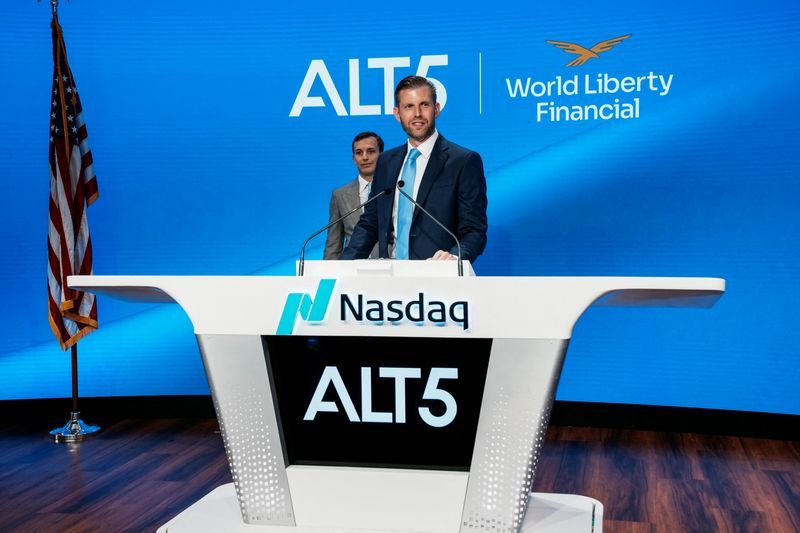
The United States' banking regulator has cleared the path for President Donald Trump's cryptocurrency venture, World Liberty Financial, to establish itself as a federally chartered trust bank. The Office of the Comptroller of the Currency announced on Friday that it has granted conditional preliminary approval to World Liberty Trust Company's application for a national trust charter, which the firm submitted in January. This development represents a significant milestone for the Trump family's expanding involvement in the digital assets sector and reflects the current administration's notably permissive stance toward cryptocurrency innovation.
The conditional approval, while not yet final, signals regulatory comfort with the firm's structural framework and operational plans. Critically, the charter would empower World Liberty to assume direct control over functions currently outsourced to third parties. At present, the company relies on cryptocurrency custodian BitGo to issue its USD1 stablecoin and to safeguard the U.S. dollar reserves that back it. Once the charter becomes fully operational, World Liberty could internalize these operations under direct federal supervision, streamlining its business model and potentially enhancing customer confidence through demonstrated regulatory oversight.
Trust bank charters represent an increasingly popular regulatory pathway for cryptocurrency firms seeking mainstream legitimacy and operational flexibility. Unlike traditional commercial bank charters, which carry restrictions on deposit-taking and lending, trust charters allow crypto enterprises to provide custody, asset management, and payment settlement functions on a nationwide basis under a single federal license. This structure has attracted intense interest from the digital assets industry, which views the charter as a bridge between decentralized finance and traditional banking infrastructure. The Trump administration's appointment of crypto-friendly Comptroller Jonathan Gould has accelerated approvals in this space, with competing platforms including Ripple and Circle having similarly secured preliminary conditional approval in recent months.
World Liberty Financial's emergence as the most prominent Trump family crypto initiative reflects their broader strategic positioning in the sector. The company was cofounded in late 2024 by Trump, his three sons, and members of the Witkoff family, which maintains deep ties to the president. Zach Witkoff, son of Trump's special diplomatic envoy Steve Witkoff, serves as the trust bank's president and chairman, while his uncle Robert Witkoff will assume a director position. This concentrated family control underscores the venture's significance as both a business enterprise and a vehicle for accumulating wealth within the Trump circle.
The USD1 stablecoin itself has demonstrated remarkable market traction since its announcement in March 2025. The asset has rapidly climbed to become the fourth-largest stablecoin by market capitalization, commanding approximately $4 billion in circulating supply. This explosive growth reflects sustained retail and institutional appetite for dollar-backed digital assets, a market segment that continues expanding as blockchain applications mature and institutional adoption accelerates across Southeast Asia and emerging markets generally. The stablecoin's positioning emphasizes accessibility and financial democratization, messaging that resonates with the Trump administration's broader critique of traditional banking systems as overly restrictive.
Financial flows associated with World Liberty Financial underscore the venture's profitability for the Trump family. Reuters calculations indicate that the president and his family accumulated roughly $50 million in earnings from the USD1 stablecoin alone through the end of June 2026. More broadly, World Liberty Financial channeled in excess of $1.6 billion to Trump and his associates as of April, making it a particularly lucrative enterprise within his diversified portfolio. These figures illuminate the commercial dimensions underlying the administration's enthusiastic embrace of cryptocurrency policy liberalization.
The regulatory approval process itself has proven contentious, particularly among Democratic lawmakers concerned about governance propriety and potential conflicts of interest. Two Senate Banking Committee Democrats requested that Treasury officials examine purported national security implications following reports of a $500 million investment stake linked to the United Arab Emirates' national security adviser. Such scrutiny reflects broader anxieties about whether presidential family involvement in financial services enterprises—particularly those dependent on regulatory goodwill—creates unacceptable ethical complications. The OCC countered by asserting that Comptroller Gould and staff had fulfilled statutory duties appropriately and that the approval reflected career staff analysis rather than political calculation.
The conditional approval incorporates specific operational requirements designed to mitigate regulatory risk. World Liberty Trust must maintain minimum capital reserves of at least $20 million, notify the OCC of any significant modifications to its business plan, and employ a qualified internal audit manager meeting federal standards. The regulator also addressed investor composition concerns by determining that foreign investors, including those mentioned in connection with Middle Eastern financial sources, would not qualify as principal shareholders and had executed passivity agreements forswearing operational control or influence. These provisions attempt to ring-fence the bank's governance from external pressure while maintaining the corporate structure preferred by Trump family interests.
From a Southeast Asian perspective, World Liberty Financial's regulatory breakthrough carries noteworthy implications for cryptocurrency adoption and institutional integration across the region. Malaysian, Singaporean, and Thai regulators have generally adopted more cautious approaches toward stablecoin issuance and crypto custody services, seeking to balance innovation against systemic risk. The U.S. regulatory precedent established through World Liberty's approval may influence regional policymakers' calculus regarding similar applications, potentially accelerating the normalization of cryptocurrency financial infrastructure. Conversely, concerns about governance integrity and concentrated wealth accumulation through regulatory privileges may harden resistance among regulators skeptical of privileged market access for politically connected entities.
The approval's finality remains contingent on World Liberty's sustained compliance with regulatory standards and OCC satisfaction with ongoing supervisory examination. The preliminary conditional status provides the regulator with mechanisms to impose additional requirements or withhold final approval should material concerns emerge. This residual uncertainty means that while the strategic regulatory hurdle has been substantially cleared, the company must continue demonstrating operational competence and adherence to banking standards that have governed traditional financial institutions for generations, as Zach Witkoff acknowledged in his statement welcoming the decision.
World Liberty Financial's trajectory reflects broader transformation in cryptocurrency's relationship with mainstream financial regulation. Rather than remaining entirely outside formal oversight structures, leading digital assets platforms increasingly seek regulatory integration as a source of competitive advantage and customer assurance. The Trump administration's alignment with this trend has accelerated institutional acceptance and removed numerous bureaucratic obstacles that previously constrained cryptocurrency innovation. Whether this permissive regulatory environment persists beyond the current administration, and whether Southeast Asian jurisdictions follow similar paths toward accommodating cryptocurrency financial services, remain open questions with significant implications for the region's fintech development.

