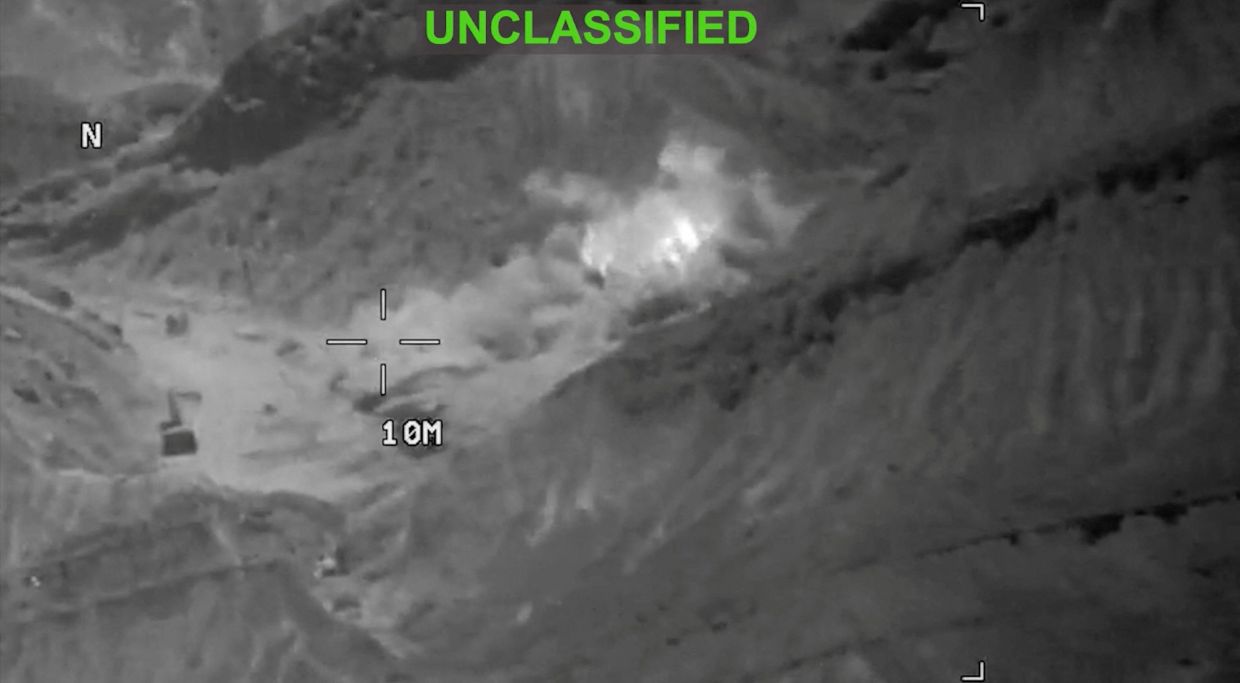
The United States intensified its military campaign against Iran on Saturday night with fresh airstrikes ordered by President Donald Trump, continuing a punishing cycle of tit-for-tat attacks that has shattered a brief ceasefire arrangement just days after it was negotiated. The operation came in direct response to an Iranian assault that claimed the lives of two American service members stationed in Jordan, with a third reported missing, marking a grim toll in what is rapidly becoming a wider regional conflict with implications for energy markets and shipping routes critical to global commerce.
US Central Command initiated the latest round of strikes at 6 p.m. Eastern Time on Saturday, targeting what military officials described as Iranian capabilities threatening commercial traffic through the Strait of Hormuz and striking back at Islamic Revolutionary Guard Corps forces responsible for the previous day's attack. The operation zeroed in on Iran's military coastal surveillance infrastructure and air defence systems, aiming to reduce Tehran's capacity to project power across vital Gulf shipping lanes. These latest attacks represent a continuation of military operations that have accelerated dramatically since the collapse of a month-old ceasefire agreement that unraveled last week, signalling a return toward full-scale hostilities that many feared could destabilise the entire region.
Iranian reports indicated that American aircraft struck targets near the southern coastal town of Sirik and locations adjacent to the Iraq border near Shadegan, though Tehran claimed no casualties or infrastructure damage resulted from these strikes. More controversially, Iran's Atomic Energy Organisation condemned what it characterised as an American strike on an under-construction nuclear power facility at Darkhovin, though the timing of this alleged attack remained unclear. The targeting of nuclear infrastructure, if confirmed, represents a significant escalation in the scope of military operations and raises questions about American strategy and its potential consequences for international nuclear security frameworks.
Kuwait and Bahrain, both American military allies hosting significant US forces, reported intercepting Iranian missile and drone attacks on Sunday, continuing a sustained campaign that saw Kuwait come under intense bombardment on Saturday. The strikes targeted military installations including Kuwait's Al-Adiri camp and Ali Al Salem Air Base, with Iranian state media claiming responsibility through the army's statement. Despite the frequency and intensity of these attacks, allied air defence systems successfully prevented casualties or significant infrastructure damage, demonstrating the effectiveness of existing defensive measures but also underlining the persistent threat environment confronting American forces and regional partners throughout the Gulf.
The mounting toll on American personnel reflects the human cost of the intensifying conflict. Central Command confirmed that Friday's Iranian attack resulted in two deaths, with search operations continuing for a third missing service member, bringing the total number of American military personnel killed since the outbreak of hostilities to sixteen, while over 420 others have sustained injuries. Defence Secretary Pete Hegseth's brief statement that the deaths would only strengthen American resolve signals Washington's commitment to maintaining its military posture despite the casualties, though such language offers little comfort to families of the fallen or those concerned about continued escalation.
Iranian state media reported that American airstrikes over the preceding three weeks alone had killed approximately fifty Iranians and wounded more than five hundred, demonstrating the asymmetric human toll this conflict is exacting on both sides. These figures, if accurate, underscore the humanitarian dimension often obscured by military communiques focused on capabilities and targets. The disparity in reported casualties between the two sides reflects both the differing defensive capabilities available to each party and the broader technological gap that characterises modern Middle Eastern conflicts, where air superiority translates directly into asymmetric casualty patterns.
The conflict's origins trace to late February when the United States and Israel launched coordinated strikes intended to cripple Iranian nuclear and missile capabilities while degrading the network of regional proxies through which Tehran projects influence. That initial campaign triggered the deterioration that has now led to direct Iranian-American military exchanges, a significant escalation from the proxy warfare that has characterised previous years of tension. The strategic objectives driving both sides remain fundamentally misaligned, with the US seeking to constrain Iranian military capabilities and Iran determined to demonstrate its capacity to strike American interests despite the technological disparity.
Control of the Strait of Hormuz has emerged as a central battleground, with both sides increasingly targeting shipping traffic through one of the world's most critical chokepoints. The United States claims it is enforcing a naval blockade preventing Iranian commerce, while Tehran asserts it is enforcing its own maritime regulations and warning vessels against unsafe transit patterns. Iran's Islamic Revolutionary Guard Corps alleged on Sunday that four commercial vessels attempted to transit using unsafe routes with American backing, claiming two subsequently abandoned the attempt while two others encountered unspecified accidents. This maritime dimension carries enormous implications for global energy supplies and inflation prospects, as any sustained disruption to Hormuz traffic could drive oil prices higher and ripple through global markets already sensitive to geopolitical risk.
Supreme Leader Ayatollah Mojtaba Khamenei, whose exact whereabouts remain undisclosed following his father Ali Khamenei's death in the initial February strikes, responded to the latest American action through written statements carried by Iranian state media. His message dismissed the credibility of agreements signed by President Trump, warning of escalating costs and further humiliation for the United States, language that suggests Iranian leadership intends to persist in confrontation rather than seek negotiated resolution. The statement's aggressive tone and the manner of its release—through proxies rather than public appearance—signal Iranian determination to maintain confrontational posture despite significant military losses, though questions persist about the actual decision-making structures within Iran's leadership following the death of the Supreme Leader.
The collapse of the ceasefire after merely one month demonstrates the fragility of any agreements negotiated between the two sides without addressing underlying strategic grievances. Both parties entered the arrangement with fundamentally incompatible objectives, and the resumption of hostilities suggests that neither side believes diplomacy offers realistic prospects for achieving its goals. For Southeast Asian observers and Malaysian policymakers monitoring developments, this escalation carries direct implications for regional stability and economic interests, as any further disruption to Middle Eastern energy supplies or shipping traffic through international waters will inevitably affect commodity prices, supply chains, and regional security arrangements that influence broader Asian geopolitics.

