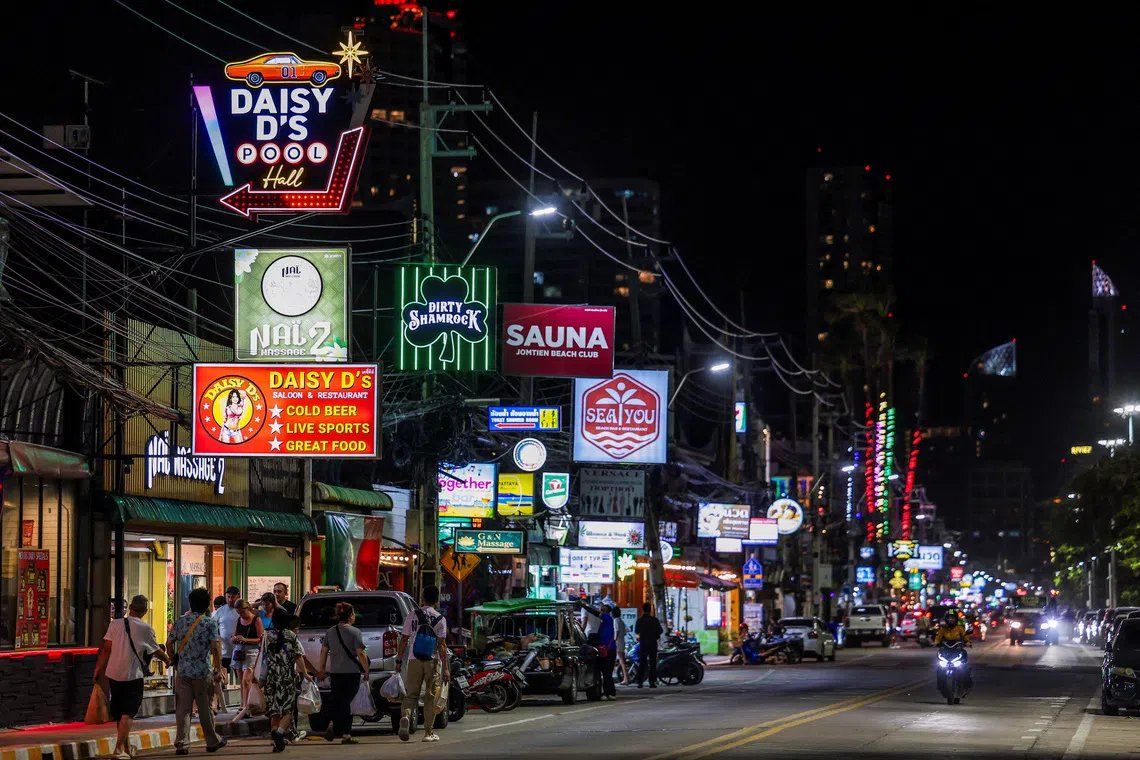
After more than seven months at sea supporting military operations in the Middle East, the USS Abraham Lincoln is set to dock at Laem Chabang near Pattaya this week, bringing nearly 5,000 sailors and Marines seeking shore leave to one of Southeast Asia's most economically vital yet controversial tourism destinations. The carrier's arrival underscores the complex interplay between military logistics, economic development, and social governance that characterises the relationship between the United States and Thailand—a dynamic that extends well beyond the immediate economic windfall local businesses anticipate.
The extended deployment has already set modern records for consecutive days at sea for a US Navy carrier, according to Democratic lawmakers in Congress. Yet this operational achievement masks deepening concerns within military circles. Recent reports in military-focused publications have detailed troubling incidents aboard the vessel, including suicide attempts and deteriorating morale among personnel enduring one of the longest continuous deployments in recent memory. These psychological pressures add a layer of complexity to shore leave arrangements, as sailors arrive in port potentially dealing with stress and fatigue after spending over 200 days confined to the carrier.
For Pattaya's tourism industry, the timing could hardly be more critical. Local business leaders describe 2024 as exceptionally weak, with occupancy rates and visitor spending far below historical norms. The city's 300,000-plus hotel rooms represent significant infrastructure investment with limited returns in the current climate. Pattaya Mayor Poramase Ngampiches estimates individual service members could spend between 1,000 and 3,000 baht daily, translating to a potential injection of several million baht into the local economy over the carrier's stay—money that restaurants, hotels, bars, and entertainment venues desperately need. Lisa Hamilton, president of the Pattaya Nightlife Business Association, captured the desperation plainly, noting she has never witnessed a year as economically challenging in her two decades living in the city.
Yet this economic calculus exists in uncomfortable tension with documented social realities. Pattaya has evolved from a small fishing village into a major international tourism hub partly because it became a destination for American servicemen during the Vietnam War era. That historical pattern has calcified into present-day structures. The FBI, in assessments from over a decade ago, identified Pattaya as one of the world's leading sex tourism destinations—a characterisation that remains largely accurate today despite Thailand's nominal prohibition on prostitution. The industry operates with remarkable openness in major tourism zones throughout the country, from parts of Bangkok to Pattaya's beachfront and nightlife districts.
Ahead of the carrier's arrival, Pattaya police have announced enhanced patrol operations, particularly around the main entertainment and beach areas. Over the past weekend alone, enforcement actions resulted in the detention of 40 to 50 people on suspicion of involvement in prostitution. However, Pattaya Police Chief Anek Srathongyoo acknowledged the fundamental challenge candidly, explaining that identifying and apprehending sex workers remains difficult because solicitation often occurs in public spaces and perpetrators take precautions to avoid detection. The acknowledgment reveals the structural limitations of enforcement when an industry operates at such scale and with such deep integration into the local economy.
Academic experts have articulated the health and human rights dimensions of this tension. Pipatpong Fakfare, an associate professor at Bangkok University's School of Humanities and Tourism Management, has highlighted the compounding risks presented by a large influx of military personnel. When demand spikes suddenly, he notes, the likelihood of sexual exploitation rises materially, as does the potential for transmission of sexually transmitted diseases. These public health concerns gain additional weight given the reported mental health struggles among some aboard the carrier—personnel arriving in port after extended isolation may be particularly vulnerable to risky decision-making or exploitative situations.
The economic dispersal of visiting personnel also matters to overall impact calculations. Not all 5,000 sailors and Marines will necessarily remain in Pattaya. Some will likely travel to Bangkok or other destinations, fragmenting the local economic benefit. Shore leave is typically staggered to maintain operational readiness, meaning visitor volume will rise and fall unevenly across the carrier's stay. Thanet Supornsahasrungsi, president of the Association of Chonburi Tourism Federation, noted that the distribution of spending depends substantially on where personnel choose to spend their limited free time, adding another layer of uncertainty to revenue projections.
The USS Abraham Lincoln's journey itself illustrates broader geopolitical shifts affecting the region. The carrier departed its home port of San Diego in November, initially on routine deployment. However, it was subsequently redirected to support US-Israeli military operations amid regional tensions involving Iran, marking a significant operational disruption that extended what would normally be a standard deployment into a record-breaking odyssey at sea. This redeployment reflects the ongoing strategic importance the United States accords to Middle Eastern operations, even as it attempts to maintain forward presence and alliance commitments across the Indo-Pacific.
For Thailand and the broader Southeast Asian region, the visit encapsulates recurring policy dilemmas. Host nations benefit from military cooperation and the economic activity generated by foreign service personnel, yet struggle to manage the social externalities that accompany such arrangements. Pattaya's transformation from fishing village to international tourism hub—accelerated by American military demand during Vietnam—created economic opportunities but also entrenched structures that have proved remarkably resistant to reform efforts. The tension between maximising economic benefits and minimising social harms remains fundamentally unresolved.
The Abraham Lincoln's arrival will undoubtedly provide measurable near-term economic relief for Pattaya's struggling tourism sector, and Mayor Poramase is correct in expecting a short-term stimulus effect. Local business operators, facing their most difficult year in recent memory, welcome the visitor influx regardless of its complicated implications. However, the visit also crystallises longstanding questions about development models and governance frameworks. Thailand and the United States must reckon not only with immediate logistics—staggered shore leave, enhanced policing, crowd management—but also with the deeper structural issues the carrier's arrival brings into sharp focus: how to balance economic imperatives with human dignity, public health, and the wellbeing of both hosts and visitors.

