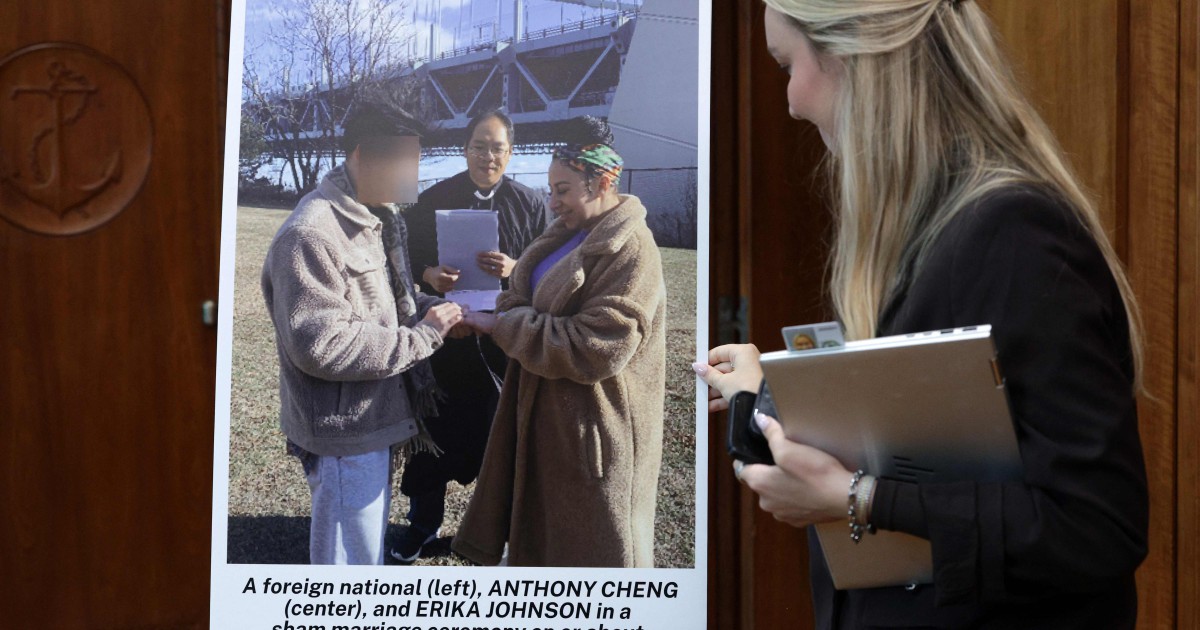
The US Justice Department has brought charges against 11 people accused of orchestrating one of the largest sham marriage networks uncovered in recent years, with court filings revealing a decade-long operation that facilitated approximately 1,000 fraudulent unions. The charges represent a significant enforcement action targeting immigration fraud during a period when the incoming Trump administration has signalled heightened scrutiny of immigration-related irregularities.
According to court documents filed in federal proceedings, the scheme operated with systematic precision, with organisers recruiting foreign nationals—predominantly from mainland China—and matching them with willing American citizens or permanent residents. These individuals were compensated for their participation in marriages that existed purely on paper, creating a backdoor pathway to US legal residency for foreign nationals who could not otherwise qualify through standard immigration channels.
The scope of the operation underscores a persistent vulnerability within the American immigration system. By leveraging the family reunification provisions embedded in US immigration law, the network exploited regulatory gaps that have long troubled immigration enforcement officials. The alleged scheme required coordination across multiple states, comprehensive documentation falsification, and coordination between financial intermediaries and marriage brokers.
For Malaysian observers, the charges illustrate how immigration fraud networks operate across borders and affect Asian nationals disproportionately. Similar schemes have occasionally intersected with Southeast Asian populations, though Chinese nationals have historically represented the largest demographic targeted by such operations. The incident demonstrates that immigration fraud remains a transnational challenge requiring regional intelligence sharing and coordination.
The timing of these prosecutions aligns with broader shifts in American immigration policy. The incoming Trump administration has pledged intensified enforcement against irregular immigration and visa fraud, signalling that the Justice Department's current actions may represent merely the opening salvo in a more aggressive posture toward immigration-related crimes. This policy environment has created renewed momentum within federal law enforcement agencies to pursue long-standing investigations.
The charges likely involved conspiracy to commit immigration fraud, wire fraud, and identity theft, though specific counts remain detailed in sealed or formal charging documents. Participants in such schemes typically faced escalating penalties depending on their role within the network hierarchy—from low-level marriage participants recruited for monetary compensation to organisers who orchestrated the entire operation and profited substantially.
From a regulatory perspective, the case raises questions about oversight mechanisms within the immigration adjudication process. Consular and immigration officers must distinguish between legitimate family-based immigration petitions and fraudulent arrangements, a task complicated by the fact that some participants knowingly cooperated with investigators. The sheer volume of fraudulent marriages—approximately 1,000 over ten years—suggests that detection mechanisms may have functioned inadequately before the operation was dismantled.
The prosecution reflects international cooperation between American authorities and law enforcement in China, where many of the foreign nationals originated. Such transnational cases require extensive evidence gathering, witness interviews across borders, and coordination with foreign governments—a process that typically spans multiple years before formal charges can be filed.
For the affected Chinese nationals, prosecution carries serious consequences beyond criminal penalties. Individuals convicted of immigration fraud face permanent bars to future immigration benefits, potential deportation, and substantial prison sentences. Many of these individuals invested significant sums to participate in the scheme, viewing fraudulent marriage as a cost-effective alternative to employment-based or family-based immigration pathways.
The case also highlights the perspective of American citizens and permanent residents who participated in the fraud. Some were economically motivated individuals who viewed the compensation as a straightforward financial transaction with minimal perceived risk. Others may have been coerced or manipulated into participation. Prosecutors must balance pursuing those who actively conspired against those who were marginal participants.
Regional implications for Southeast Asia deserve consideration. While this particular case involves Chinese nationals, the successful operational model demonstrated by this network—leveraging marriage as a migration pathway—could theoretically be adapted by other nationality groups. Malaysian immigration authorities and ASEAN nations should monitor whether similar schemes attempt to exploit Southeast Asian nationals seeking US residency.
The investigation's success depended on cooperation from individuals willing to become informants and cooperate with federal authorities. This suggests that despite the network's apparent sophistication, weaknesses in operational security eventually provided law enforcement with entry points for investigation and evidence collection.
Moving forward, the prosecution may prompt refinements to visa interview protocols and marriage-based petition review procedures at American consulates and immigration offices. Enhanced scrutiny of marriage petitions, particularly those involving significant age gaps or minimal prior contact between petitioners and beneficiaries, may become standard practice. These policy responses could inadvertently impact legitimate family-based immigration applications while attempting to filter out fraudulent claims.

