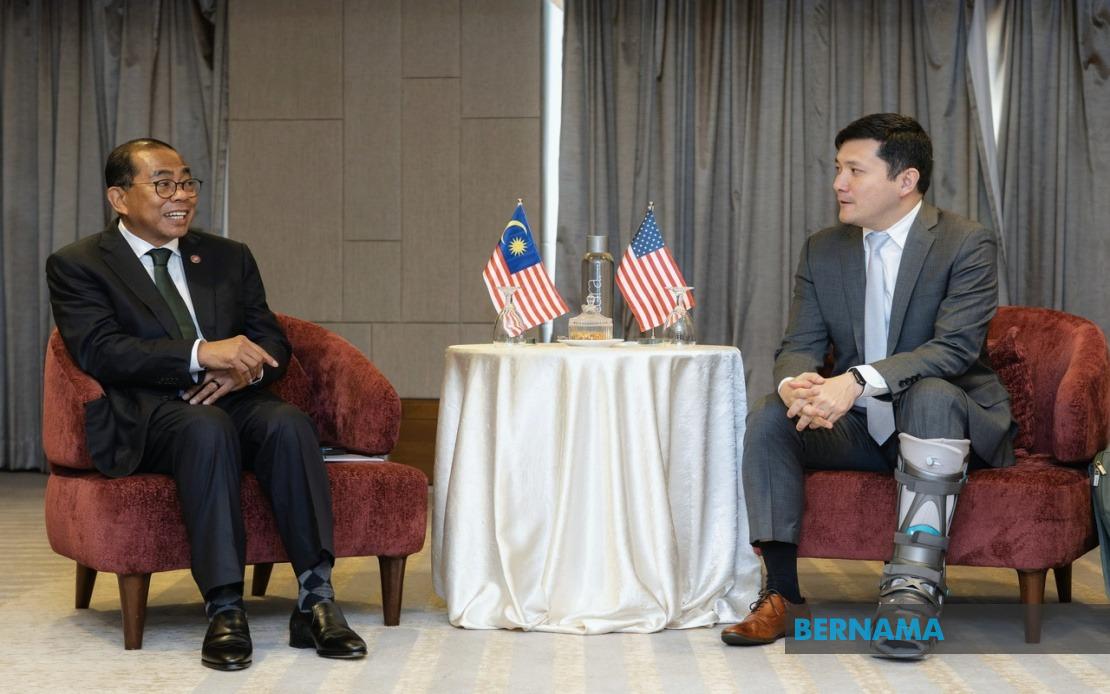
The United States has underscored its determination to deepen defence cooperation with Malaysia, with US Ambassador to ASEAN Kevin Kim conveying Washington's strategic priorities during a formal courtesy call to Malaysian Defence Minister Datuk Seri Mohamed Khaled Nordin in Kuala Lumpur. The exchange took place on the sidelines of the 37th Annual Military Law and Operations Conference, a significant regional gathering that has brought together defence officials and military representatives from over 30 nations to examine shared security concerns across Southeast Asia.
During the meeting, Ambassador Kim emphasised that the United States views Malaysia as a crucial partner in the region and intends to maintain momentum in strengthening bilateral defence relations. Mohamed Khaled characterised the discussion as primarily focused on consolidating existing cooperation frameworks rather than addressing substantive policy disagreements, suggesting a relationship marked by alignment on fundamental strategic interests. The tone of the engagement reflected mutual recognition of the importance of sustaining defence ties in a period of considerable geopolitical flux across the Indo-Pacific.
The timing of this reaffirmation carries particular significance given broader shifts in regional security architecture. As the United States continues to implement its Indo-Pacific strategy and maintain presence in Southeast Asia, countries like Malaysia occupy an increasingly important position as partners capable of facilitating dialogue, hosting military operations, and contributing to multilateral security arrangements. The defence sector represents one avenue through which Malaysia and the United States can deepen practical collaboration while managing the complexities of balancing relationships with other major powers.
Beyond the bilateral dimension, Mohamed Khaled's meetings also highlighted the interconnected nature of defence cooperation in Southeast Asia. During a separate courtesy call, ASEAN Secretary-General Dr Kao Kim Hourn engaged the Defence Minister in substantive discussions about the challenges confronting the association and the pivotal role defence institutions must play in upholding ASEAN Centrality—a foundational principle affirming the regional bloc's central role in addressing shared challenges. Both officials acknowledged that the defence sector holds significant potential for supporting ASEAN's broader agenda of maintaining peace, stability, and prosperity across the region.
The conversations between Mohamed Khaled and Kao underscored an emerging recognition within ASEAN that defence cooperation, when properly structured and transparent, can strengthen the cohesion of member states rather than fragment it. By channelling defence engagement through ASEAN frameworks, the association attempts to balance the interests of smaller nations with those of larger powers whilst preserving the association's ability to maintain strategic autonomy. This balance has become increasingly delicate as geopolitical competition intensifies in the region.
Singapore's newly appointed Permanent Secretary for the Ministry of Defence, Joseph Leong, also met with Mohamed Khaled to signal Singapore's commitment to sustaining and expanding defence cooperation with Malaysia. Leong's recent appointment underscores Singapore's focus on defence matters, particularly as the city-state navigates evolving security challenges and maintains its carefully calibrated relationships across the region. The discussions encompassed not only bilateral Malaysian-Singaporean defence ties but also participation in the Five Power Defence Arrangements, a long-standing multilateral framework involving Malaysia, Singapore, the United Kingdom, Australia, and New Zealand.
The Five Power Defence Arrangements represent a distinctive model of regional security cooperation that has endured for decades. This framework allows participating nations to address common security concerns whilst respecting each other's sovereignty and avoiding the perception of exclusionary alliance-building that might provoke tensions with other regional actors. For Malaysia, participation in FPDA reflects a pragmatic approach to security that neither alienates neighbouring countries nor compromises strategic autonomy by overcommitting to any single power.
The 37th MILOPS conference itself demonstrates the depth of professional engagement that occurs between defence establishments across the Asia-Pacific. These forums bring together legal experts, military strategists, and policy officials to examine the intersection of law and military operations—topics of increasing importance as regional powers develop more sophisticated naval capabilities, enhance cyber operations, and engage in maritime activities in contested waters. For Malaysian defence professionals, participation in such conferences provides valuable opportunities to engage with counterparts from major powers and regional neighbours alike.
For Malaysia specifically, maintaining robust defence partnerships with multiple actors serves important strategic functions. The country faces diverse security challenges ranging from maritime domain awareness and counterterrorism to managing relationships with major powers competing for influence. By sustaining strong defence ties with the United States whilst simultaneously deepening regional cooperation through ASEAN and FPDA, Malaysia preserves flexibility in navigating the region's complex geopolitical landscape.
The emphasis placed by all parties on strengthening rather than transforming defence cooperation reflects a shared interest in stability. Neither Malaysia nor the United States appears to be pursuing dramatic escalation or fundamental restructuring of their defence relationship. Rather, both nations seem focused on ensuring that existing mechanisms function effectively and that new challenges—whether environmental, technological, or security-related—are addressed through enhanced coordination and information-sharing.
Looking ahead, the outcomes of these high-level interactions will likely influence Malaysia's defence spending priorities, its participation in regional exercises, and its engagement with security dialogues throughout Southeast Asia. The country's ability to deepen defence cooperation with multiple partners whilst maintaining credibility within ASEAN will remain a critical balancing act, particularly as strategic competition in the region continues to intensify and great powers vie for influence over regional outcomes.

