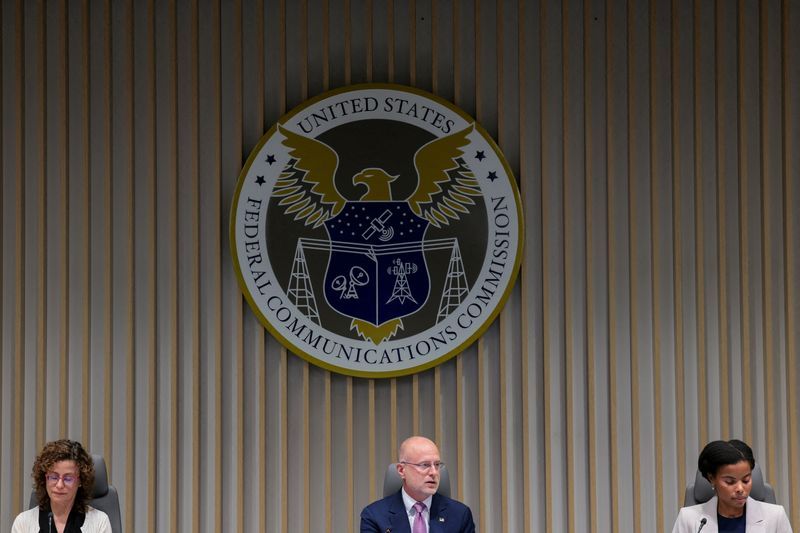
The United States Federal Communications Commission has moved to significantly tighten restrictions on Chinese technology entering American markets, voting this week to prevent the sale of any device containing components manufactured by firms on its national security blacklist. The regulatory action, announced on July 22, represents a substantial escalation in Washington's ongoing effort to exclude Chinese telecommunications and hardware suppliers from the US technology ecosystem, a campaign that has intensified under the current administration.
The FCC maintains a curated list of companies deemed to pose risks to American national security, prominently featuring telecommunications giant Huawei and its rival ZTE. Equipment manufactured by these entities has long faced an outright sales prohibition in the United States. However, a significant regulatory gap had persisted since 2022: while complete devices bearing Huawei's name could not receive new authorizations to enter the market, manufacturers could circumvent this restriction by incorporating Huawei-produced component parts into devices under different brand names, which would then obtain approval for sale in America.
FCC Chair Brendan Carr characterized the Wednesday vote as a definitive closure of what the agency describes as the component part loophole. The revised regulations now extend the ban beyond finished products to encompass any device incorporating Huawei-manufactured logic-bearing hardware components—essentially targeting the semiconductors and processing units that serve as the computational backbone of modern electronics. This shift from a product-level to a component-level restriction reflects growing American concern about how Chinese manufacturers might engineer vulnerabilities into the fundamental building blocks of technological systems.
The underlying security rationale for this escalation centres on the potential for compromise embedded at the hardware level. Chris McGuire, a former White House National Security Council official serving under the Biden administration, articulated the concern to Reuters by noting that compromised components, particularly semiconductors destined for communications applications, could theoretically allow foreign actors to corrupt the functionality of entire devices. This threat model presumes that Chinese state actors or companies with ties to Beijing could programme malicious instructions directly into chip designs, creating surveillance or sabotage capabilities that would prove extraordinarily difficult for American end-users or network operators to detect or remediate.
The FCC action represents merely one component of a broader campaign by the Trump administration to systematically exclude Chinese technology vendors from American infrastructure and consumer markets. This sweeping initiative extends well beyond telecommunications equipment to encompass numerous categories of connected devices. In recent weeks, the commission has banned imports of additional equipment from a group of Chinese manufacturers effective July 16, and on the preceding day proposed restrictions on most military-grade unmanned aerial vehicles originating from Chinese producers.
The regulatory pressure has broadened to target consumer and infrastructure categories that might initially appear tangential to national security. The FCC has prohibited new foreign drone models and router equipment from entering American commerce in recent months, reflecting anxiety about the proliferation of networked devices that could potentially serve as vectors for surveillance or network intrusion. Additionally, the agency has proposed rules that would prevent American telecommunications carriers from establishing interconnection agreements with Chinese telecom firms classified as national security risks, essentially walling off China-based operators from the American telecommunications network.
Perhaps most significantly, the FCC is contemplating even more aggressive measures targeting the operational footprint of Chinese telecommunications companies within the United States. The agency is considering restrictions that would prohibit Chinese telecom firms from maintaining data centres or so-called Points of Presence within American territory. These facilities, located at critical internet exchange points where data traffic from multiple networks converges, provide operators with strategic visibility into and control over transnational data flows. Mandating that Chinese telecom companies cease operating such infrastructure would effectively expel them from participation in America's core telecommunications architecture.
For Southeast Asian readers and policymakers, these American regulatory manoeuvres carry significant implications. Malaysia and its regional neighbours have increasingly sought to develop technology ecosystems that balance relationships with both Western and Chinese technology suppliers, viewing strategic diversification as essential to economic resilience and technological sovereignty. The American ban architecture, however, creates pressure on regional governments and companies to align with US restrictions or face complications in their own dealings with American firms and markets. For Malaysian telecommunications operators and technology companies with supply chains spanning both Chinese and American sources, navigating these diverging regulatory frameworks presents genuine operational complexity.
Moreover, the component-level restrictions announce a particularly consequential shift in how technological decoupling between the United States and China is being implemented. Rather than merely blocking finished products, the ban now targets the raw materials of global electronics manufacturing. This approach could disrupt supply chains throughout Asia and beyond, as manufacturers worldwide scramble to source alternative components or redesign products to achieve compliance. Malaysian electronics manufacturers and technology firms with exposure to US markets will need to carefully audit their supplier relationships and component sourcing strategies to ensure continued market access.
The regulatory framework also reflects deepening American scepticism about the technical transparency and trustworthiness of Chinese technology suppliers, positioning hardware vulnerability as a quasi-permanent concern rather than a resolvable problem. Huawei has not immediately responded to the latest FCC action, though the company has previously contested American security allegations, arguing that American restrictions are protectionist measures masquerading as security policy. Regardless of the company's response, the regulatory momentum appears decidedly toward comprehensive exclusion rather than negotiated compromise.
These developments underscore a fundamental recalibration of American technology policy, where national security concerns have substantially expanded the scope of goods and services subject to restriction. The implications extend beyond trade and commerce to encompass fundamental questions about technological interdependence in an increasingly fractious geopolitical environment. For Malaysia and Southeast Asia, these restrictions signal the necessity of developing clearer strategies for technology sourcing, supply chain resilience, and participation in bifurcating global technology ecosystems.

