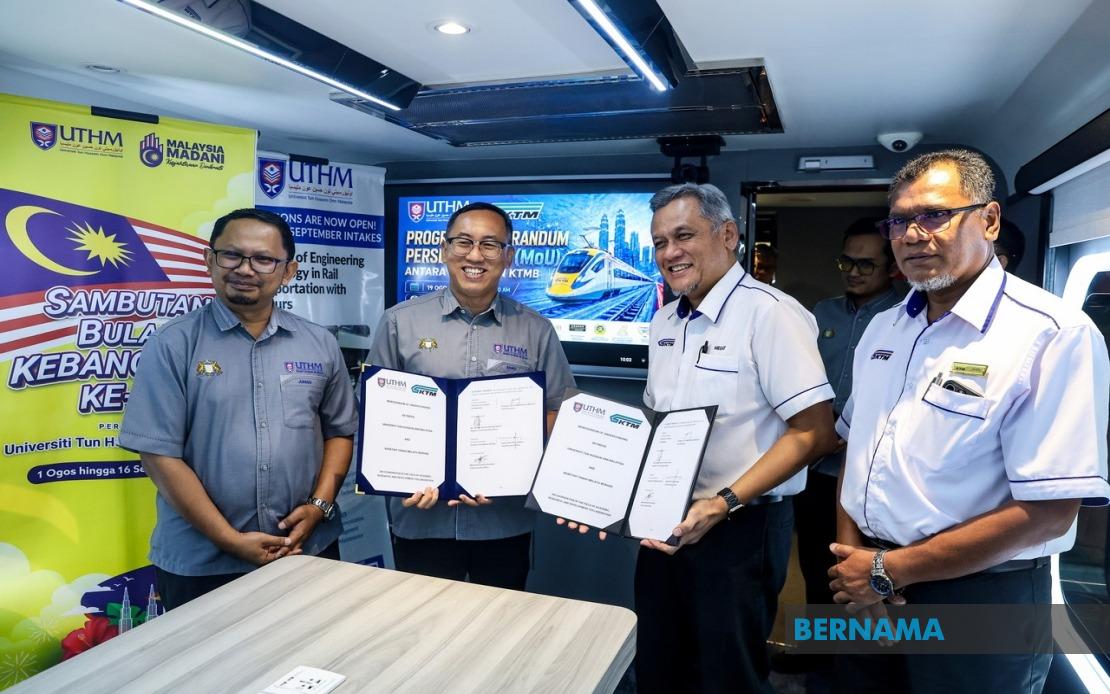
Malaysia's rail sector is receiving a significant boost through an expanded academic-industry partnership announced this month. Universiti Tun Hussein Onn Malaysia (UTHM) and Keretapi Tanah Melayu Bhd (KTMB) have formalised a new three-year collaboration running from October 2026 to July 2029, building on foundations laid nearly a decade ago. The agreement, formalized aboard a KTMB chartered train travelling from Kluang Station to KL Sentral, aims to tackle longstanding gaps between classroom instruction and operational reality in rail transportation engineering.
The partnership represents a deliberate attempt to strengthen Malaysia's domestic expertise in railway technology and operations at a time when the country continues expanding its transport infrastructure. Under the framework, students from UTHM will gain structured exposure to KTMB's daily operations, technical systems and industry-specific challenges through work-based learning programmes. This hands-on approach addresses a critical weakness in traditional engineering education, where theoretical knowledge often diverges significantly from real-world application. UTHM vice-chancellor Prof Dr Mas Fawzi Mohd Ali emphasised that such direct exposure enables students to bridge this gap effectively, allowing them to understand not only how rail systems function but why operational decisions matter in practice.
The foundation for this expanded cooperation was established in 2019, and the partnership has already demonstrated measurable success. Nearly 200 graduates from UTHM's Bachelor of Rail Transportation Engineering Technology with Honours programme have entered the workforce, with some securing positions not only domestically but also in Singapore and Saudi Arabia. This international placement record suggests the programme produces graduates meeting standards recognised beyond Malaysia's borders, a significant achievement for a specialised engineering discipline. These early graduates have reportedly benefited substantially from their exposure to KTMB's actual operations, developing both technical competency and professional maturity before entering employment.
UTHM's strategic vision shapes the partnership's design. The university has articulated an ambition to become a Global Technopreneur University by 2030, a framework emphasising the integration of knowledge, technology, innovation and entrepreneurship in preparing talent for industry and society. The rail sector partnership directly supports this objective by grounding innovation within a real operating environment. Rather than pursuing abstract research disconnected from practical needs, UTHM and KTMB will jointly identify technical challenges within Malaysia's rail network and develop solutions leveraging the university's research facilities and analytical capacity alongside KTMB's operational experience and industry data. This fusion of academic rigour and operational insight positions both institutions to make meaningful contributions to rail technology advancement in Southeast Asia.
The collaboration extends well beyond student placements. Joint research and development initiatives will become a central pillar, with both organisations committing resources to explore solutions addressing technical challenges across rolling stock maintenance, rail infrastructure integrity and operational efficiency. KTMB gains access to UTHM's research capabilities and facilities, while UTHM obtains practical grounding and validation for its theoretical work. This reciprocal arrangement acknowledges that neither institution possesses complete answers—universities offer analytical depth and methodological rigour, while operating companies provide real-world constraints and performance data essential to practical innovation.
The partnership also encompasses structured academic consultation across multiple educational levels. KTMB's own training institution, KTM Academy (MyRA), will receive guidance on curriculum development for diploma, bachelor's and postgraduate programmes in rail transportation engineering technology. This cascading effect ensures that rail sector training extends beyond UTHM into KTMB's internal development programmes, amplifying the partnership's reach. Additionally, KTMB has already committed five staff members to pursue master's degrees in rail-related fields at UTHM, demonstrating institutional commitment to developing internal expertise at advanced levels. This investment suggests KTMB recognises that improving operational capability requires not just procedural changes but deeper technical knowledge among its workforce.
The timing of this announcement carries significance for Malaysia's broader transportation strategy. The country has committed substantial capital to rail development, including urban transit expansions and potential high-speed rail corridors. Such projects require engineers and technicians capable of managing complex systems to international standards. The UTHM-KTMB partnership directly addresses this demand by ensuring a pipeline of graduates with both theoretical grounding and practical experience. Singapore and Saudi Arabia's absorption of UTHM rail engineering graduates indicates that Malaysian training meets international benchmarks, though developing domestic capacity remains crucial given the scale of national projects planned.
Megat Khairulazhar Khairodin, KTMB's chief corporate officer, articulated the operator's perspective: the partnership enables KTMB to access specialised expertise and research infrastructure to address operational challenges. This framing reveals KTMB's recognition that solutions to technical problems increasingly require systematic research rather than ad hoc troubleshooting. Access to university facilities and academic expertise represents tangible value that justifies institutional engagement. The arrangement also positions KTMB as an attractive partner for talent, as the company now offers students direct exposure and research opportunities unavailable elsewhere, strengthening recruitment capability.
Industry-academia partnerships of this type have become increasingly common across Southeast Asia as regional economies transition toward higher-value manufacturing and technical services. Malaysia's model with UTHM and KTMB offers lessons for other sectors facing skills gaps. The partnership succeeds because it addresses clear mutual interests: the university gains research opportunities and employment pathways for graduates, while the operating company obtains skilled talent and access to innovation capabilities. Rather than viewing each other as separate systems, both institutions have recognised their complementarity and structured formal arrangements capturing that interdependence.
Looking forward, the success of this expanded collaboration will depend on execution across multiple initiatives. Work-based learning programmes must be structured rigorously, ensuring students contribute meaningfully to KTMB operations while developing competencies aligned with both current and anticipated industry needs. Joint research projects require clear governance and intellectual property arrangements protecting both parties' interests while enabling practical application. Academic consultation must influence curriculum substantively rather than remaining ceremonial. These operational challenges are less glamorous than the partnership announcement itself, yet determining whether the collaboration achieves its stated objectives.
The partnership also reflects Malaysia's determination to develop indigenous technical capabilities rather than remaining dependent on external expertise for infrastructure operation and maintenance. Building domestic expertise in rail technology strengthens national resilience and reduces long-term operational costs. UTHM and KTMB's commitment extends beyond immediate training needs, positioning Malaysia to develop innovations addressing challenges within tropical climates and developing-economy contexts—conditions that generic international solutions may not address adequately. This localized innovation capacity, developed through sustained academic-industry cooperation, represents perhaps the partnership's most significant long-term contribution to Malaysia's transportation sector.

