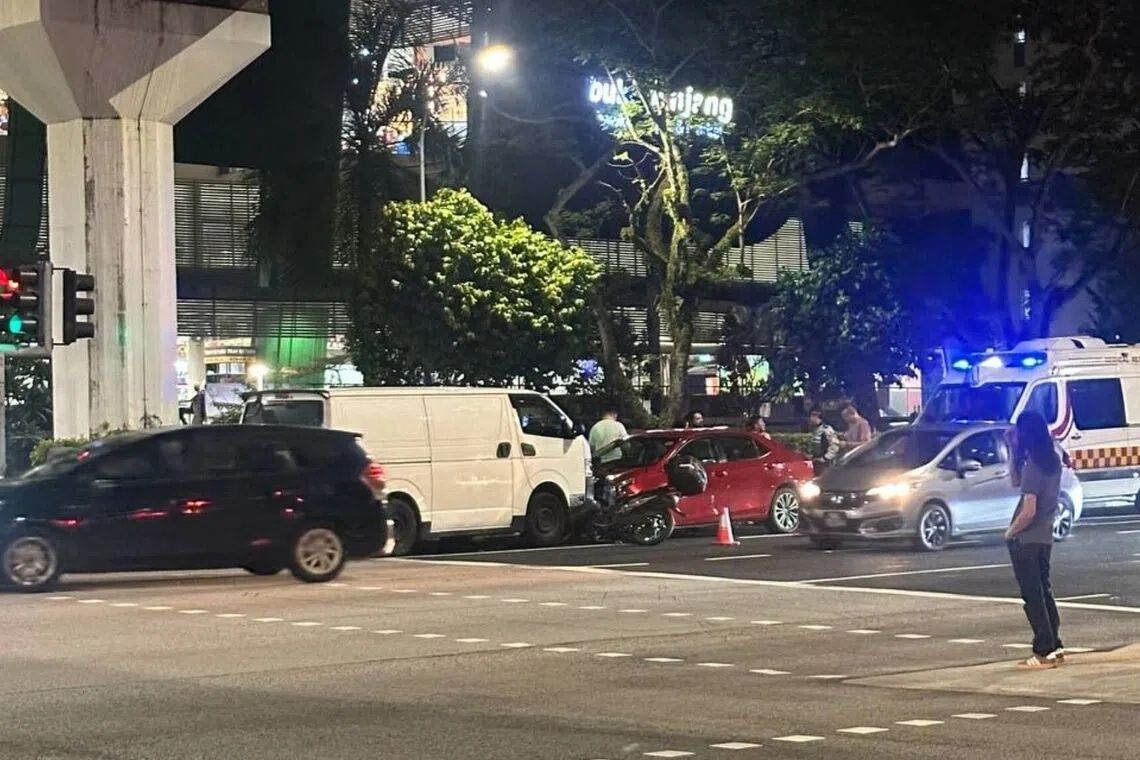
A 27-year-old man has been taken into custody by Singapore police following a serious multi-vehicle collision on Bukit Panjang Road on Friday night, with investigators suspecting drug impairment was a factor in the crash. The incident, which unfolded near the junction with Bukit Panjang Ring Road at approximately 9pm, involved five vehicles and left two occupants with minor injuries, though both declined medical transport to hospital.
Emergency responders from the Singapore Civil Defence Force and police officers attended the scene after receiving reports of the accident. Initial investigations by the Traffic Police revealed that a van operated by the arrested driver had collided with multiple other vehicles in the vicinity. Among the vehicles involved were a motorcycle and two separate cars, with at least one witness account suggesting the van was travelling against the normal flow of traffic at the moment of impact.
During their examination of the van, officers discovered two vaporising devices along with three associated cartridge pods. These items have been seized as evidence, and the discovery has triggered a separate investigative pathway through Singapore's Health Sciences Authority, the government body responsible for regulating substances and drug paraphernalia in the city-state. The police indicated that the offences related to the vaporiser equipment have been formally referred to that authority for further assessment and potential prosecution under relevant health and drug regulations.
This incident underscores the persistent challenges facing traffic authorities across Southeast Asia in combating drug-impaired driving. Unlike breathalyser tests for alcohol, detecting drug impairment at the roadside presents considerably greater technical difficulties, making post-incident investigations critical to establishing whether substance use contributed to dangerous driving behaviour. The circumstances surrounding this Bukit Panjang collision suggest a pattern of reckless operation that may have been compounded by chemical intoxication.
Eyewitness footage circulating on social media platform Instagram, posted through the account sgfollowsall, provides graphic visual evidence of the collision's severity. The video shows the van positioned directly opposite a red sedan in what appears to be a head-on or near head-on configuration, with a motorcycle pinned between the two larger vehicles. A black sedan is visible several metres behind the red vehicle, suggesting the impact sequence may have involved the van crossing traffic lanes before striking oncoming traffic.
The minor injuries reported by those involved represent a fortunate outcome given the apparent violence of the collision. However, the involvement of a motorcycle—a vehicle category that affords minimal protection to riders compared to enclosed automobiles—raises questions about how severe the incident could have been. That both injured parties declined hospital treatment suggests either genuine minor injury or possible shock and disorientation that delayed medical assessment.
For Malaysian readers and regional observers, this incident carries relevance beyond Singapore's borders. Drug-impaired driving represents a growing concern across the Association of Southeast Asian Nations (ASEAN), with public health authorities in Malaysia, Thailand, Indonesia, and the Philippines increasingly documenting cases of road accidents linked to controlled substance use, particularly among younger drivers. The sophistication of detecting and prosecuting such offences remains uneven across the region, with some jurisdictions relying primarily on behavioural observation and post-incident toxicology rather than roadside screening technologies.
The role of vaporising devices in this case introduces an additional layer to the investigation. While some vaporisers are used for nicotine delivery and remain in legal grey areas in various jurisdictions, others are employed to consume controlled substances that produce psychoactive effects. The distinction is crucial for law enforcement and regulatory agencies attempting to prevent impaired driving. The fact that Singapore authorities immediately referred these items to the Health Sciences Authority indicates acknowledgment that determining the substance involved and whether it constitutes a regulated substance requires specialist analysis.
Singapore's approach to such matters demonstrates the city-state's characteristic emphasis on rigorous investigation and multi-agency coordination. The involvement of both the Traffic Police and the Health Sciences Authority in the aftermath of this accident reflects a systematic approach to disentangling the various potential offences—drug driving itself, possession of drug paraphernalia, and regulatory violations related to controlled substances. This methodical pathway, while sometimes slower than immediate charging, produces more robust legal outcomes that can withstand scrutiny in court.
Ongoing investigations will likely determine whether the driver's impairment played a direct causal role in the accident or whether other factors contributed. Preliminary findings about road conditions, vehicle mechanical condition, and the precise sequence of events remain under examination. Police statements indicate that the investigative file remains open, suggesting that additional charges or clarifications may emerge as toxicology results return and witness statements are fully documented.
The arrested driver's fate will depend partly on the findings of forensic analysis and partly on Singapore's existing sentencing guidelines for drug-impaired driving offences. Penalties in the city-state for such violations have progressively tightened over the past decade, reflecting regional and international trends toward stricter standards for driving under the influence of any substance affecting cognitive and motor function. The case will likely conclude with a combination of driving prohibition, financial penalties, and potentially custodial sentence, depending on the specifics of the substances detected and any prior driving history.

