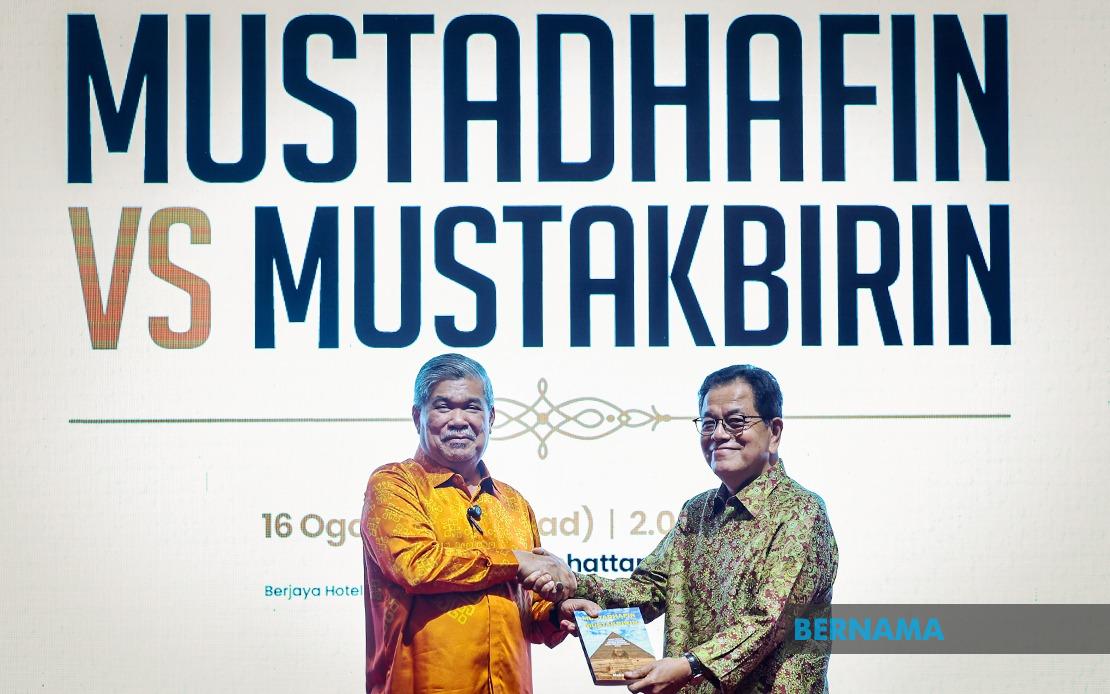
Datuk Seri Mohamad Sabu, president of Amanah, has issued a pointed reminder to Malaysians to exercise critical thinking when encountering political accusations, cautioning that unchecked allegations breed a dangerous form of group loyalty that blinds supporters to their own side's failings. Speaking at the launch of his memoir in Kuala Lumpur on August 16, the Agriculture and Food Security Minister articulated concern about 'asabiyyah'—a concept rooted in Islamic tradition describing tribal allegiance that causes people to defend their faction reflexively regardless of merit while dismissing the virtues of rivals.
The minister's intervention comes amid a persistent pattern of unsubstantiated claims circulating through Malaysian political discourse. He specifically addressed recurring accusations that the Democratic Action Party functions as a communist organisation and that any coalition partner working with DAP implicitly endorses communist ideology. Rather than dismissing these charges outright, Mohamad Sabu posed a fundamental question to the public: whether such characterisations withstand factual scrutiny. His approach mirrors a broader educational thrust within his political messaging, emphasising that citizens must distinguish between assertion and evidence.
Modern information ecosystems amplify the problem Mohamad Sabu highlighted. Allegations and suspicions travel at remarkable velocity through social media platforms, often requiring minimal verification before reaching mass audiences. In contrast, comprehensive facts and nuanced understanding demand time, concentration, and intellectual effort—commodities increasingly scarce in the attention economy dominating public discourse. This asymmetry means that false or misleading narratives frequently establish themselves as conventional wisdom before fact-checkers or sceptical voices can mount effective counterarguments.
The Amanah president drew from personal experience in formulating this position. He described his longstanding practice of investigating matters independently rather than accepting information passively, even from sources he might otherwise trust. From his youth, Mohamad Sabu cultivated a methodology of direct inquiry and observation rather than relying on propaganda circulated through whatever communication channels existed at any given historical moment. This personal philosophy appears foundational to his political worldview and informs how he frames the contemporary information crisis affecting Malaysian public life.
Mohamad Sabu's book, launched by National Journalism Laureate Tan Sri Johan Jaaffar—who also serves as director of Star Media Group Berhad—documents his own journey navigating complex political and geopolitical terrain. The memoir records encounters with various stakeholders as he endeavoured to understand issues grounded in observable reality rather than secondhand reporting or ideological positioning. By publishing these reflections, Mohamad Sabu appears to model the investigative approach he recommends to the broader Malaysian public.
The work extends beyond domestic political commentary. Mohamad Sabu incorporated reflections on global geopolitical dynamics informed by his observations and analytical perspective. The memoir addresses themes including colonialism's historical and ongoing impacts, the trajectory of Islamic movements across different societies, the Palestinian-Israeli conflict's complexity, and the shifting distribution of power among major global actors. These international dimensions suggest that Mohamad Sabu situates Malaysian political developments within wider historical and geopolitical contexts that Malaysian readers must understand.
His emphasis on independent verification carries particular weight given Malaysia's specific political circumstances. The country has experienced recurrent cycles of communal polarisation, partly facilitated by the strategic deployment of inflammatory rhetoric. Accusations of communist sympathies have historically triggered strong emotional responses in Malaysian society, making such allegations especially potent vehicles for political manipulation. When political actors invoke these charges without substantial foundation, they activate deeply rooted historical anxieties and interethnic sensitivities.
The DAP specifically occupies a contested position in Malaysian political narrative. As a multiethnic party with significant support among urban Chinese and Indian voters, it attracts both fierce support and equally intense criticism depending on perspective. Communist accusations against DAP have circulated for decades despite the party's consistent denial and its documented participation in constitutional democratic processes. The persistence of these claims despite available evidence suggests either wilful ignorance among proponents or strategic deployment of charges known to resonate emotionally regardless of factual foundation.
Modern technology has transformed how these dynamics operate in practice. During previous eras when information dissemination relied on controlled media channels, false accusations faced higher barriers to establishment as widely believed truth. Contemporary digital platforms have demolished those barriers, enabling rapid propagation of unverified claims and creating echo chambers where particular narratives become reinforced through repetition rather than evidence. Malaysian political actors of all ideological orientations have learned to exploit these dynamics, though responsibility for combating the problem falls partly on citizens who must consciously resist the pull of emotionally satisfying narratives unsupported by facts.
Modamad Sabu's intervention suggests growing recognition within some Malaysian political circles that the information environment itself threatens democratic deliberation. When citizens cannot reliably distinguish credible claims from fabrications, informed electoral choices become impossible and political discourse devolves into tribal conflict divorced from substantive policy disagreement. The minister's advocacy for critical examination of allegations before acceptance represents a modest but necessary step toward restoring evidentiary standards to Malaysian public discourse. Whether such calls gain traction depends partly on media institutions, educational systems, and political leaders collectively emphasising factual rigor and epistemic responsibility.

