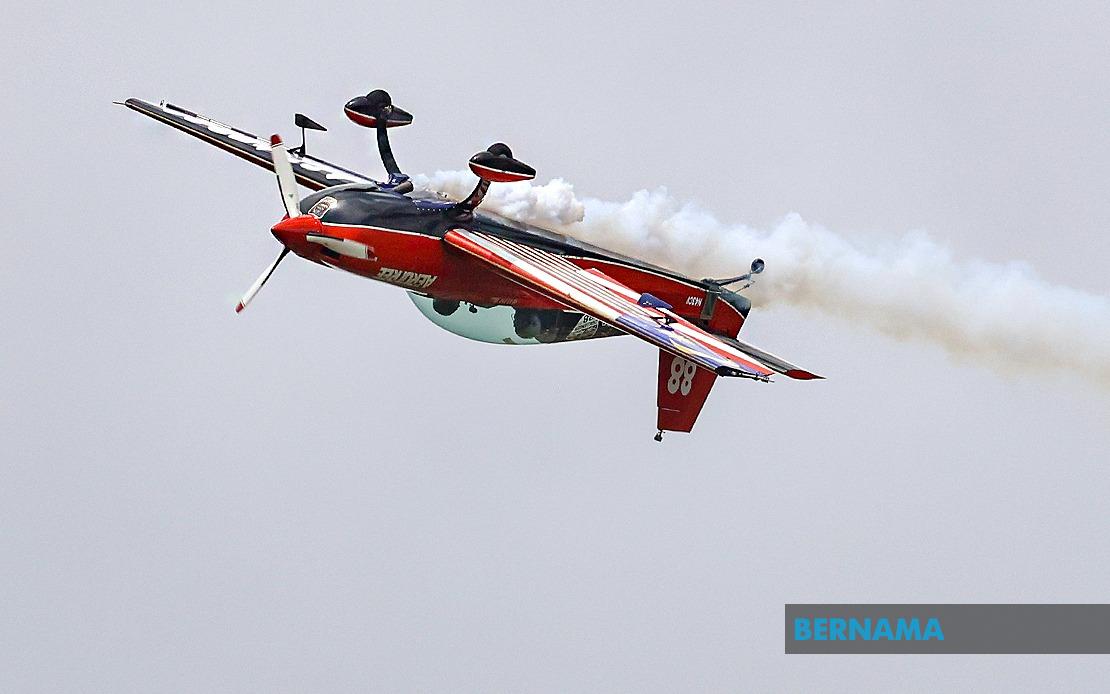
Major (Rtd) Datuk Halim Othman, a 60-year-old retired Royal Malaysian Air Force fighter pilot, captained the inaugural 'Merdeka Sunset Show: Melukis Senja' air display in Putrajaya on August 30, demonstrating the calibre of homegrown talent available within Malaysia's aerospace sector. His involvement marked a significant milestone for the nation's aviation community, bringing together four decades of accumulated expertise in military aviation, aerobatic flying, and international air racing competition. The twilight performance, scheduled for 7 pm, combined precise aerobatic manoeuvres with smoke and pyrotechnics set against the National Month backdrop, offering audiences a distinctly Malaysian contribution to the 69th National Day celebrations.
Halim's distinguished career trajectory reflects the evolution of Malaysia's military aviation capabilities and the nation's growing presence on the international air racing circuit. He began his professional journey in 1985 as an RMAF fighter pilot and subsequently earned the prestigious 'Top Gun' designation, a recognition bestowed upon pilots demonstrating exceptional skill and mastery of their aircraft. His progression into aerobatic flying and international competition exposed him to the highest standards of aerial performance and introduced him to a competitive environment traditionally dominated by non-Asian pilots. This exposure proved transformative, as it eventually positioned him as the first Malaysian to qualify for the Red Bull Air Race World Championship, an achievement that carries profound significance for aspiring aviators across Southeast Asia.
The technical demands of aerobatic flying transcend mere physical capability or daring manoeuvres. As Halim articulated during his interview, success in this discipline requires an intricate combination of disciplined training regimens, rigorous self-assessment, and comprehensive understanding of aircraft performance envelopes and operational limitations. Competing at the Red Bull Air Race World Championship level demands precision calibrated to milliseconds, spatial awareness functioning across multiple dimensions simultaneously, and decision-making capacity under conditions of extreme physiological stress. These attributes cannot be improvised or compensated through raw talent alone; they represent the cumulative product of thousands of flight hours, systematic skill development, and unwavering commitment to continuous improvement.
Halim's track record in international competition underscores his credentials and the competitiveness of Malaysian pilots on global platforms. In 2014, he secured victories in the Challenger Cup competitions held in Ascot, United Kingdom, and Las Vegas, United States, whilst achieving a second-place finish in the Challenger Cup Final at the Red Bull Ring in Austria. These results demonstrate that Malaysian aviation professionals can compete effectively against international counterparts and achieve podium finishes in prestigious events. The significance of these accomplishments extends beyond individual accolades; they establish precedent and visibility for subsequent generations of Malaysian aviators contemplating careers in high-performance flying and competitive air racing.
Throughout his career, Halim has accumulated experience across an impressive spectrum of aircraft types, ranging from advanced military platforms to sophisticated civilian transports. His military experience included the MiG-29N, F/A-18D Hornet, A-4 Skyhawk, and F/A-5E Tiger, aircraft representing varying generations of fighter technology and operational doctrine. In the civilian domain, he qualified on the Learjet 35A and King Air 350i, establishing his adaptability across different aircraft categories and operational environments. This breadth of experience enhances his credibility as an aerobatic performer and provides insight into aircraft handling characteristics that inform his approach to precision flying at the boundaries of aircraft capability.
Beyond his individual accomplishments, Halim has contributed substantially to the institutional development of Malaysia's aerobatic flying community. As founder and president of Aerotree Defence and Services Sdn Bhd, he established infrastructure supporting professional aerobatic operations. More significantly, he played a pivotal role in establishing Krisakti, Malaysia's first official aerobatic display team, which made its competitive debut at LIMA 2011. This achievement represents an important milestone in professionalizing aerobatic flying within Malaysia and creating a structured pathway for talented pilots to develop expertise in this specialized discipline. The establishment of such teams reflects broader efforts to consolidate Malaysia's aerospace sector capabilities and present sophisticated technical competency to international audiences.
Halim's vision for expanding aerobatic performance capacity demonstrates forward-thinking commitment to institutional growth within the sector. He revealed plans to develop a new aerobatic team comprising six aircraft equipped with advanced coloured smoke systems, intended for deployment at future National Day celebrations and upcoming LIMA exhibitions. This expansion indicates confidence in demand for professional aerobatic performances and recognition that such displays serve important functions beyond entertainment, including diplomatic representation and youth inspiration. The investment in coloured smoke technology reflects international standards adopted by leading aerobatic teams globally, signalling Malaysian commitment to matching established performance benchmarks.
The philosophy underpinning Halim's approach to aerobatic performance extends beyond technical virtuosity to encompass broader social responsibilities. He explicitly framed the Merdeka Sunset Show performance as part of Aerotree's corporate social responsibility initiatives aimed at inspiring local youth and cultivating interest in aerospace careers. This positioning acknowledges that high-visibility performances serve motivational functions for younger generations considering aviation careers and that professional aviators carry responsibility for developing successor talent pools. In a regional context where aerospace sector growth depends upon sustained recruitment and professional development, such mentorship approaches prove essential for sector sustainability and competitiveness.
The introduction of the Merdeka Sunset Show concept itself demonstrates innovation in how Malaysia presents its aviation capabilities during national celebrations. Rather than importing international aerobatic teams or relying upon established foreign performers, the emphasis on Malaysian expertise reflects growing confidence in domestic capability and deliberate choice to showcase homegrown talent. The sunset timing and integration of smoke and pyrotechnics create distinctive visual aesthetics that differentiate the performance from standard daytime aerobatic displays, potentially establishing a new template for aerial performances during subsequent National Day celebrations. This approach carries implications for how Malaysia positions its aerospace sector internationally and signals availability of sophisticated performance capabilities within the region.
From a broader Southeast Asian perspective, Halim's prominence in international air racing competition and his success at Red Bull Air Race World Championship level carry significance extending beyond Malaysia. The region's aviation sector remains concentrated in relatively few countries, with advanced aerobatic flying and international air racing remaining specializations with limited regional participation. Malaysian success in these domains establishes precedent for other Southeast Asian nations and demonstrates that regional aviators can compete effectively on global platforms. This visibility potentially catalyses interest in aerobatic flying across Southeast Asia and establishes Malaysia as a regional hub for advanced aviation expertise and performance.
The Merdeka Sunset Show performance also reflects evolving approaches to National Day celebrations, incorporating technological sophistication and professional expertise into commemorative programming. Rather than relying upon traditional parade formats or conventional entertainment, the emphasis on aviation displays leverages Malaysia's aerospace sector capabilities to create memorable experiences for citizens. This integration of sectoral expertise into national celebrations serves multiple objectives simultaneously: providing entertaining content for mass audiences, showcasing technological capability, and creating platforms for professional recognition of specialized expertise. Such approaches demonstrate how national celebrations can serve dual functions as cultural events and sector promotion mechanisms.
Halim's articulation of his motivations regarding younger generation aspiration reveals underlying conviction about professional responsibility in high-visibility roles. His statement that he performs "for the younger generation and the country, to show that Malaysians are capable of competing at this level" reflects consciousness that individual achievement carries meaning extending beyond personal accomplishment to encompass sectoral representation and national capability signalling. This perspective aligns with broader Malaysian efforts to develop human capital in technical sectors and establish domestic expertise pools reducing dependence upon foreign specialists. For aerospace sector development specifically, visible examples of Malaysian expertise at international competitive levels provide powerful recruitment and motivation incentives for talented individuals considering career trajectories within aviation.
Looking forward, the trajectory established by Halim and the institutional frameworks he has helped create through Aerotree and Krisakti suggest expanding opportunities for Malaysian involvement in international aerobatic competition and air racing. The planned expansion to a six-aircraft aerobatic team equipped with coloured smoke systems indicates scaling of performance capability and commitment to maintaining competitive standards. Whether these developments translate into sustained international competitiveness or serve primarily as enhancement to National Day celebrations remains to be determined. Nonetheless, the visibility and professional credibility associated with Halim's career and the institutional investments he champions establish foundational capacity upon which further aviation sector development can proceed, potentially positioning Malaysia as a destination for serious aerobatic flying and international air racing participation within Southeast Asia.

