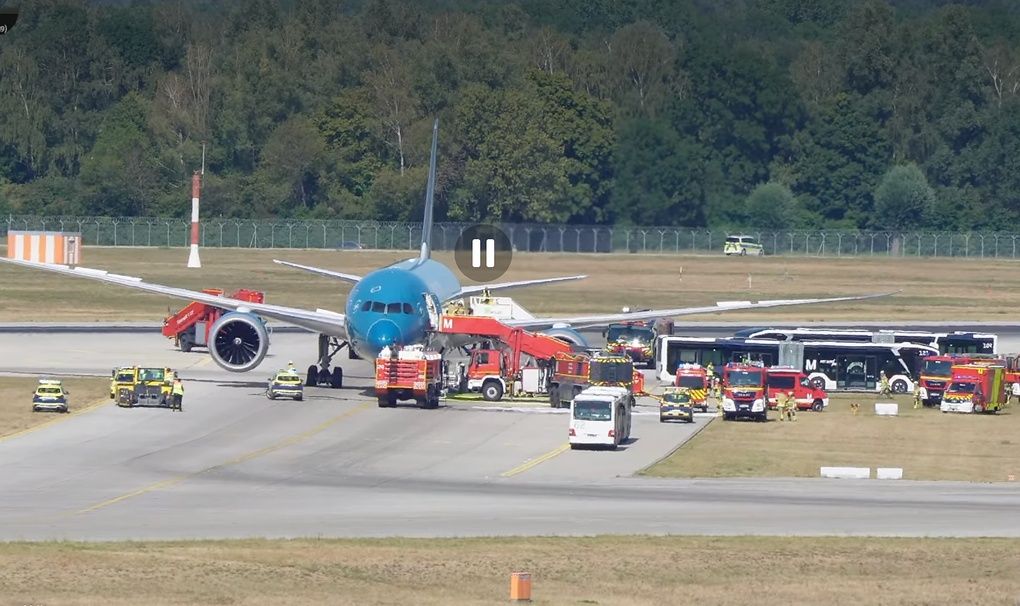
A Vietnam Airlines Boeing 787-9 aircraft operating a scheduled service from Munich to Hanoi experienced technical difficulties shortly after takeoff on August 15, prompting the crew to execute an emergency return to the Bavarian airport. The carrier confirmed that all passengers and crew members on board remained safe throughout the incident, with passengers subsequently transferred to the terminal building where they received support from ground staff.
According to details compiled by aviation monitoring organisations, the incident unfolded with concerning precision at the point of departure. Footage captured near Munich Airport documented the wide-body jet accelerating along the runway and lifting off extremely late in the takeoff run, with visible dust clouds rising as the aircraft became airborne just metres from the end of the runway surface. This sequence of events indicates that the aircraft experienced what aviation specialists term a "late rotation," a condition where the nose lifts off the ground later than typical during the takeoff phase.
Avia reports from specialist monitoring services, including the Aviation Herald, documented that the situation was more complex than a simple technical alert. The aircraft sustained what is known as a tailstrike—contact between the tail section and the runway surface—and subsequently experienced a runway overrun condition. These developments resulted in damage to the aircraft's tyres, a critical safety concern that necessitated the emergency return. The combination of these factors indicated to the flight crew that landing at the nearest suitable airport was the appropriate course of action.
Crew response to the emergency followed established protocol. Rather than attempting an immediate descent, the aircraft climbed to approximately 9,000 feet and entered a holding pattern, a standard procedure that serves multiple objectives simultaneously. This altitude and flight pattern allowed the flight crew time to assess the extent of the damage and coordinate with ground authorities. Simultaneously, the circling pattern enabled the aircraft to consume fuel from its tanks, reducing the total aircraft weight before landing—a precaution that is standard practice when landing with known or suspected structural damage.
Municipal authorities at Munich Airport responded by placing all emergency response services on standby, positioning firefighting and rescue equipment at the ready in case the landing encountered difficulties. This precautionary measure reflected the seriousness with which ground personnel treated the situation, though the subsequent landing proved to be safely executed. Approximately two hours after the initial takeoff, the aircraft made contact with the runway surface once more, an event that reportedly caused further tyre damage and generated visible smoke, though structural integrity was maintained.
Vietnam Airlines issued statements confirming that the airline's personnel were actively collaborating with German aviation authorities and relevant technical organisations to establish the precise cause of the initial technical problem. The investigation phase is standard following such incidents and forms part of international aviation safety protocols. The airline has committed to providing comprehensive updates once mechanical inspections are finalised and operational plans regarding the aircraft have been determined.
Meanwhile, the carrier prioritised passenger welfare by arranging comprehensive support services for all affected travellers. Alternative travel arrangements were being prepared to enable passengers to reach their intended destination of Hanoi, either on rebooked flights or through other suitable transport solutions. This response reflects contemporary airline industry practice following significant operational disruptions, where customer care is emphasised alongside safety priorities.
Vietnam Airlines maintains regular international services connecting Vietnam's two major urban centres with Europe's economic heartland. The carrier operates direct routes linking both Hanoi and Ho Chi Minh City to Munich and Frankfurt, employing primarily wide-body aircraft suited to long-haul operations. The fleet comprises modern Boeing 787 Dreamliners and Airbus A350 XWB aircraft, both contemporary designs that incorporate advanced safety systems and redundancy features.
This incident, whilst successfully resolved without injury, underscores the complex technical and operational demands of long-haul commercial aviation. The Vietnam Airlines flight situation exemplifies how modern aircraft safety systems and trained crew procedures function to manage emergency conditions effectively. For Southeast Asian carriers operating European routes, the event serves as a reminder of the critical importance of rigorous maintenance schedules and crew training protocols. The investigation findings, once released, may yield insights applicable across the regional aviation industry regarding aircraft maintenance standards and emergency response procedures.

