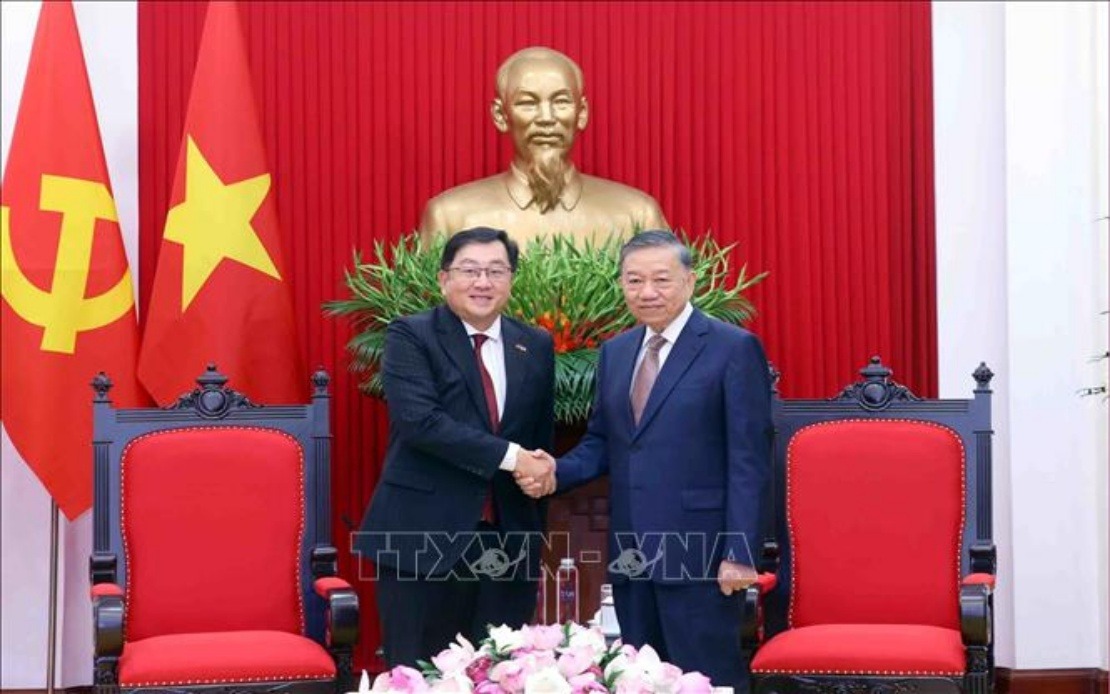
Vietnam's President To Lam has characterised the relationship between Hanoi and Kuala Lumpur as increasingly dynamic, built on foundations of robust political confidence and expanding economic engagement. The Vietnamese leader made these remarks during an official meeting with Datuk Tan Yang Thai, Malaysia's outgoing ambassador to Vietnam, underscoring the significance both nations place on their bilateral partnership within the broader Southeast Asian context.
The timing of this diplomatic exchange carries particular weight in the regional calendar. Tan's tenure in Hanoi concludes at a moment when Vietnam-Malaysia relations are experiencing tangible momentum across multiple sectors, reflecting years of deliberate effort to transform the relationship from routine diplomatic courtesy into substantive strategic alignment. For Malaysian policymakers and business leaders, the Vietnamese president's explicit affirmation that Malaysia occupies an important place in Vietnam's foreign policy framework signals sustained commitment to deepening engagement beyond ceremonial exchanges.
Economic dimensions of the partnership have accelerated markedly. Bilateral trade reached US$10.8 billion during the first six months of 2026, representing a remarkable 40 per cent surge compared to the corresponding period the previous year. This trajectory demonstrates that the relationship extends well beyond political positioning into genuine commercial and investment flows that benefit enterprises and consumers in both nations. The growth rate far exceeds typical regional averages, suggesting that Vietnamese and Malaysian businesses have identified complementary opportunities and established distribution networks that generate sustained transaction volumes.
Malaysia's investment profile in Vietnam reflects the country's substantial economic footprint across the broader Southeast Asian region. As the third-largest ASEAN investor in Vietnam and the 10th-largest among all 154 foreign investment sources, Malaysia has anchored its economic presence through both greenfield initiatives and acquisition of existing operations. This ranking positions Malaysian capital alongside major investors from developed economies, underscoring the confidence that Malaysian corporations have in Vietnam's economic trajectory and regulatory environment. The sustained flow of Malaysian investment suggests optimism about Vietnam's manufacturing capabilities, labour availability, and market access.
Political cooperation has evolved from sporadic high-level meetings into a regularised system of exchanges across multiple governmental tiers. President To Lam specifically highlighted regular visits by party, state, government, and parliamentary delegations, alongside the establishment of effective bilateral institutional mechanisms. For Malaysian observers, this institutional depth matters considerably because it creates predictable channels for managing disagreements and coordinating positions on regional issues, particularly within ASEAN forums where consensus-building remains essential for collective action.
Both nations have identified several strategic domains as priorities for future collaboration. Digital economy development represents a critical frontier where Vietnam's expanding technology sector and Malaysia's established financial technology ecosystem can generate mutual benefit. Green economic transition and renewable energy cooperation hold particular significance given Southeast Asia's vulnerability to climate impacts and the region's growing energy demands. Additionally, maritime cooperation warrants close attention, given Vietnam's significant coastline, Malaysia's maritime trade importance, and the complex geopolitical dynamics of the South China Sea where both nations operate with distinct interests requiring careful diplomatic management.
The personal dimension of diplomatic relationships should not be underestimated. Tan's explicit expression of affection for Vietnam and confidence in the bilateral partnership's future trajectory suggests that personal relationships between senior officials facilitate cooperation even when institutional pressures or regional tensions might otherwise strain ties. His commitment to drawing on professional experience to further Vietnam-Malaysia relations beyond his ambassadorial tenure indicates that diplomatic networks often outlast formal positions, creating informal channels that prove valuable during moments of tension or crisis.
Mutual invitations exchanged during the meeting underscore both sides' eagerness to elevate the relationship further. The Vietnamese president's conveyed regards to His Majesty Sultan Ibrahim and Prime Minister Datuk Seri Anwar Ibrahim, alongside his invitation for Malaysian leadership to visit Vietnam, signal openness to higher-level engagement. Reciprocally, the Malaysian ambassador transmitted an invitation from the Malaysian King for President To Lam to visit Malaysia. These courtesies, though protocol-bound, carry substance in the context of contemporary Southeast Asian diplomacy where presidential and monarchical visits require substantial preparation and signal genuine commitment to bilateral engagement.
The Comprehensive Strategic Partnership framework provides the architecture through which Vietnam and Malaysia intend to deepen cooperation. Rather than remaining declarative, this partnership designation has generated tangible outcomes in trade expansion, investment flows, and institutional exchanges. President To Lam's emphasis on implementing high-level agreements and strengthening defence and security cooperation suggests that the partnership now encompasses sensitive domains traditionally reserved for the closest allies, reflecting mutual confidence in strategic intentions.
For Malaysian policy makers and business communities, Vietnam's emergence as an increasingly dynamic economy offers substantial opportunities. Vietnam's manufacturing capabilities, positioning in global supply chains, and growing consumer market create complementary opportunities with Malaysia's service sector strengths, financial expertise, and established regional networks. Enhanced cooperation in science, technology, and innovation could position both nations more competitively within the broader global innovation landscape, where Southeast Asian contributions remain disproportionately modest relative to regional economic size.
Regional implications merit consideration as well. Strong Vietnam-Malaysia ties contribute to ASEAN cohesion by demonstrating that major Southeast Asian economies can pursue deepening bilateral partnerships while maintaining collective commitment to regional institutions and norms. This dynamic contrasts with historical patterns where great power competition or resource competition generated intra-ASEAN tensions. The emphasis both sides place on joint contributions to fostering a united and resilient ASEAN reflects sophisticated understanding that bilateral prosperity increasingly depends on regional stability and effective multilateral frameworks.
Looking forward, the momentum evident in current Vietnam-Malaysia relations appears sustainable provided both nations prioritise institutional development, address potential trade imbalances, and manage maritime and security issues through established dialogue channels. The 40 per cent year-on-year trade growth cannot continue indefinitely, but a trajectory toward US$20-25 billion in annual bilateral trade within five years remains plausible. Such expansion would position Vietnam-Malaysia economic ties among Southeast Asia's most significant bilateral relationships, with multiplier effects across labour mobility, technological transfer, and supply chain integration that would benefit broader regional development.

