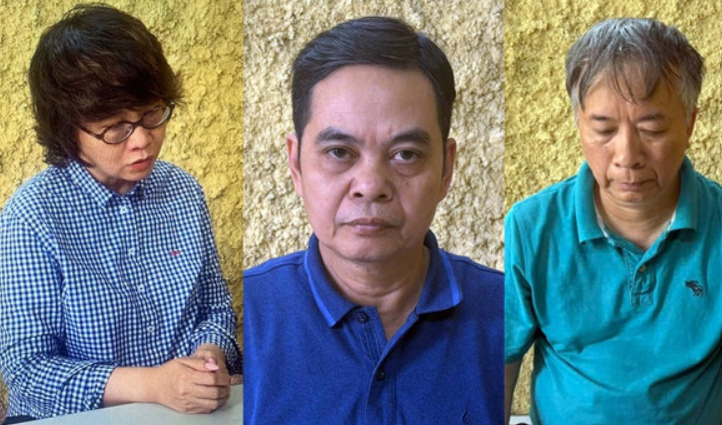
Vietnam's government has intensified its grip on media and publishing by moving against a publishing house and dozens of news organisations that distributed a controversial biography of Ho Chi Minh, the revered founder of the ruling Communist Party. Police announced on Wednesday, 15 July, that they had detained three senior executives from the Vietnam Writers' Association Publishing House, which released "Stories with Thanh -- A New Account of Light" in May. The action represents one of the clearest demonstrations in recent months of Hanoi's determination to police historical narratives and control public discourse around the nation's revolutionary heritage.
The arrests extend a broader enforcement campaign that has already ensnared the book's author, Nguyen Thanh Nam, a former telecommunications executive who was apprehended in early July on charges of producing material intended to undermine the Socialist Republic of Vietnam. The crackdown has also caught an online influencer who used social media to promote the work, signalling that authorities view digital dissemination as equally problematic as traditional publishing channels. These parallel actions suggest that Vietnamese security forces are applying systematic pressure across multiple platforms to suppress the book's circulation and influence.
According to police statements released on the day of the arrests, the three detained individuals held the positions of director, editor-in-chief, and head of the editorial board at the publishing house. All three face identical charges relating to the creation, possession, and distribution of materials designed to oppose the state. In its formal statement, Hanoi police alleged that these executives were directly involved in editing, revising, and promoting content that it claims distorts revolutionary history and contradicts party and government policy guidelines. The authorities characterised the book as damaging to Ho Chi Minh's historical image and capable of sowing public confusion about the nation's political foundations.
The biography itself focuses on Ho Chi Minh's years spent outside Vietnam, during which he sought inspiration and strategies to ignite independence movements at home. Rather than presenting a straightforward hagiography, the work apparently contains historical interpretations or details that diverge from the official state narrative. For Vietnamese leadership, such deviation from sanctioned accounts of the revolutionary struggle represents a threat to the ideological consensus that underpins Communist Party legitimacy. The publisher, recognising the political danger posed by the volume, has already recalled it from circulation under government pressure, yet this compliance has not shielded its executives from legal jeopardy.
The state's response extended beyond the publishing house to encompass the news media ecosystem. Vietnam's Ministry of Culture announced simultaneously that it was penalising 23 news organisations that had published favourable coverage of the book. This coordinated action against media outlets demonstrates that authorities view sympathetic reporting as equivalent to direct distribution in terms of culpability and threat. The sanctioned outlets have collectively paid nearly US$2,500 in fines, while more than a dozen journalists and editorial staff members involved in the coverage have faced reassignment, suspension, or termination. The ministry characterised these measures as teaching the press the importance of source verification and editorial rigour, framing the crackdown as a corrective rather than punitive exercise.
In a nationally broadcast address, author Nguyen Thanh Nam publicly recanted, acknowledging what he termed factual inaccuracies and false claims within his work. His televised apology, in which he specifically stated that passages contradicted party and state positions and damaged Ho Chi Minh's reputation, appears to have been orchestrated as part of the broader effort to delegitimise the book and signal to potential readers that its contents are unreliable. Such forced public confessions remain a tool of state power in Vietnam, used to reinforce official narratives and discourage similar initiatives. The calculated humiliation of Nam serves as a warning to other writers and publishers considering works that might deviate from approved historical frameworks.
This episode illuminates the persistent challenges facing independent thought and expression in Vietnam, notwithstanding the country's economic liberalisation and integration into global markets. While Vietnam has undergone significant development and modernisation since the Cold War era, its political system remains fundamentally closed to criticism of core party narratives and leadership figures. The targeting of a book about Ho Chi Minh -- a figure of almost sacred status in Vietnamese national identity -- underscores that certain historical subjects remain entirely off-limits for alternative interpretation. International human rights organisations, notably Human Rights Watch, have documented that Vietnam currently holds more than 160 prisoners of conscience, individuals detained specifically for their political views or speech.
For Malaysia and the wider Southeast Asian region, Vietnam's approach to media control and historical gatekeeping carries implications for how governments across the bloc approach questions of freedom of expression and academic discourse. The incident raises uncomfortable questions about the extent to which developing authoritarian states will tolerate diversity of interpretation regarding national history and foundational political figures. It also underscores the vulnerability of publishers, journalists, and digital influencers in environments where state tolerance for deviation from official narratives remains minimal. As Vietnam continues positioning itself as a modern, middle-income nation engaging with global culture and commerce, such aggressive suppression of historical inquiry sits uneasily with aspirations to intellectual openness and cultural confidence.

