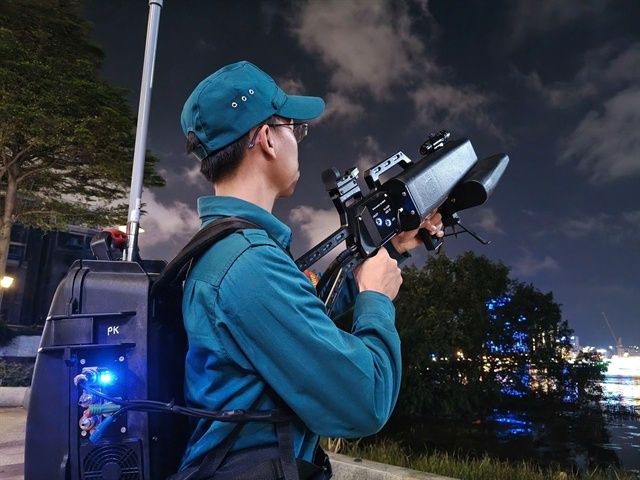
Vietnam's authorities have issued a formal warning to the public against operating drones without authorisation near airport zones, responding to a dramatic acceleration in incidents that have disrupted aviation schedules, inflicted substantial financial losses on carriers, and heightened the potential for catastrophic in-air collisions. The Ministry of Public Security's Immigration Department has flagged the issue as an emerging threat to the country's aviation safety infrastructure, prompting stricter enforcement and public awareness campaigns.
The scale of the problem has become impossible to ignore. Vietnam recorded 34 instances of unauthorised drones or other aircraft entering restricted airspace around airports during 2025, a baseline that nearly doubled when 17 additional cases occurred in just the first half of 2026. The accelerating trajectory suggests the challenge will intensify further unless interventions prove effective. Each intrusion triggers an immediate cascade of emergency responses from air traffic control teams, who must halt aircraft takeoffs, cancel landings, or redirect planes to alternative airports to prevent potential mid-air contact.
The financial consequences have been staggering for both carriers and airport operators. Vietnam Airlines disclosed that drone-related disruptions spanning merely eight days—from February 17 to 24—resulted in losses of approximately VNĐ5.6 billion (US$215,000) and cascaded into travel chaos affecting roughly 9,200 passengers through delayed flights and schedule modifications. Danang International Airport separately quantified its direct economic damage at more than VNĐ10 billion ($384,000) from a single incident, without accounting for the cascading costs borne by freight operators, tourism businesses, and stranded travellers. These figures offer only a window into the broader economic cost, as secondary impacts ripple through supply chains and business operations.
Beyond the quantifiable financial impact lies a deeper safety concern that officials emphasise repeatedly. A collision between a drone and an aircraft during the vulnerable phases of takeoff or landing could precipitate a catastrophic accident, potentially claiming multiple lives and causing substantial damage. Aircraft are particularly susceptible during these phases because pilots have limited manoeuvrability and response time. The regulatory framework in Vietnam now reflects this gravity through increasingly severe penalties.
Vietnam's legal structure requires drone operators to register their equipment and secure an explicit flight permit before operations commence. Crucially, registration alone does not authorise flight; permits specify precise geographical boundaries, altitude ceilings, operational windows, and scope limitations. Violations trigger administrative, civil, or criminal consequences calibrated to the severity of the breach. A government decree introduced in 2025 allows authorities to impose fines, confiscate equipment, and revoke flight privileges for infractions.
More serious transgressions—specifically those obstructing air traffic or creating substantial aviation hazards—qualify as criminal offences prosecuted through formal judicial channels. Penalties escalate dramatically, ranging from monetary fines and non-custodial reform sentences to imprisonment extending up to 15 years in the most egregious cases. Notably, the law does not require that an actual accident occur; the creation of genuine collision risk alone constitutes grounds for prosecution.
Operators who deliberately or recklessly direct drones into aircraft approach corridors, takeoff paths, or landing zones face particular criminal exposure. These actions, classified as creating material risk of collision, can result in fines spanning VNĐ10 million to VNĐ50 million ($384-$1,920), non-custodial reform sentences of up to two years, or custodial imprisonment of three months to two years. Conviction also triggers collateral professional consequences: individuals may be barred from holding specified employment positions or public roles for one to five years following their sentence, effectively extending the practical impact beyond the immediate legal penalty.
The enforcement approach reflects Vietnam's assessment that voluntary compliance and individual responsibility have proven insufficient. The Ministry of Public Security's Immigration Department has therefore urged drone operators to strictly observe permit conditions regarding timing, geographic location, and operational parameters. Simultaneously, authorities have appealed to the broader public to report suspicious or unauthorised drone activity near airports to law enforcement, military personnel, or airport security officials. This dual strategy—heightened penalties combined with community-based surveillance—aims to create both deterrent and detection mechanisms.
The regulatory positioning places aviation safety squarely within a shared social responsibility framework. Officials have articulated the message that careless drone operations threaten not only individual passenger lives but also broader economic stability, supply chain integrity, and national security. This framing suggests that Vietnam perceives drone misuse near airports as something more than a nuisance; it represents a potential vulnerability in critical infrastructure. For Malaysian readers and others in Southeast Asia, Vietnam's escalating regulatory response serves as both a cautionary example and a template, as other nations in the region grapple with similar challenges as consumer and commercial drone adoption accelerates. The financial and operational costs Vietnam has experienced—and the legal framework now implemented—may increasingly influence how other governments across Southeast Asia approach drone regulation near high-security aviation zones.

