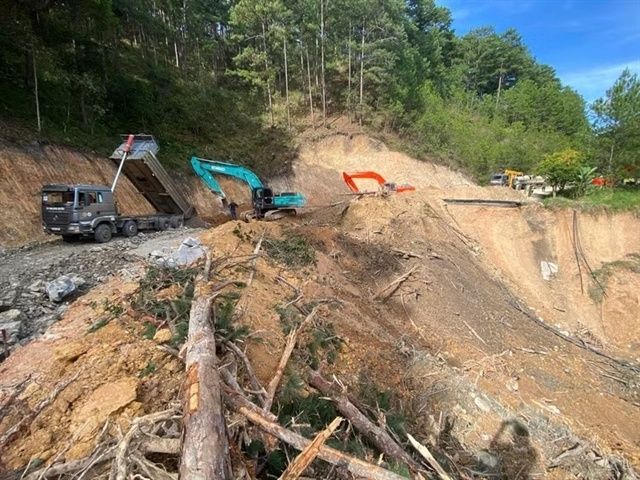
Vietnam's Ministry of Construction has formally declared a natural disaster emergency affecting a crucial section of Ho Chi Minh Road passing through Tuyen Quang Province, marking a significant infrastructure crisis triggered by relentless rainfall during the monsoon season. The declaration specifically targets the Km115+000 position where the road intersects with National Highway 2C, a location managed under Road Management Zone I's jurisdiction. This action underscores the serious nature of weather-related damage threatening one of Southeast Asia's most vital transport arteries connecting northern regions to Ho Chi Minh City.
Extended precipitation patterns ravaged the corridor throughout June, with the Tuyen Quang Provincial Hydrometeorological Station and the National Centre for Hydrometeorological Forecasting documenting multiple consecutive heavy rainfall episodes spanning the entire month. The cumulative effect of these weather systems overwhelmed drainage systems and destabilized road foundations, causing substantial deformation of the transport infrastructure. Such deterioration poses acute safety hazards to both passenger and commercial vehicles traversing this economically important route daily, necessitating urgent intervention by central authorities.
The emergency declaration prioritizes immediate safeguarding of road users against the hazards created by structural damage. Officials emphasized that the extent of pavement and subgrade degradation resulting from these extreme weather conditions warranted the highest level of government response. This classification grants accelerated access to resources and streamlined decision-making procedures typically required for routine road maintenance, enabling faster mobilization of repair crews and materials.
The Department for Roads of Vietnam and Road Management Zone I have assumed lead responsibility for conducting comprehensive damage assessments and developing remedial strategies. These agencies must review the full extent of infrastructure compromise, evaluate alternative restoration approaches, and prepare an Emergency Construction Order authorizing extraordinary measures to restore road functionality. The framework allows these entities to implement solutions that might otherwise require extended bureaucratic approval processes, recognizing the time-sensitive nature of restoring a vital transport connection.
For Malaysian and Southeast Asian observers, this situation reflects broader regional vulnerabilities to intensifying monsoon patterns and extreme weather events. The Ho Chi Minh Road, critical for cross-border trade and regional connectivity, undergoes regular stress from seasonal rainfall. Vietnam's formal emergency declaration signals escalating climate-related pressures on infrastructure across the subregion. Countries including Malaysia should recognize these developments as indicative of mounting challenges facing land transport networks throughout Southeast Asia, potentially disrupting supply chains and commerce that depend on reliable road corridors.
The repair timeline remains fluid, contingent upon engineering assessments and resource allocation. Once emergency construction activities conclude, the Department for Roads of Vietnam must report completion status to the Ministry of Construction, which will then evaluate whether conditions warrant terminating the emergency declaration. This staged approach balances urgency with verification that restoration efforts have adequately resolved safety concerns and restored the road to operational standards.
Authorities have also identified a secondary flooded section between Km124+600 and Km128, where Ho Chi Minh Road overlaps with National Highway 2, requiring immediate congestion management and traffic flow optimization. This stretch presents additional complications for vehicle passage and necessitates parallel intervention efforts. Coordination between multiple administrative layers becomes essential, as both national and provincial governments maintain authority over different segments of this crucial transport corridor.
Accountability mechanisms embedded within the emergency response framework designate specific officials responsible for reporting and execution. The Director General of the Department for Roads of Vietnam and the Director of Road Management Zone I face explicit responsibility to the Minister of Construction for damage assessments, repair implementation, and traffic management outcomes. This hierarchical assignment ensures senior leadership maintains direct oversight and establishes clear chains of accountability for resource deployment and timely resolution.
The Transport and Road Safety Division of the Ministry of Construction serves as the coordinating body tasked with monitoring compliance and directing relevant agencies in implementing corrective measures. This arrangement centralizes oversight while distributing operational responsibilities among entities with specialized expertise in road maintenance, construction, and traffic management. The division's monitoring role helps prevent fragmentation of efforts across multiple jurisdictions.
For regional policymakers and business communities dependent on Vietnam's transport infrastructure, this emergency declaration illustrates the intersection of climate vulnerability and economic resilience. The Ho Chi Minh Road serves as an arterial connection for trade flowing between Vietnam, Laos, Cambodia, and Thailand. Disruptions, even temporary ones, cascade through supply chains across Southeast Asia. Malaysian companies engaged in regional commerce or investment face potential delays or rerouting costs during repair phases, underscoring interdependencies within the ASEAN economic framework.
Longer-term implications suggest Vietnam may need to reconsider infrastructure design standards to accommodate intensifying rainfall patterns. Climate projections indicate continued shifts toward more extreme precipitation events, potentially rendering current drainage and structural specifications inadequate. Regional governments, including Malaysia, should similarly reassess infrastructure resilience in light of observed climate trends, particularly for critical economic corridors.
The resolution of this emergency will demonstrate Vietnam's capacity to manage climate-related infrastructure crises while maintaining economic connectivity. Successful and expedient restoration could strengthen confidence in the country's infrastructure governance, while extended disruptions might prompt regional stakeholders to diversify logistics routes. Either outcome carries implications for investment confidence and trade patterns throughout Southeast Asia, making this more than a domestic Vietnamese concern but a matter relevant to the entire region's economic interdependencies.

