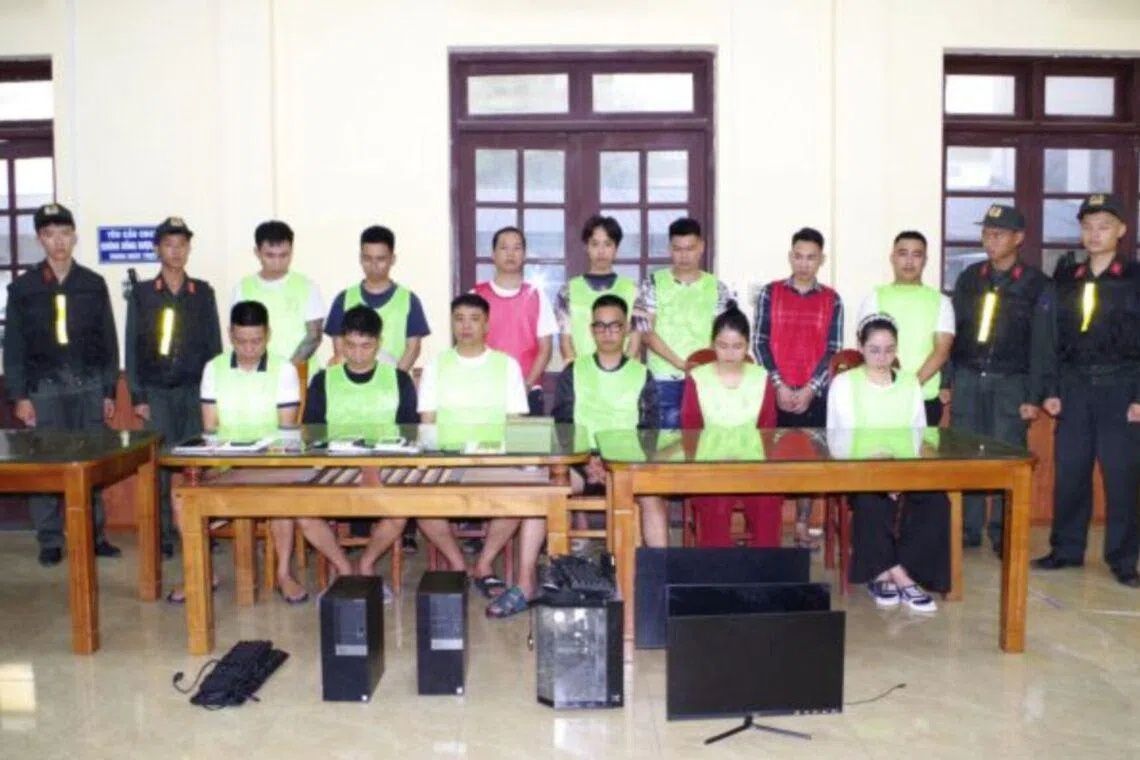
Authorities in Vietnam's northern Ninh Binh province have successfully broken up an organised transnational online fraud syndicate that systematically defrauded hundreds of victims of over 250 billion dong, equivalent to RM39.2 million. The operation, which spanned across borders and involved recruits transported to Cambodia, represents a significant victory against increasingly sophisticated cybercrime networks that have become a persistent challenge across Southeast Asia. The police arrested 12 suspects during the investigation, with two individuals identified as the alleged masterminds orchestrating the criminal enterprise.
The breakthrough came following extensive surveillance and investigative work that revealed the network's intricate operational structure. During raids, law enforcement officers confiscated substantial quantities of material evidence and specialised equipment used in executing the frauds. Among the seized items were significant quantities of cash, a motor vehicle, numerous mobile phones and computers, falsified identity documents, jewellery, and comprehensive records detailing the group's criminal transactions and communications. The breadth of seized assets underscores how well-resourced and organised the operation had become before its dismantling.
The investigation identified Nguyen Van Cuong, aged 28, and Nguyen Van Phuong, aged 34, as the principal architects of the scheme. These individuals reportedly orchestrated a carefully compartmentalised operation where different members performed specific roles within a hierarchical structure. A deliberate strategy of recruiting Vietnamese nationals and positioning them in Cambodia created geographical distance between operational centres and victims, complicating law enforcement coordination and increasing the difficulty for victims to seek redress across borders.
The fraudsters employed an exceptionally diverse range of deception tactics that capitalised on trust in authority figures and legitimate institutions. By impersonating police officers, prosecutors, judges, banking employees, and tax officials, they exploited the inherent respect these positions command in society. The sophistication extended to digital deception, with the group creating counterfeit websites and mobile applications that meticulously replicated genuine government agency portals and established business platforms. These convincing digital facades served as entry points for victims who believed they were engaging with legitimate entities.
The scam scenarios themselves demonstrated considerable creativity and psychological manipulation. Perpetrators deployed fake employment recruitment offers targeting individuals seeking part-time income supplementation. They presented fraudulent investment opportunities centred on finance, securities, and cryptocurrency products that promised unrealistic returns to attract victims seeking wealth accumulation. Romance scams represented another avenue, where fraudsters cultivated emotional relationships with targets before requesting financial assistance. The group additionally hijacked legitimate social media accounts and exploited existing networks of trust to solicit loans from the victims' own contacts, leveraging established relationships as a manipulative tool.
One particularly complex scheme involved suspects posing as military officers who contacted retail establishments and business operators with substantial product orders. The fraudsters subsequently convinced victims to procure additional inventory on their behalf, then requested deposits or advance payments sent to bank accounts controlled by the criminals. This layered deception relied on the psychological pressure of a confirmed large order and the victim's expectation of legitimate business transaction completion. By the time victims realised the deception, funds had been transferred and the fraudsters had vanished.
The investigation revealed that since October 2024, the network had successfully compromised approximately 500 individuals across Vietnamese territory, accumulating losses exceeding 250 billion dong. This scale of victimisation demonstrates how the operation had grown significantly in just a few months of active criminal conduct. The breadth of the victim pool, spread across different regions and demographic groups, indicates the perpetrators had refined their targeting methodology and expanded their operational capacity considerably.
Vietnam's judicial system has processed the initial charges against the suspects. Six individuals have been formally charged with fraudulent appropriation of property and placed in temporary detention pending further legal proceedings. The remaining six suspects remain subject to procedural measures as police continue their investigation into the full extent of the network's activities. This staged approach allows authorities to gather additional evidence while maintaining custody of key figures.
The police investigation remains ongoing, with officers working to identify and apprehend additional network members who may have escaped the initial dragnet. Such transnational fraud operations typically involve numerous supporting actors and facilitators beyond the core operational team, suggesting the genuine scope may extend beyond the 12 arrested individuals. Authorities are simultaneously pursuing asset seizure and account freezing orders targeting funds derived from criminal activity, seeking to recover stolen money for victims and disrupt the perpetrators' financial capabilities.
This case reflects a broader Southeast Asian challenge with organised online fraud increasingly operated from low-regulation jurisdictions. The Cambodia-based operations utilising Vietnamese recruits exemplify how criminal networks exploit geographical disparities in law enforcement capacity and regulatory oversight. For Malaysian readers, the case underscores vulnerabilities in cross-border fraud prevention and highlights how fraudsters systematically evolve their methodologies to circumvent existing safeguards. The scale of losses and sophistication of techniques mirror concerns raised repeatedly by Malaysian authorities investigating similar crimes targeting local citizens, emphasising the need for enhanced regional cooperation and public awareness campaigns addressing the psychological manipulation tactics employed by these networks.

