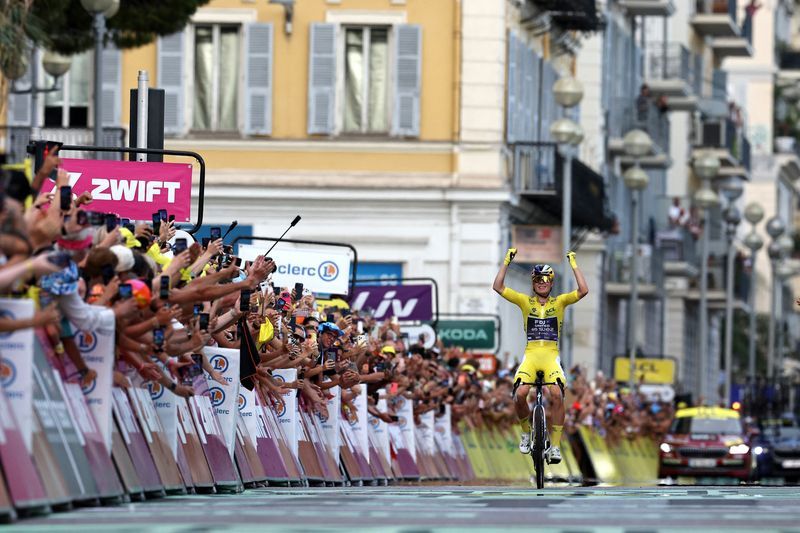
Demi Vollering has added another significant chapter to her cycling legacy by capturing her second Tour de France Femmes title, the sport's premier women's stage race. The 29-year-old Dutch rider from team FDJ-Suez secured the victory in commanding style on Sunday with a dominant display during the ninth and final stage held near Nice, France, cementing her status among the current generation's elite cyclists.
Vollering's career trajectory reflects the remarkable ascent of women's professional cycling over recent years. Beyond her two Tour de France Femmes victories, her palmares include the 2026 Giro d'Italia Women and consecutive La Vuelta Femenina titles in 2024 and 2025, marking her as a complete stage racer capable of sustaining performance across multiple grand tours. These achievements underscore how top female cyclists now compete across the sport's most demanding multi-week events with the same professionalism and intensity that characterises the men's peloton.
Entering the final 99.2-kilometre stage, Vollering held a slender eight-second advantage over Poland's Katarzyna Niewiadoma-Phinney, having seized the yellow jersey the previous day. This narrow margin meant the outcome remained genuinely uncertain, and victory required a decisive performance on a course that featured the testing Col d'Eze. Rather than merely defending her position, Vollering chose to attack, demonstrating the aggressive racing philosophy that distinguishes champions from mere title holders.
The decisive moment arrived on the fourth and final ascent of Col d'Eze, where Vollering launched a powerful attack that Niewiadoma-Phinney, the 31-year-old competitor from her rival's team, could not match. Vollering subsequently rode alone to the finish in Nice, extending her advantage and making her dominance unmistakable. This attacking approach proved psychologically important for Vollering herself, as she revealed in post-race commentary that winning in the yellow jersey held particular significance in her mind.
Vollering's reflections during her victory interview illustrated the deeper satisfaction of her triumph beyond the numerical fact of winning. She spoke about drawing motivation from her team's collective efforts, specifically mentioning teammate Celia Gery who had endured a difficult night, suggesting the camaraderie and interdependence that characterises professional cycling. Her remarks emphasised the distinction between winning races through tactical dominance and winning them as part of a unified team effort motivated by shared passion and dedication.
The margin of her ultimate victory substantially increased from that eight-second deficit to one minute and eighteen seconds in the final general classification, demonstrating how dramatically the final stage shaped the race outcome. Italy's Elisa Longo Borghini rounded out the podium positions, while Spain's Paula Blasi claimed the second-place finish on the individual stage itself, finishing one minute and four seconds behind Vollering. Niewiadoma-Phinney, despite her strong overall performance, completed the final stage podium in third position.
Vollering's performance on Sunday represented her third stage victory during this year's edition and her sixth stage win across all her Tour de France Femmes participations, indicating her consistency in delivering results across the race's varied terrain and stage profiles. This versatility across different stage types—mountain finishes, time trials, and flatter terrain—reflects the comprehensive skill set required of modern grand tour winners who must excel in multiple cycling disciplines simultaneously.
The 2024 Tour de France Femmes victory carries additional significance within the broader context of women's cycling's continued professionalisation and visibility. The race itself has evolved substantially since its revival in 2022 after a 33-year absence, attracting increased media coverage, sponsorship, and audience interest. Vollering's back-to-back triumph in this revived format positions her as one of the defining figures of contemporary women's cycling during its period of rapid expansion and improvement.
For Malaysian and Southeast Asian cycling enthusiasts, Vollering's performance offers perspective on the calibre of athletes competing at cycling's highest level. While the region has produced accomplished cyclists in recent years, the consistency and dominance displayed by riders like Vollering across multiple grand tours represents the standard expected at the sport's elite level. The competitive depth of the Tour de France Femmes, evident in the challenges posed by accomplished rivals like Niewiadoma-Phinney and Longo Borghini, illustrates how rapidly women's professional cycling has developed as a truly world-class sporting competition.
Vollering's second Tour de France Femmes triumph arrives in the same calendar year that Slovenia's Tadej Pogacar claimed his record-equalling fifth Tour de France title in July, achieving his third consecutive victory in cycling's most prestigious event. This parallel achievement by Pogacar in the men's race demonstrates how top-tier cyclists can sustain excellence across entire seasons and multiple years, setting themselves apart through consistent performance at sport's highest competitive level. Both victories underscore the physical and mental demands required to succeed repeatedly at cycling's grandest stages.

