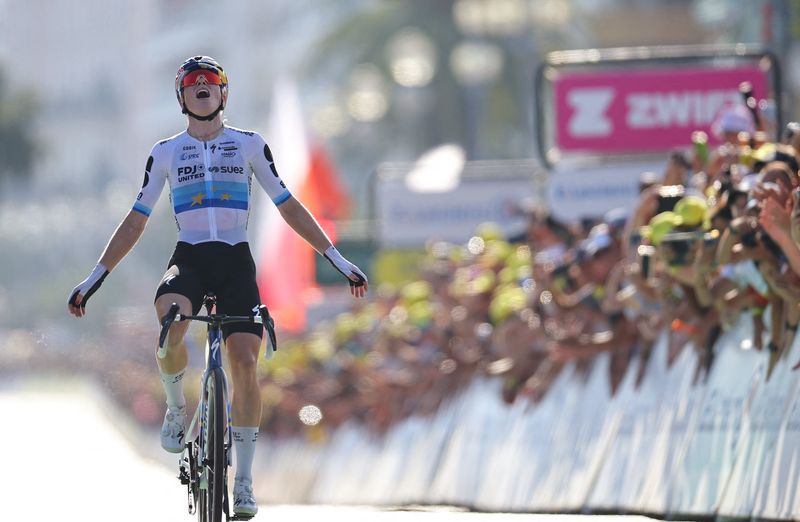
Demi Vollering has surged into the overall lead of the Tour de France Femmes following a dramatic victory on the eighth mountain stage, claiming the coveted yellow jersey from Kasia Niewiadoma-Phinney with just one day of racing left. The Dutch cyclist's decisive performance on Saturday's gruelling 171.9-kilometre mountain route from Sisteron to Nice demonstrates the unpredictable nature of elite women's cycling, where momentum and tactical execution can swing the advantage within hours.
The stage itself was marked by an unexpected twist before the peloton even hit the road. Pauline Ferrand-Prevot, the defending champion riding for Visma-Lease a Bike, was forced to withdraw due to illness, removing one of the race's most formidable competitors from contention just as the decisive mountain stages arrived. This development fundamentally altered the dynamics of the competition, leaving the door open for other strong contenders to make their move.
Vollering's winning move came with surgical precision on the steep Chemin de l'Arieta climb, with just six kilometres separating her from the finish line in Nice. The FDJ United-Suez rider accelerated with devastating effect at the critical moment, dropping both Niewiadoma-Phinney and Italy's Elisa Longo Borghini before consolidating her advantage during the technical descent into the coastal city. This tactical brilliance showcases the depth of decision-making required in professional cycling, where timing an attack to coincide with terrain that suits one's strengths can prove decisive.
The victory represents a remarkable turnaround for Vollering, who had suffered a significant setback just one day earlier on Mont Ventoux. The previous stage had seen her lose one minute and 16 seconds to Niewiadoma-Phinney, a substantial deficit in a closely contested race where seconds accumulate into meaningful advantages. Her ability to respond with authority the following day highlights the psychological resilience and physical capability required at the highest levels of women's professional cycling.
Vollering's philosophical approach to stage racing provides insight into the mental fortitude demanded by multi-day events. Speaking after her victory, she acknowledged the emotional rollercoaster inherent in such competitions, noting how disappointment one evening must be replaced by renewed determination the following morning. Her comments underscore that success in racing is not merely about physical capacity but also mental discipline and the ability to maintain focus despite setbacks. She emphasized that the race remained wide open entering the final stage, with significant uncertainty still surrounding the eventual winner.
The stage victory represented Vollering's fifth spell wearing the yellow jersey during this edition of the Tour de France Femmes, reflecting the competitive depth of the event. Her assumption of the lead also made her the fifth different rider to hold the race lead across the three weeks of competition, demonstrating that this particular edition has featured multiple contenders capable of mounting title challenges rather than domination by a single athlete.
Longo Borghini's second-place finish on the stage positioned the UAE Team ADQ rider prominently, edging out Niewiadoma-Phinney in a close sprint to the line. The Polish rider's third-place finish meant she surrendered the race lead she had held going into the stage, a frustrating outcome given her team's evident desire to defend their advantage through various tactical approaches.
Niewiadoma-Phinney's reaction to the stage highlighted the contentious nature of professional cycling tactics. She expressed significant frustration with FDJ United-Suez's approach, specifically criticizing teammate Celia Gery for what she characterized as a deliberate blocking maneuver that forced her to cease pedalling as she approached the barriers on the climb. The Polish cyclist suggested this represented unsporting behaviour that fell short of fair play standards, indicating friction between the competing teams extends beyond simple sporting rivalry.
The eight-second advantage that Vollering now holds over Niewiadoma-Phinney sets up a thrilling final stage around Nice on Sunday. In women's professional cycling, this margin represents a meaningful but hardly insurmountable lead, particularly when the concluding stage is designed to test climbers and competitors with strong performances over multiple ascents. The final day will determine whether Vollering can convert her present advantage into ultimate victory or whether Niewiadoma-Phinney can mount a comeback to reclaim the yellow jersey.
For regional cycling enthusiasts and Malaysian fans of professional sport, this Tour de France Femmes represents the growing global visibility of women's cycling as a serious competitive discipline. The dramatic shifts in leadership, the tactical sophistication displayed by competing teams, and the psychological dimension of stage racing combine to create compelling sporting narratives that rival any men's competition in terms of drama and athletic excellence.
The conclusion of this year's Tour de France Femmes will be decided on Sunday's finale, but Vollering's decisive intervention on the Chemin de l'Arieta has ensured that women's cycling retains its position as one of Europe's most engaging sporting spectacles. Her recovery from yesterday's disappointment and subsequent attack on the crucial mountain climb demonstrates why professional cycling continues to captivate audiences worldwide, blending physical endurance with tactical brilliance and mental resilience.

