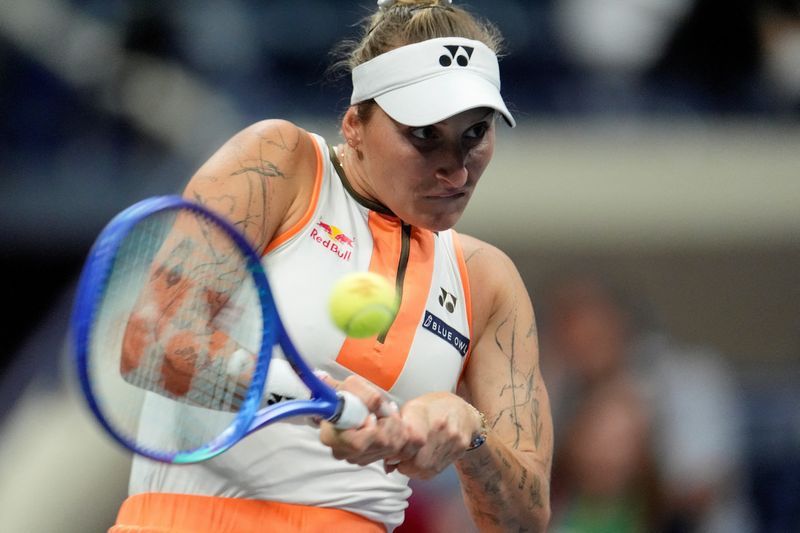
The four-year suspension handed to Marketa Vondrousova, the 2023 Wimbledon champion, has exposed deep tensions within professional tennis between the need for rigorous anti-doping enforcement and the protection of athlete welfare. The Czech player was banned by the International Tennis Integrity Agency after failing to provide a sample during an unannounced out-of-competition test at her home in December, a penalty that has now triggered the Professional Tennis Players Association to demand a fundamental overhaul of how doping regulations are shaped within the sport.
Vondrousova's case carries particular weight because she has never tested positive for a banned substance, yet faces one of the heaviest penalties available under anti-doping law. The 26-year-old has publicly explained that her refusal to cooperate stemmed from genuine safety concerns. When a doping control officer arrived at her residence at 8:15 p.m. requesting an immediate test, Vondrousova declined to open the door, citing fears rooted in a traumatic 2016 incident when fellow Czech player Petra Kvitova was stabbed by an intruder in her home. Her decision to prioritise personal security over compliance has crystallised a debate that extends far beyond her individual circumstances, raising uncomfortable questions about the boundaries between legitimate testing protocols and the reasonable expectation of privacy that athletes should enjoy.
The PTPA's response to Vondrousova's suspension represents a watershed moment in player advocacy within professional tennis. In a carefully worded statement, the organisation acknowledged that while random testing remains essential to preserve competitive integrity, the current framework imposes disproportionate burdens on athletes without giving them meaningful input into the rules governing their lives. The association specifically highlighted the contradiction at the heart of the case: a player facing her severest sanction despite maintaining a clean record, whilst higher-ranked competitors like Jannik Sinner and Iga Swiatek received relatively lenient treatment after testing positive for banned substances. This perceived inconsistency has eroded confidence in the impartiality of anti-doping administration and suggests that procedural fairness—a cornerstone of any legitimate regulatory system—may be lacking.
The broader context of tennis anti-doping governance reveals a sport caught between competing imperatives. Since aligning with the World Anti-Doping Agency code, tennis now operates within a standardised international framework designed to maintain consistency across all Olympic and professional sports. The ITIA, through its CEO Karen Moorhouse, maintains that decisions are determined strictly by facts and evidence, regardless of a player's ranking, nationality, or public profile. This assurance is intended to reassure stakeholders that the system functions with mechanical impartiality. Yet the stark contrast in outcomes between high-profile cases suggests that either the facts differ substantially or that the appearance of consistency masks deeper discretionary judgments that remain opaque to external scrutiny.
The safety and privacy concerns raised by Vondrousova resonate particularly strongly across women's professional sports, where unannounced visits to residences by unidentified officials present genuine risks. While the ITIA emphasises that testers are well-trained professionals who carry identification and can be verified through additional means, the reality remains that an athlete's home is their sanctuary. Requiring players to admit strangers at irregular hours, under threat of severe penalty for non-compliance, represents a form of structural vulnerability that disproportionately affects women athletes. The Kvitova attack, whilst an extreme case, serves as a stark reminder that the precaution Vondrousova took was grounded in a comprehensible and documented threat rather than irrational anxiety.
From a Southeast Asian perspective, Vondrousova's case carries implications for how emerging tennis nations approach anti-doping governance. Malaysia, Thailand, and other regional powers with growing tennis talent pipelines will increasingly face questions about how to balance compliance with international standards against the protection of their athletes' fundamental rights. The precedent set by tennis—where uncompromising adherence to testing protocols overrides privacy and safety considerations—may establish expectations that extend to other sports and create friction between national authorities and international federations.
The PTPA's call for expanded athlete representation in anti-doping rule-making addresses a structural democratic deficit that has long characterised doping control frameworks. Athletes are subject to intrusive, unpredictable testing regimes that fundamentally disrupt their daily lives, yet they have historically wielded minimal influence over the rules that govern these procedures. Vondrousova's suspension demonstrates how this absence of athlete voice produces outcomes that feel arbitrary and punitive to those enduring them. Moorhouse's assertion that an independent tribunal affirmed the necessity of unpredictable testing, whilst technically correct, sidesteps the question of whether the current form of testing—particularly unannounced home visits outside regular hours—represents the only or even the most proportionate way to achieve anti-doping objectives.
The case also illuminates the gap between formal compliance and substantive fairness. Tennis anti-doping authorities can correctly point out that they follow standardised protocols, conduct regular training, and maintain transparent appeals mechanisms. Yet procedural correctness does not automatically produce just outcomes when the underlying rules themselves may be excessive or when their application creates foreseeable risks to vulnerable athletes. Vondrousova's suspension suggests that the system may be functioning exactly as designed whilst simultaneously producing results that reasonable observers find disproportionate and unjust—a troubling possibility that demands careful examination.
Vondrousova, who has been sidelined from competition since January due to a shoulder injury, retains the option to appeal her suspension to the Court of Arbitration for Sport, where she may present arguments about proportionality, safety concerns, and the absence of any positive test result. Her appeal will likely attract intense scrutiny, not least because it offers the sport an opportunity to recalibrate its anti-doping enforcement to accommodate legitimate athlete concerns without compromising competitive integrity. The question facing tennis authorities is whether they can devise testing protocols that preserve the element of surprise necessary for effective doping detection whilst respecting the basic dignity and safety of the athletes being tested.
Looking ahead, the resolution of Vondrousova's case will reverberate throughout professional tennis and potentially influence anti-doping governance across global sport. If the Court of Arbitration for Sport upholds the ban, it will vindicate the absolute priority given to testing compliance and likely discourage other athletes from voicing safety concerns. Conversely, if the court finds the penalty disproportionate or accepts that genuine safety fears warrant some mitigation, it would signal that anti-doping frameworks must evolve to incorporate athlete welfare as a co-equal principle rather than a secondary consideration. Either way, the PTPA's insistence that players deserve substantive input into the rules shaping their lives appears unlikely to dissipate, and tennis administrators may find that meaningful dialogue with athlete representatives offers a more durable path to legitimacy than appeals to regulatory authority alone.