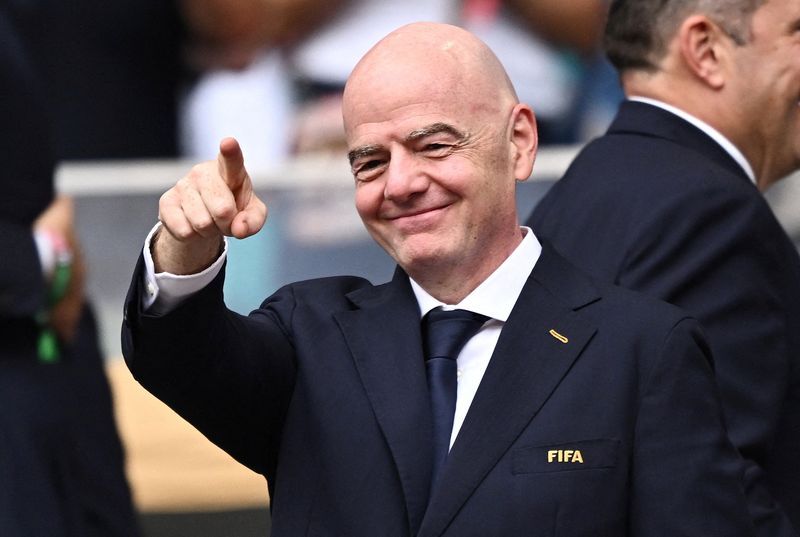
The Football Association of Wales has formally withdrawn its support for FIFA President Gianni Infantino's bid to secure another term leading world football, marking a significant setback for the Swiss executive whose grip on the organisation appeared unshakeable just months ago. The decision follows the spectacular implosion of Infantino's audacious scheme to inject up to $4.2 billion into FIFA's coffers by selling approximately 20% of the commercial rights to competitions, including the flagship World Cup, to private investors. The collapse of this initiative has crystallised growing concerns among national federations about governance standards and strategic decision-making at the highest echelons of international football.
The Welsh FA's statement was unsparing in its critique, citing fundamental failures across multiple dimensions of institutional leadership. According to the federation, Infantino's handling of the privatisation proposal revealed serious shortcomings in governance structures, procedural integrity, stakeholder consultation, and basic communication with member organisations. The withdrawal represents more than mere disagreement over a single policy initiative; it constitutes a formal declaration of lost confidence in Infantino's ability to steer the global governing body in directions that prioritise football's broader interests over financial manoeuvring. This framing carries particular weight coming from Wales, a smaller federation whose support carries less voting power than European giants, yet whose principled stance may embolden others to reconsider their positions.
Infantino's proposed privatisation scheme had been positioned as a transformative revenue-generation mechanism, designed to unlock substantial sums without requiring the traditional route of securing FIFA member votes or restructuring core operations. However, the plan encountered fierce pushback from major regional confederations and member federations who viewed the proposal as threatening to fundamental principles of democratic governance within world football. The ambitious timeframe for executing such a complex financial transaction, combined with limited transparency around the mechanics and beneficiaries of the arrangement, generated precisely the kind of institutional anxiety that has long characterised football's complicated relationship with private capital and external ownership.
The timing of Wales's withdrawal gains additional significance when contextualised against recent statements from UEFA and CONCACAF, the European and North American confederations respectively. Both organisations have publicly declared that they no longer retain confidence in Infantino's stewardship, with UEFA playing a particularly vocal role in orchestrating opposition to the privatisation initiative. UEFA's dispatch of a document preservation order to FIFA suggests that the European confederation is preparing for potential legal action, indicating that the conflict between Infantino's vision and the concerns of major stakeholder groups may extend well beyond political manoeuvrings at FIFA's Congress to formal disputes requiring jurisprudential intervention.
The political landscape surrounding Infantino's position has shifted dramatically from his apparent dominance earlier in the year. When the FIFA president announced in April his intention to contest for a fourth consecutive term, few observers anticipated serious resistance materialising. Since assuming office in 2016 following Sepp Blatter's departure amid corruption scandals, Infantino had navigated FIFA's treacherous internal politics with considerable dexterity, securing two unopposed re-elections and consolidating control over the executive apparatus. His management style, emphasising expansion of the World Cup format and increased commercial development, had generally aligned with the preferences of major confederations and wealthy football associations.
Yet the privatisation debacle has exposed deeper fissures within FIFA's membership concerning the organisation's strategic direction and decision-making processes. The proposal itself represented a departure from traditional FIFA governance, as it would have required surrendering meaningful control over competition administration to external financial interests. For many stakeholders, particularly those from federations with less developed commercial infrastructure, such an arrangement threatened to concentrate power further among elite actors within world football whilst diverting revenue streams from the grass-roots development initiatives that smaller nations depend upon for advancement. The scheme thus became a focal point for accumulated frustrations regarding Infantino's tenure.
The immediate context for this political upheaval includes the forthcoming FIFA Congress scheduled for March in Morocco, where Infantino's re-election will formally be decided. Previously, such congresses have functioned as largely ceremonial occasions, with incumbent presidents facing minimal opposition and enjoying assured continuation in their roles. However, the convergence of Welsh withdrawal, UEFA's unambiguous loss of confidence, CONCACAF's parallel concerns, and the broader negative sentiment surrounding the failed privatisation initiative suggests that the March gathering could feature genuine competitive dynamics. Should additional federations follow Wales's example and withdraw support, Infantino might face an unprecedented challenge to his re-election.
For Malaysian readers and the Southeast Asian football community, this development carries implications extending beyond institutional intrigue at FIFA headquarters. The broader question of how international football governance evolves—particularly regarding the balance between commercialisation imperatives and member state autonomy—affects decisions that ripple through regional competitions and funding allocations. Southeast Asian football associations depend significantly upon FIFA's financial distributions and competition structures, making the constitutional health of world football's governing apparatus a matter of material consequence. Should Infantino's authority be substantially weakened, or should his successor adopt a more collaborative approach to major strategic initiatives, the distribution of resources and opportunities within Asian football could shift accordingly.
The failed privatisation scheme illuminates a fundamental tension within contemporary football administration: the pressure to generate ever-increasing revenues for reinvestment in infrastructure and development, balanced against the necessity of preserving democratic decision-making processes and equitable stakeholder representation. Infantino's proposed solution attempted to square this circle through private capital injection, but the mechanism threatened to undermine the very democratic principles that lend legitimacy to FIFA's governance structures. His inability to navigate this contradiction successfully, and the subsequent backlash from confederations and federations, suggests that future FIFA leadership will confront intense pressure to demonstrate that commercial development can proceed without compromising fundamental institutional integrity or marginalising smaller stakeholders whose voices must remain integral to world football's governance architecture.

