When flames threatened his Altadena, California home on the evening of January 7, 2025, Matt Blea faced an agonising question familiar to thousands of residents in disaster zones: evacuate immediately or wait for official orders? A friend's recommendation to download Watch Duty proved decisive. Through the app, Blea could monitor the fire's advancing perimeter, check evacuation directives, and follow real-time emergency response updates. The information proved crucial—he departed that night with his family, escaping the Eaton Fire that would ultimately consume their home. Blea's experience reflects a broader shift in how Americans manage life-threatening emergencies, one driven by the expanding reach of a nonprofit digital platform that has become indispensable to millions navigating climate-driven disasters.
During the catastrophic Los Angeles fire season that week, more than 2.5 million people relied on Watch Duty to make critical safety decisions. Behind the app stood roughly two dozen staff members and over one hundred volunteers operating as an ad-hoc emergency intelligence network, systematically monitoring emergency radio frequencies, aircraft communications, and official agency broadcasts to compile verified information that feeds into a unified platform. David Hertz, a Malibu fire brigade captain, observed that Watch Duty functioned as a crucial democratisation of emergency information, particularly when official channels failed. The Eaton and Palisades fires that week killed 31 people, with many residents in some areas receiving minimal advance warning—a gap that Watch Duty's volunteer network helped bridge by accelerating information flow to the communities most at risk.
The organisation's decision to extend operations into flood monitoring, beginning in June 2025, represents a strategic response to emerging climate realities. The timing coincides with the onset of America's peak flash flood season and arrives nearly a year after last July's devastating Texas floods that claimed more than 130 lives and triggered widespread criticism about the failure to alert residents and visitors to imminent danger. John Mills, the nonprofit's CEO and co-founder, articulated the motivation bluntly: the existing infrastructure for emergency communication functions inadequately, with crucial information often trapped within bureaucratic processes or distributed too slowly across fragmented channels. Mills himself founded Watch Duty in 2021 after experiencing firsthand how official alert systems had failed to provide him with evacuation instructions when a Northern California wildfire approached his home.
The underlying problem extends far beyond any single disaster. Contemporary emergency alerting in the United States operates through multiple nominally coordinated systems—text alerts, radio broadcasts, emergency management websites, weather service bulletins—yet the actual process of issuing specific warnings or evacuation orders remains mired in procedural complexity. Decision-makers operating under extreme time pressure must navigate layers of institutional hierarchy and verification protocols. Meanwhile, communities hungry for actionable intelligence find themselves navigating fragmented information sources, each requiring separate navigation and interpretation. Mills recognised that much of the necessary information already exists within emergency response networks—monitored through police and fire radio scanners, satellite imagery, citizen observations, and official announcements—but extracting, verifying, and presenting that data in accessible form has fallen to no institution serving the general public until Watch Duty emerged.
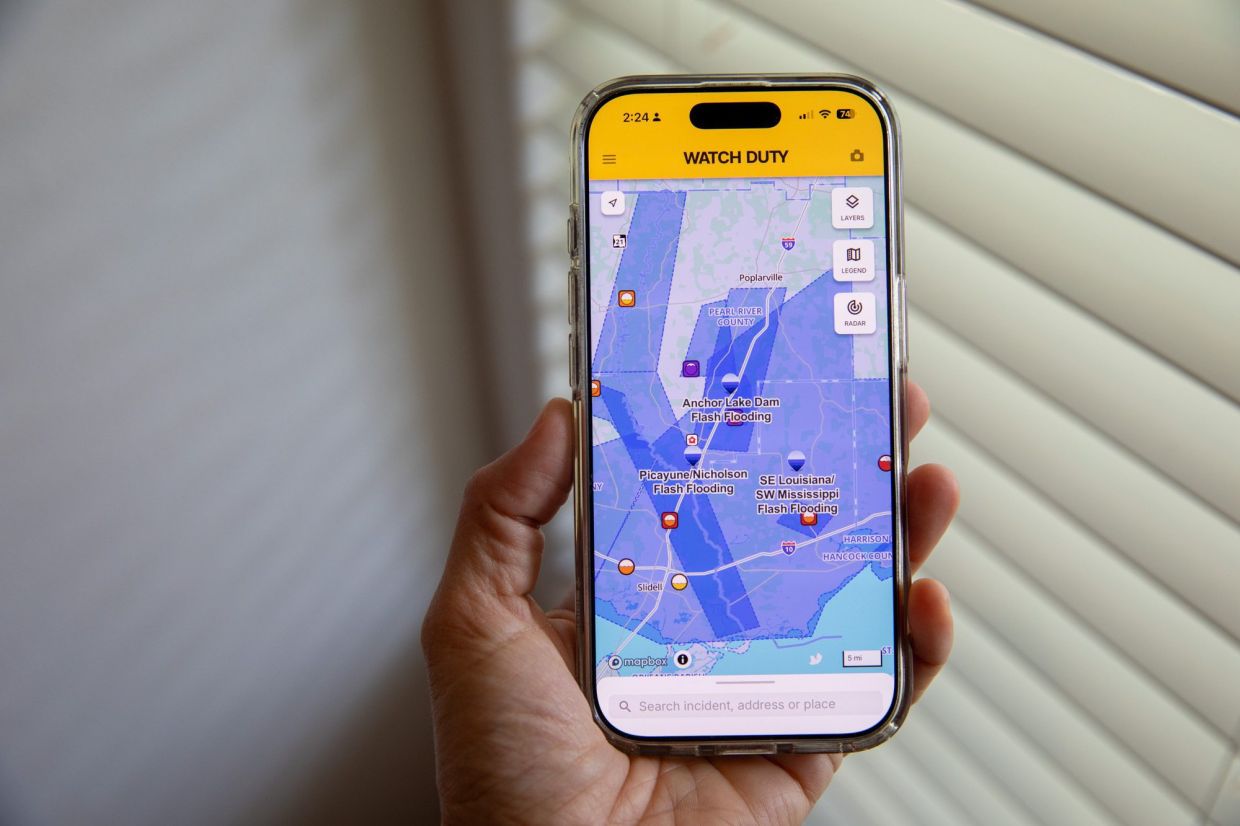
The app's architecture reflects this analysis. Watch Duty now coordinates approximately 300 volunteer "reporters" who function as a distributed intelligence-gathering operation, aggregating data from radio scanners, cameras, satellites, user-generated content, and official announcements. The platform presents information through maps, text feeds, and push notifications configured to penetrate even silenced phones—ensuring that emergency alerts reach users during sleep or distraction. Pete Curran, Watch Duty's meteorologist and a retired firefighter, emphasises the consolidation advantage: users need not navigate separate websites for weather services, county emergency management, or governmental agencies. Instead, information arrives through a single interface in plain language, accompanied by notifications calibrated to interrupt and alert. This operational model gives Watch Duty a structural advantage over official agencies. Curran notes that volunteer reporters shoulder only one responsibility—to monitor and transmit verified information—whereas municipal and state emergency managers must simultaneously coordinate complex incident response operations. That singular focus permits faster information dissemination than competing institutional demands typically allow.
Since its 2021 founding, Watch Duty has grown into a significant emergency infrastructure player, now serving over 20 million users and receiving nearly six million dollars in grants and donations during 2025 alone. The nonprofit structure proved essential to building institutional trust and distinguishing the platform from commercial services driven by advertising incentives or data collection concerns. Watch Duty's expansion into flood monitoring stems from recognition that climate change increasingly generates hydrological hazards in regions historically unaccustomed to severe flooding. Lori Moore-Merrell, the retired US Fire Administrator who now serves on Watch Duty's board, articulated this reality: rainfall patterns have shifted so radically that precipitation events once considered impossible now occur routinely in places lacking infrastructure, knowledge, or institutional memory to manage them effectively. Communities cannot protect themselves from hazards they have never experienced and about which they possess no baseline understanding.
The flood tracking system integrates meteorological data from the National Weather Service, National Oceanic and Atmospheric Administration, and US Geological Survey, translating technical outputs into actionable community intelligence. Users access National Weather Service flood warnings and watches alongside real-time river gauge measurements and alerts regarding potential dam or levee failures. Notably, Watch Duty enables users to understand their personal risk profile before emergencies occur. The app indicates whether a residence sits within FEMA-designated flood zones and explains what specific river gauge readings would signal imminent danger. Users customise notifications to activate alerts if monitored gauges approach dangerous thresholds, effectively providing community members with the scientific literacy and decision frameworks typically reserved for emergency professionals.
Yet enthusiasm for Watch Duty's technological solution must confront harder realities about emergency preparedness and public resilience. Chad Berginnis, executive director of the Association of State Floodplain Managers, articulates this sobering observation: possession of a warning means nothing without knowledge of how to act upon it. The Texas floods demonstrated that communities cannot adequately respond to threats they do not understand, regardless of how quickly alerts are delivered. Effective emergency management requires not merely information dissemination but prior knowledge of evacuation routes, practised family communication plans, and understanding of local hazard geography. Berginnis emphasises that substantial preparedness failures stem not from information gaps but from residents lacking any workable action plan. These are failures that no application can remedy; they demand community education, municipal planning, and individual household responsibility conducted continuously outside emergency contexts.
The national infrastructure undergirding emergency alerting itself faces precarious funding. Federal agencies and local emergency warning systems have endured budget reductions and now confront additional proposed cuts that threaten their operational capacity. According to Berginnis, maintaining physical infrastructure for monitoring weather and distributing alerts requires sustained financial commitment; sophisticated systems prove useless without personnel and equipment to operate them. The Watch Duty phenomenon, while innovative and undeniably valuable, cannot substitute for adequately funded government institutions conducting emergency management work. Mills himself emphasises this interdependence, stressing that Watch Duty functions as a complement to, not replacement for, the National Weather Service, fire services, and established emergency infrastructure. Users should maintain enrollment in official local alert systems even while accessing Watch Duty's streamlined information aggregation.
Practical limitations further constrain what smartphone applications can accomplish. Watch Duty reaches only people who have discovered, installed, and configured the app—a significant percentage of the population, but far from universal coverage. Cell service coverage remains patchy in many rural and mountainous regions where flood risk frequently concentrates, leaving residents unable to access even downloaded applications during emergencies. These realities have prompted emergency management professionals to advocate for redundancy across multiple alert channels. Berginnis notes that communities forget that inexpensive NOAA weather radios provide alert functionality independent of cellular networks or downloaded applications. In contemporary emergency management, fixation on cutting-edge technology sometimes obscures simpler, more reliable, and often more accessible solutions. The most resilient warning systems layer multiple notification channels—official broadcasts, community sirens, social media dissemination, broadcast radio and television alerts, and applications like Watch Duty—rather than depending on any single mechanism to reach all residents.
For Southeast Asian contexts including Malaysia, Watch Duty's expansion into flood monitoring carries particular relevance. The region experiences intensifying monsoon-driven flooding, urban flash floods triggered by intense convective rainfall, and increasingly complex hydrological hazards resulting from development patterns, tropical deforestation, and climate change. Malaysian communities dealing with recurring flood emergencies could benefit from technological solutions aggregating real-time environmental data, consolidating information from meteorological agencies, and delivering alerts through accessible interfaces. However, the Watch Duty model demonstrates that technology implementation alone proves insufficient. Sustainable emergency preparedness requires adequate funding for monitoring infrastructure, trained personnel to interpret data and issue warnings, community education regarding hazard awareness and response protocols, and public trust in institutions managing emergency communications. These prerequisites demand investment and institutional commitment that transcend application design.

