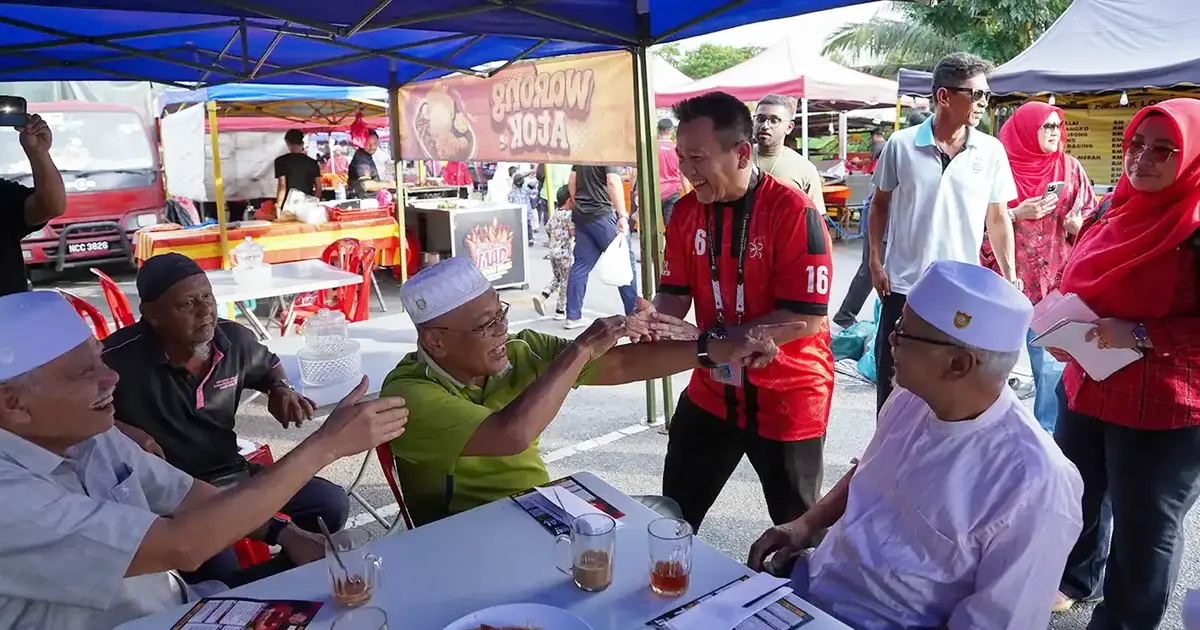
The decision by Wawasan to field a candidate in the Sikamat constituency threatens to complicate what would otherwise be a binary electoral contest, according to assessments from Tun Faisal Ismail Aziz. The political operator contends that this three-way race remains genuinely competitive, partly because constituents have grown disillusioned with the governance record of the administration that previously held sway in the state. His analysis suggests that neither the ruling coalition nor the opposition holds a commanding advantage in this particular battleground.
Wawasan's entry into Sikamat represents a significant variable in Malaysia's complex multiparty system, where regional parties and newer political movements increasingly fragment traditional voting blocs. The party's decision to contest reflects the broader political realignment occurring across peninsular Malaysia, where established coalitions face pressure from newly-formed challengers and movements built on alternative policy platforms. For voters accustomed to straightforward binary choices between established coalitions, the introduction of a third substantial force genuinely resets the electoral calculus.
Tun Faisal's assertion that BN and PAS adherents may harbour reservations about Wawasan's participation underscores a fundamental tension within Malaysian electoral politics. Conservative voters who have historically backed either the government coalition or the Islamic opposition party might perceive Wawasan not merely as a competitor, but as an unwelcome intrusion that dilutes their own faction's advantage. This perception becomes particularly acute when Wawasan's policy positioning occupies terrain that overlaps with existing parties, effectively cannibalising support that might otherwise have consolidated behind one of the traditional contenders.
The electoral landscape in Sikamat reflects broader demographic and ideological shifts occurring throughout Malaysia's states. Constituents across the peninsula have become increasingly discerning voters, less inclined to simply inherit the political preferences of previous generations. The previous state administration's performance has evidently failed to satisfy sufficient numbers of residents, creating space for alternative candidates and movements to stake credible claims. This openness to new political forces distinguishes contemporary Malaysian politics from earlier eras, when established parties commanded more durable voter loyalty.
Wawasan's participation strategy reveals how emerging political actors position themselves within Malaysia's fragmented political environment. Rather than contesting safely against the governing coalition, the party has chosen constituencies where genuine three-way competition appears feasible. This approach suggests confidence in their ground organisation and messaging, but also recognition that Wawasan's growth prospects depend upon breaking into competitive races rather than fighting token campaigns in predetermined seats. For party strategists, Sikamat apparently represented a calculated opportunity to establish credibility through serious competitive engagement.
The implications for BN supporters in Sikamat deserve particular attention, given the governing coalition's reliance upon maintaining solid support in state constituencies. When three candidates compete seriously for votes, the winner typically requires a lower vote share than would be necessary in a straight fight. Conservative voters loyal to BN might worry that Wawasan's candidacy effectively enables their preferred alternative to win with reduced electoral support, a dynamic that transforms the strategic calculation for coalition-aligned voters attempting to maximise their preferred outcome.
Similarly, PAS faces comparable strategic complications, given the Islamic party's strength in numerous state-level constituencies. For PAS supporters who have successfully competed against BN through disciplined voting behaviour, the emergence of Wawasan as a third substantial force introduces uncertainty and requires recalibration of campaign strategies. The party must now ensure that its core vote remains sufficiently consolidated, even as political space opens for other credible contestants to build support among undecided or dissatisfied voters.
The previous state administration's shortcomings have created the electoral opening that makes Sikamat genuinely unpredictable. Tun Faisal's characterisation suggests that constituents remain unconvinced that the incumbent administration merits continued support, creating vulnerability that neither established opposition nor new challengers can entirely exploit until votes are actually cast. This voter scepticism towards existing governance creates the conditions where unexpected results become plausible, transforming constituencies that might otherwise have seemed secure into genuine battlegrounds.
Sikamat's electoral situation illustrates how Malaysia's political system continues evolving beyond the comfortable two-coalition framework that dominated earlier decades. Regional parties, new political movements, and constituency-specific dynamics increasingly determine outcomes in ways that national-level predictions cannot fully capture. The three-way contest that Wawasan's entry has created forces voters and party strategists alike to think more carefully about actual electoral arithmetic, rather than relying upon historical patterns or assumed political alignments.
For Malaysian observers monitoring state-level politics and electoral trends, the Sikamat constituency offers a revealing microcosm of contemporary political dynamics. The race demonstrates that voter dissatisfaction with incumbent administration does not automatically benefit a single alternative, but instead opens space for multiple competing visions of better governance. Wawasan's participation challenges both BN and PAS to articulate clearer distinctions from their competitors while simultaneously acknowledging that many Sikamat voters remain genuinely undecided about which political force deserves their support in what Tun Faisal correctly identifies as a wide-open contest.

