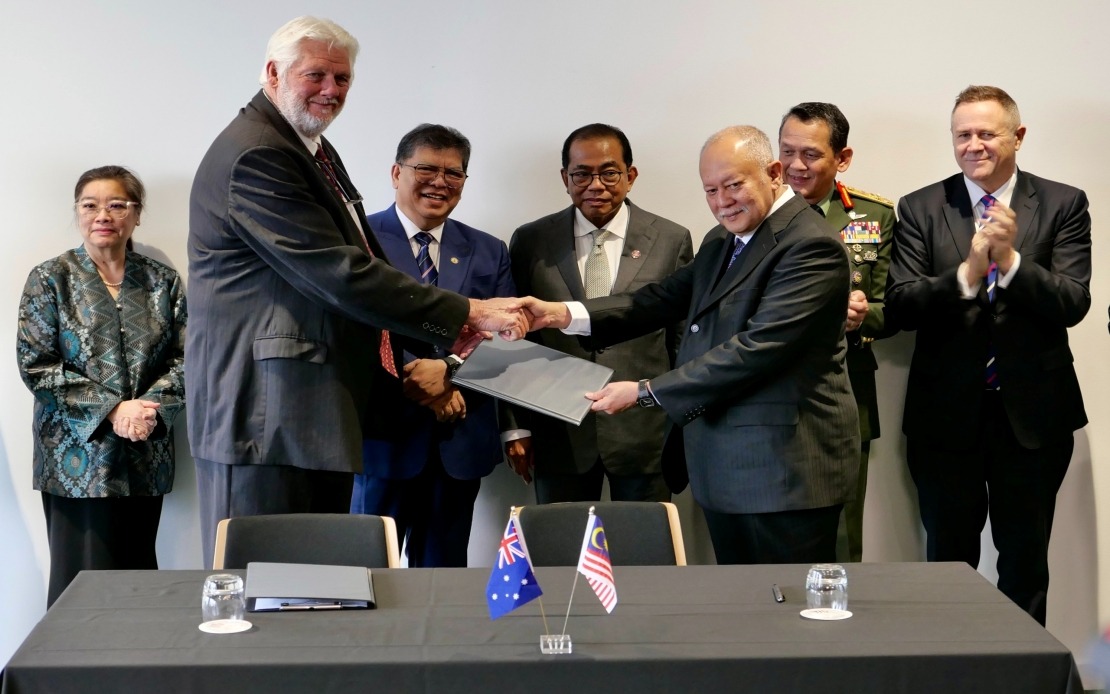
Malaysia's defence ambitions took a significant leap forward with the formalisation of a partnership between homegrown Weststar Defence Industries and Australian rocket technology firm Rocket Technologies International, marking a watershed moment in the nation's effort to develop indigenous missile and rocket capabilities. Defence Minister Datuk Seri Mohamed Khaled Nordin announced the collaboration on July 3, characterising it as a pivotal step toward building Malaysia's sovereign defence industrial base at a time when regional security dynamics are shifting and countries increasingly prioritise domestic manufacturing over foreign dependency.
The agreement carries particular weight within Malaysia's broader strategic framework. By establishing production facilities on Malaysian soil, Weststar will begin manufacturing rockets domestically within two years, with expansion into missile production to follow. This timeline reflects a deliberate acceleration of local capacity-building, moving beyond the research and conceptual phases that have historically characterised Malaysia's defence technology sector. The partnership directly supports the National Defence Industry Policy (DIPN), a government initiative designed to deepen Malaysia's technical expertise and reduce reliance on imports for critical defence systems.
Weststar Group founder and group managing director Tan Sri Dr Syed Azman Syed Ibrahim and RTI founder Allan James Payne formalised the arrangement during an official ceremony at the National Convention Centre in Canberra, where Mohamed Khaled was conducting a three-day working visit to Australia. The setting—at the heart of Australian political institutions—underscored the high-level diplomatic backing the collaboration commands, with the Australian government itself providing explicit support and approval for knowledge transfer and manufacturing arrangements.
Beyond immediate production capabilities, the partnership offers Malaysia entry into RTI's established international supply chain. This dimension proves particularly valuable for Malaysian defence contractors seeking to expand beyond domestic markets. By becoming part of a proven global ecosystem, local companies gain exposure to international standards, procurement processes, and partnership opportunities that would otherwise require years to develop independently. For small and medium-sized Malaysian defence enterprises, such access can prove transformative, opening revenue streams and technological learning that accelerate industrial maturation.
The Defence Minister emphasised that the investment would generate substantial economic returns while simultaneously strengthening the nation's long-term defence posture. This dual benefit—combining commercial viability with strategic security outcomes—appeals to policymakers seeking to justify defence spending in an era of fiscal constraints. Manufacturing capabilities in advanced rocket and missile technology represent high-value industrial activity, attracting skilled engineering talent and supporting the emergence of a knowledge-based defence sector beyond traditional shipbuilding and light manufacturing.
During his Australian sojourn, Mohamed Khaled led a delegation that included senior military and academic figures, reflecting the cross-institutional nature of modern defence development. The Royal Malaysian Air Force chief General Tan Sri Muhamad Norazlan Aris, Universiti Pertahanan Nasional Malaysia vice-chancellor Lt Gen Datuk Wira Arman Rumaizi Ahmad, and National Aerospace Industry Corporation Malaysia chief executive officer Prof Shamsul Kamar Abu Samah toured the Institute for Space, Defence and Advanced Technologies at the University of Southern Queensland. This visit revealed Australia's model of harnessing academic research for defence applications, a methodology Malaysia appears keen to replicate through similar university-industry partnerships.
The delegation examined advanced composite manufacturing and hypersonics laboratories developed in collaboration with defence contractors including RTI itself. Such exposure allows Malaysian officials and technologists to benchmark their own programmes against international standards and identify capability gaps requiring urgent attention. Composite materials and hypersonic technologies represent frontiers in contemporary defence science, and Malaysia's engagement with these fields suggests ambitions extending well beyond conventional rocket and missile systems.
Parallel to these technical discussions, Mohamed Khaled held meetings with Australian Deputy Prime Minister and Defence Minister Richard Marles, signalling the bilateral defence relationship's elevation beyond industrial cooperation into strategic partnership territory. These conversations centred on deepening defence ties and identifying new domains for cooperation, framing the Weststar-RTI deal within a broader architecture of Australia-Malaysia security collaboration. For Malaysia, such reinforced ties with a technologically advanced ally offer both immediate capacity-building opportunities and longer-term strategic alignment in an increasingly contested Indo-Pacific region.
Parliamentary engagement during the visit underscored the political commitment underpinning defence initiatives. Mohamed Khaled, alongside Dewan Rakyat Speaker Tan Sri Johari Abdul and Malaysia's High Commissioner to Australia Datin Paduka Sharrina Abdullah, received official welcome protocols at the Australian Parliament House and convened meetings with Speaker of the House of Representatives Milton Dick and other parliamentarians. Such parliamentary-to-parliamentary engagement establishes cross-party foundations for sustained cooperation, insulating defence partnerships from government transitions.
The strategic timing of this announcement merits consideration within broader regional contexts. Southeast Asia faces mounting pressure to strengthen indigenous defence capabilities amid geopolitical uncertainties involving major powers and maritime disputes. Malaysia's move to establish domestic rocket and missile manufacturing capabilities reflects a region-wide trend toward reducing technological dependence and building redundancy into critical defence systems. Countries increasingly recognise that military readiness during crises depends partly on supply chain resilience, making domestic production capacity a strategic imperative beyond mere industrial development.
For Malaysia specifically, the Weststar-RTI partnership addresses long-standing vulnerabilities in air defence and precision strike capabilities. Indigenous rocket and missile production enables customisation to Malaysian operational requirements and reduces vulnerabilities associated with foreign supply disruptions. It also positions Malaysia as a potential regional hub for advanced defence manufacturing, attracting investment and expertise that compounds competitive advantages over time.
The Defence Minister's characterisation of this investment as securing Malaysia's defence capability for future generations suggests thinking extending beyond immediate procurement needs. Building institutional knowledge, engineering capacity, and industrial infrastructure takes decades. By establishing production facilities and supply chain participation now, Malaysia invests in capabilities that will define its defence posture for multiple generations, creating path dependencies that favour continued sophistication and indigenous innovation rather than perpetual dependency on foreign suppliers.

