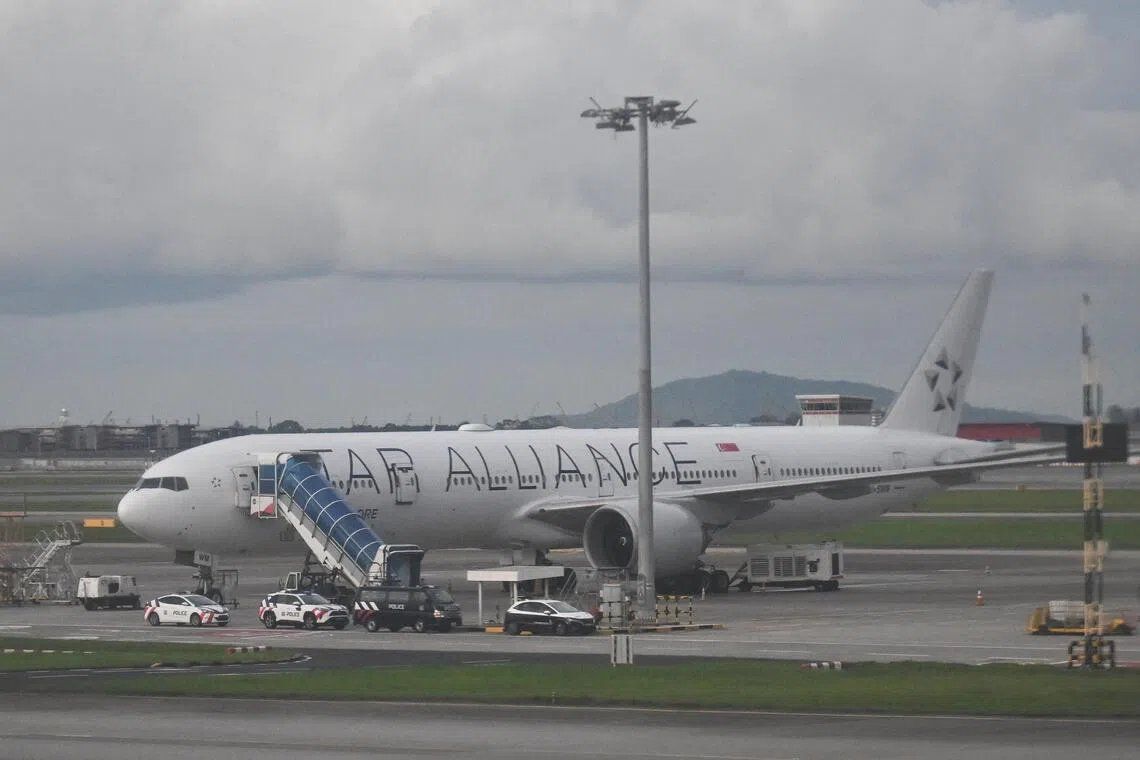
Linda Kitchen, 74, has taken legal action against Singapore Airlines at Britain's High Court, seeking compensation following a catastrophic turbulence event that claimed her husband's life and left her with severe spinal injuries. The incident, which occurred on Flight SQ321 travelling from London to Singapore on May 21, 2024, has become one of the most significant aviation safety cases in recent years, with multiple passengers and crew members filing separate legal claims against the carrier.
The flight experienced an abrupt atmospheric disturbance whilst traversing airspace over Myanmar during what should have been a routine breakfast service. In the span of just five seconds, the Boeing 777-300ER aircraft descended more than 54 metres, a dramatic plunge that sent passengers, crew members, and cabin equipment tumbling throughout the cabin. Geoffrey Kitchen, who had been married to Linda for 52 years, suffered a fatal heart attack during this violent motion. The couple had embarked on an ambitious six-week holiday visiting Singapore, Indonesia, and Australia when tragedy struck.
During the dramatic descent, Geoffrey fell directly onto his wife, crushing her against the armrest with considerable force. Fellow passengers and crew members subsequently helped move him, and a medical doctor travelling on board immediately initiated cardiopulmonary resuscitation. Despite these efforts, Geoffrey could not be saved. The aircraft, carrying 211 passengers and 18 crew members, was immediately diverted to Bangkok's Suvarnabhumi Airport for an emergency landing. The incident ultimately left 79 people requiring medical treatment for injuries ranging from minor to life-altering.
Linda endured a harrowing ordeal following the emergency landing. She was hospitalised in Thailand for ten days before being airlifted back to Bristol in the United Kingdom. The emotional devastation compounded her physical suffering when she learned of Geoffrey's death two days after the incident. "When I got separated from Geoff, I knew he was in a bad way, but nothing prepared me for hearing he had died. It was absolutely devastating," she recalled in statements to British media outlets. The recovery process proved equally challenging, requiring her to spend an additional week in a UK hospital upon repatriation, followed by months of intensive home-based care assistance.
Anthe Korelidou, the aviation specialist lawyer representing Kitchen's interests, emphasised that the legal action serves a broader purpose beyond financial compensation. "While it's more than two years since Geoff's death, Linda and the rest of her family continue to have a number of questions and concerns about what happened and if more could have been done to prevent their injuries," Korelidou stated. The High Court proceedings represent a critical procedural step in pursuing comprehensive investigations and obtaining answers that have eluded the family. Legal papers filed with the court reveal two distinct claims: one on behalf of Linda Kitchen personally, and another filed in her name representing Geoffrey Kitchen's estate.
The lawsuit filed by the Kitchen family is part of a broader wave of legal action against Singapore Airlines. Court records indicate that additional passengers, including Bradley Richards, Jack Jenkins, Hannah Fullerton, Andrew Dawood, Bryan Matthews, and the couples Pauline and Michael Rainey, have similarly initiated legal proceedings against the airline. This coordinated legal response reflects widespread dissatisfaction among affected passengers regarding both the incident itself and the airline's response mechanisms.
Singapore Airlines has maintained a cautious stance regarding the litigation. When contacted by The Straits Times on August 29, the airline declined to comment on matters currently before the courts, a standard legal posture when facing active litigation. However, the airline has previously extended compensation offers to affected passengers. Those who sustained minor injuries received offers of US$10,000, whilst passengers suffering serious injuries requiring ongoing medical intervention were offered advance payments of US$25,000. Additionally, SIA committed to providing full refunds of airfares to all passengers aboard the flight and issued a formal apology stating that "the safety and well-being of SIA's passengers and staff are our top priority."
Official investigation findings have shed partial light on the catastrophic sequence of events. Singapore's Transport Safety Investigation Bureau determined that the storm clouds responsible for the severe turbulence escaped detection by the aircraft's onboard weather radar, thereby catching the flight's captain entirely unaware. This radar failure represents a critical safety gap, as modern aviation safety protocols rely substantially on advanced meteorological detection systems to enable pilots to navigate around hazardous weather formations. However, the TSIB investigation remains inconclusive regarding whether the radar system itself suffered technical malfunction or whether the particular atmospheric conditions simply overwhelmed the equipment's detection capabilities.
The unresolved questions surrounding the weather radar's performance have raised significant concerns within the aviation safety community and among affected passengers. The fact that advanced detection systems failed to identify a weather system severe enough to cause such dramatic aircraft movement underscores potential vulnerabilities in current safety protocols. For Malaysian and regional aviation stakeholders, the incident serves as a sobering reminder of the unpredictable nature of severe atmospheric disturbances and the limitations of existing safety infrastructure, even on modern commercial aircraft operated by well-established carriers.
The Linda Kitchen case has broader implications for aviation liability and passenger protection across Southeast Asia. As the airline industry in the region continues to expand, with increased flight volumes and route expansions, this litigation may establish important legal precedents regarding airline responsibility for weather-related incidents. The case also highlights the long-term financial and emotional toll such incidents impose on survivors and bereaved families, demonstrating that compensation settlements, whilst necessary, cannot fully address the profound personal consequences of aviation disasters.
For Singapore Airlines and regional carriers, the accumulated legal actions serve as a catalyst for enhanced safety reviews and operational procedures. The incident has prompted broader industry examination of weather radar capabilities, pilot training protocols for extreme turbulence scenarios, and cabin safety procedures. The extensive litigation also underscores the importance of transparent communication with affected passengers and prompt, adequate compensation mechanisms that recognise the severity of injuries sustained.
As the legal proceedings advance through Britain's High Court system, the outcome will likely influence how regional airlines approach safety investments and liability frameworks. Linda Kitchen's determination to pursue comprehensive investigations and obtain answers reflects a wider passenger expectation that airlines must go beyond standard compensation to ensure such incidents are thoroughly examined and lessons are rigorously implemented. The case demonstrates that even routine international flights carry inherent risks that passengers and airlines must both acknowledge and actively work to mitigate through continuous safety improvement and transparent accountability measures.

