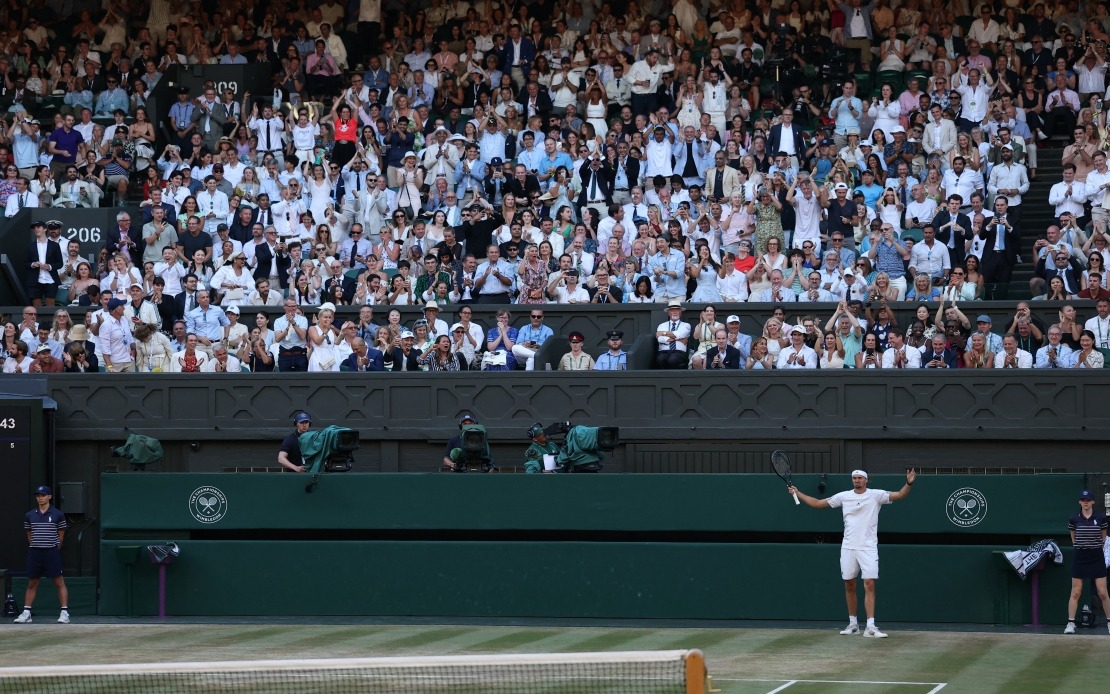
The 2026 Wimbledon Championships delivered its share of unforgettable moments, with Jannik Sinner's four-set triumph over Alexander Zverev in the men's singles final providing the ideal climax to a fortnight brimming with compelling narratives. Yet the tournament's greatest drama extended far beyond Centre Court, with several matches capturing the essence of what makes grass-court tennis at the All England Club so captivating for global audiences.
Marketa Noskova's women's singles victory carried particular emotional resonance, not merely because she claimed a maiden Grand Slam title at 21 but because her journey to that achievement mirrored one of Wimbledon's most poignant historical moments. The Czech champion's path to glory required her to overcome devastating adversity in the final itself, squandering five championship points during a catastrophic second-set collapse before ultimately prevailing in a decisive final set. That collapse inevitably recalled the memory of Jana Novotna, another former Czech champion whose 1993 final loss to Steffi Graf left the tennis world with one of sport's most enduring images: Novotna weeping on the shoulder of the Duchess of Kent after surrendering what appeared an insurmountable advantage. Where Novotna required five additional years before capturing her own Wimbledon crown in 1998, Noskova's resilience paid immediate dividends, and her determination during that bathroom break—reportedly passing the trophies while vowing to claim the larger one—spoke to a psychological fortitude that eventually secured her place among Wimbledon's champions.
The tournament's most unexpected hero proved to be British wild card Jack Fery, whose improbable semi-final run captivated the SW19 faithful and provided rare cause for celebration among home supporters in an otherwise disappointing competition for British tennis. The 23-year-old Wimbledon resident, ranked 114th in the world, achieved what seemed nearly impossible when he overcame Belgian Zizou Bergs in a thrilling quarter-final contested under brutal conditions on the exposed Court 18. Fery's victory came after he had trailed 4-1 in both the fourth and fifth sets while battling three nosebleeds in sweltering heat, yet somehow summoned the mental reserves to level the match through a tie-break before maintaining his composure in a tense 10-point decider as his higher-ranked opponent wilted under pressure. That triumph secured Fery's place as only the fifth British male this century to reach the second week at Wimbledon, a statistical reminder of how challenging the modern game has become for home competitors.
Novak Djokovic's extraordinary quarter-final against Felix Auger-Aliassime, while ultimately successful for the Serbian, exemplified both the 39-year-old's enduring competitive spirit and the physical toll extracted by elite grass-court tennis. The match consumed five hours and fifteen minutes—the longest quarter-final in Wimbledon history—and finished a mere eight minutes before the 11pm curfew, leaving little margin for error. Djokovic's performance was characterized by the familiar drama that has long attended his appearances: an injury concern affecting his calf at the end of the opening set, a heated altercation with tournament referee Denise Parnell regarding roof closure before the third set, and ultimately the physical exhaustion visible as his reserves depleted. Though the 24-time Grand Slam champion progressed past the third seed, his semi-final exit to Jannik Sinner suggested that even Djokovic's legendary endurance has limits in the modern era.
Coco Gauff's semi-final encounter with Karolina Muchova distilled an entire match into a single, extraordinary tie-break that stretched eighteen pulsating minutes and produced multiple match points for both contestants. The deciding tie-break encapsulated the volatility and precision demands of elite women's tennis, with opportunities emerging and evaporating in rapid succession. At eight points apiece, a time violation against Muchova followed by an errant forehand handed Gauff her first match point, yet the American inexplicably netted what should have been a straightforward drop-shot winner. Muchova subsequently fashioned her own match point only to slip dramatically mid-volley, allowing Gauff's cross-court forehand to escape punishment. When Muchova received another opportunity, the Czech ninth seed executed flawlessly, moving her 22-year-old opponent around the court before Gauff's tired forehand capitulated into the net. Such compressed drama—containing multiple momentum shifts within minutes—illustrated why Wimbledon matches achieve almost mythic status in tennis folklore.
Serena Williams's return to competitive tennis at age 44, nearly four years after her gradual transition away from professional play, generated the tournament's most compelling human-interest narrative and drew unprecedented attention to the opening week's proceedings. The American legend's appearance on Centre Court as a wild card entry generated an immediate standing ovation, and her early break against 24-year-old Australian Destanee Aiava suggested a fairytale conclusion might unfold. However, a knee injury sustained late in the opening set fundamentally altered the trajectory of the match, and Williams's subsequent fading performance highlighted the considerable physical demands that even the greatest champions face when returning after extended absence. The injury additionally precluded her from a doubles reunion with sister Venus, representing another small disappointment in what remained nonetheless a triumphant return to the sport she has dominated throughout her career. For Malaysian and Southeast Asian tennis enthusiasts, Williams's comeback demonstrated that the sport's biggest stages continue to celebrate not merely youth and contemporary dominance but also historical significance and the enduring appeal of legendary figures.
Together, these five matches established the narrative tapestry of Wimbledon 2026, weaving together storylines of redemption, breakthrough performances, athletic resilience, and the inevitable passage of time. Each match offered distinct emotional and technical dimensions: Noskova's mental recovery after adversity, Fery's improbable ascent from obscurity to semi-finalist status, Djokovic's defiant refusal to fade gracefully despite advancing years, Gauff and Muchova's microsecond-level fluctuations of fortune, and Williams's symbolic return to the sport. For the global tennis audience, particularly viewers in Malaysia and across Southeast Asia who have increasingly embraced the sport, these narratives demonstrated why Wimbledon retains unparalleled cultural and sporting significance within professional tennis despite the emergence of new champions and the shifting dynamics of the modern game.

