The All England Club's manicured lawns and centuries-old customs have come to define Wimbledon, yet beneath the tournament's elaborate ceremony and strict dress codes lies a rawer, more primal contest that mirrors the intensity of any major sporting event. While the 149-year-old Grand Slam maintains its reputation as sport's most tradition-bound competition—with players confined to all-white attire, strawberries and cream defining the spectator experience, and royal patronage as standard—the actual tennis being played reveals a desperately competitive arena where the world's best athletes push themselves to the edge.
This year's tournament, spread across some 675 matches in all categories, presented a fascinating study in contrasts that speaks to broader questions about how sport is perceived and presented in the modern world. Even as the FIFA World Cup unfolded simultaneously with Wimbledon, the two events offered starkly different visual languages. Where one embraced contemporary spectacle and global entertainment, the other clung deliberately to understated elegance and Edwardian propriety. Yet the underlying human drama—the desperation to succeed, the fear of failure, the ecstasy of victory—proved remarkably similar across both competitions.
Photographic documentation from the tournament reveals this contradiction vividly through moments of unguarded intensity that shatter the tournament's genteel facade. These images capture the true soul of Wimbledon not in its pageantry but in fleeting instances where competitors' emotions overwhelm the carefully maintained decorum. The contrast between what spectators expect Wimbledon to be and what actually transpires on court becomes the tournament's most compelling narrative.
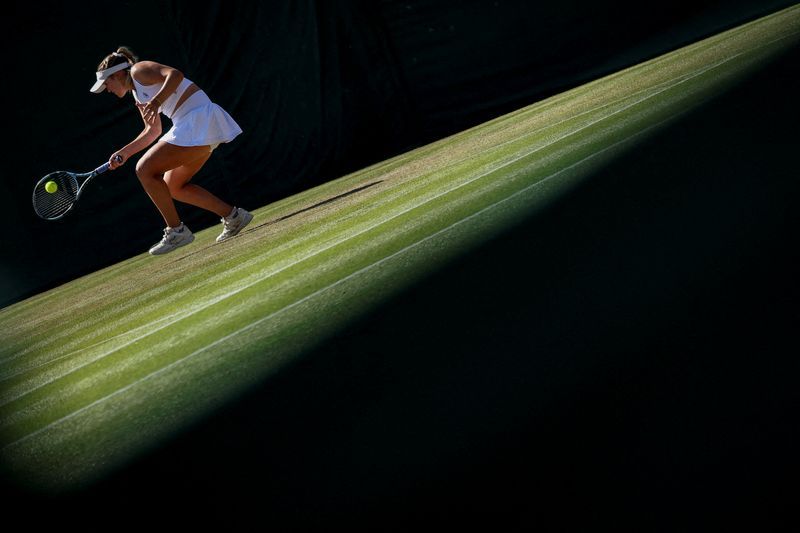
One particularly striking example emerged when Philippine player Alexandra Eala fell while attempting a forehand return against Poland's third-seeded Iga Swiatek, a six-time Grand Slam champion. In that moment, Eala's gritted teeth and earthbound position told the story of a young player's desperate struggle against overwhelming odds. For the 21-year-old, competing against one of tennis's elite represented the kind of test that defines athletic careers. Photographer Toby Melville, who had anticipated capturing a triumphant celebration, instead caught something far more compelling: genuine competitive agony frozen in time, a landscape of human determination compressed into a single frame.
The tournament's emotional landscape extends beyond dramatic falls and failures. Otto Virtanen's first-round victory, fought hard against determined opposition, produced its own moment of raw vulnerability. Walking to the courtside barrier during a pulse of frustration, Virtanen's body language suggested a desire to escape the mounting pressure, his silhouette against the green canvas embodying the psychological burden that accompanies elite-level competition. These moments reveal how Wimbledon's tranquil exterior actually contains considerable internal turbulence for participants.
Yet triumph finds expression with equal clarity in the tournament's photography. Naomi Osaka's appearance on Centre Court, dressed in a kimono-inspired design that reflected both personal style and cultural significance, captured the fearlessness with which the two-time Grand Slam champion approached her campaign. Her eventual progression to the quarter-finals marked a significant return to form, and her composed stride across the court's hallowed turf conveyed the confidence of a player operating at the peak of her capabilities.
The interplay between light and shadow across the grounds adds another dimensional layer to understanding the competition. Jannik Sinner's championship-winning performance against Alexander Zverev in the men's final produced an arresting image of athletic extremity: the Italian stretching impossibly far to return a forehand, his elongated shadow appearing to extend his reach beyond physical possibility. This visual metaphor—of competitors literally reaching beyond themselves—encapsulates the transcendent quality that makes Wimbledon capture imaginations across the sporting world.
Similarly, a photograph of women's doubles champions Guo Hanyu and Kristina Mladenovic embracing in celebration cast shadows that produced an optical illusion, with one silhouette appearing to raise a fist in triumph. These visual coincidences, entirely unplanned yet somehow perfectly capturing competitive spirit, underscore how Wimbledon's drama operates simultaneously at multiple levels of perception and interpretation.
The physical toll on the venue itself provides perhaps the most eloquent testimony to the intensity concealed beneath tradition's veneer. Centre Court's grass courts, famously maintained with meticulous care throughout the year, bear visible scars after two weeks of elite competition. Time-lapse photography capturing the passage of countless players' feet across the same turf reveals wear patterns that map the tournament's human geography—thousands of explosive movements, defensive sprints, and triumphant strides leaving their mark on grass that must be resurrected before next year's competition.
For Malaysian and Southeast Asian readers, Wimbledon's competitive intensity carries particular resonance given the region's growing tennis prominence and the occasional appearance of regional players competing at Grand Slam level. The tournament's insistence on preserving tradition while hosting uncompromising athletic competition offers a model applicable to how Asian sporting institutions might balance heritage with contemporary excellence. The visual documentation of genuine human struggle against elite opposition demonstrates that Wimbledon's appeal transcends its ceremonial elements, rooted ultimately in universal themes of ambition, perseverance, and the eternal human drive to excel.
As the tournament concludes and its courts stand temporarily empty, the physical evidence of two weeks' intense competition remains visible in every patch of worn grass, every divot, and every thread stressed to its limit. This tangible record of human effort, captured through photography and visible in the landscape itself, represents Wimbledon's true legacy—not the strawberries and cream or the royal appearances, but rather the transcendent moments when elite athletes confront their limitations and occasionally surpass them under sport's oldest and most prestigious spotlight.

