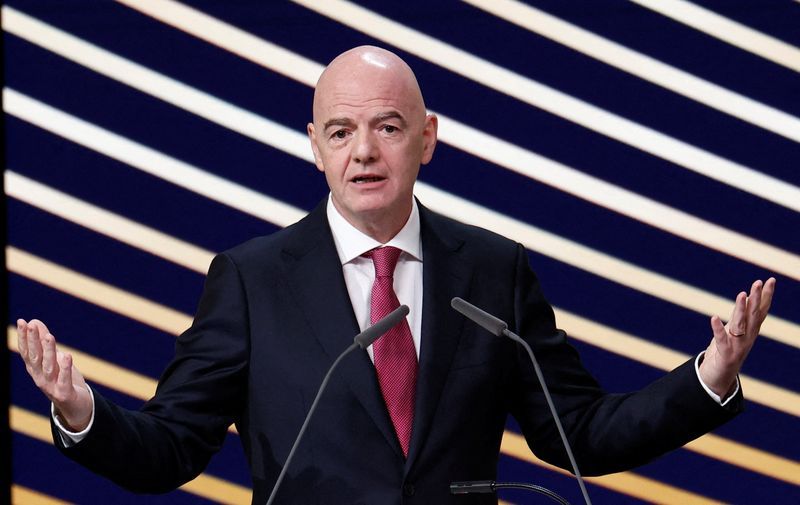
The gravest political crisis of Gianni Infantino's decade as FIFA President has found its most vocal critics in an unlikely place: two women who sit on UEFA's executive committee. Laura McAllister of Wales and Lise Klaveness of Norway have positioned themselves at the forefront of the revolt against the FIFA chief, whose ambitious plan to establish a private equity-backed venture called FIFA Football Enterprises (FFE) crumbled under fierce resistance from European football bodies and regional confederations worldwide. Their prominence in this standoff has ignited a broader conversation about whether football's historically male-dominated leadership structure might finally be ready to embrace a woman at the helm of the global game.
McAllister, who holds the position of UEFA vice-president, has articulated both optimism and caution about the prospect of female leadership in football. When asked whether a woman could eventually lead FIFA, she acknowledged the idealistic appeal of such a development whilst tempering expectations with hard political reality. She emphasised that merit alone would not be sufficient to break through the entrenched power structures within international football governance. The political economy of FIFA's 211 member associations, spread across continents with vastly different cultural and institutional contexts, presents formidable obstacles to any candidate, regardless of gender. McAllister's assessment reflects a seasoned understanding that football's highest office remains bound by complex geopolitical calculations rather than purely meritocratic principles.
The timing of this governance debate gained additional weight when Sepp Blatter, Infantino's predecessor, publicly endorsed the case for female FIFA leadership specifically through praise of Klaveness. That intervention by one of football's most influential historical figures lent legitimacy to discussions that might otherwise have been dismissed as tangential to the immediate crisis. Yet McAllister cautioned against reading too much optimism into such statements, pointing out that genuine structural change in football governance would require far deeper shifts than symbolic gestures from prominent figures. She stressed that football as an institution has significant catching up to do compared to broader societal expectations around gender equality and inclusive leadership.
The collapse of the FFE initiative represents the most serious challenge to Infantino's authority since his election to the presidency. The scheme, designed to monetise global football through private capital investment, encountered overwhelming opposition from UEFA and other regional confederations. Wales became the first national association to withdraw its endorsement of Infantino's re-election bid, a defection that signalled the beginning of broader dissent within FIFA's own institutional machinery. The speed with which opposition consolidated underscores how thoroughly the FFE proposal alienated stakeholders across football's governance hierarchy, forcing Infantino to convene an emergency meeting in Morocco to address the escalating crisis.
McAllister's proposal to organise a UEFA boycott of FIFA events garnered unanimous backing during an emergency session of UEFA's decision-making bodies, demonstrating the unprecedented solidarity mobilised against Infantino's initiatives. This institutional backing proved decisive in translating individual criticism into collective action that imposed real costs on the FIFA President's political position. Yet McAllister frames this confrontation not merely as a personality-driven conflict but as symptomatic of deeper, systemic governance failures that have accumulated throughout Infantino's tenure. The turmoil reflects what she characterises as a crisis point in FIFA's institutional integrity, marked by a series of controversial decisions that have progressively eroded confidence in his leadership.
The catalogue of governance controversies that McAllister invokes extends far beyond the FFE debacle. FIFA's involvement with the failed European Super League project, the political dimensions surrounding recent World Cup hosting decisions, and the internationally reported incident involving American striker Folarin Balogun all represent instances where FIFA's decision-making appeared compromised by factors unrelated to sporting merit or established regulations. Most strikingly, FIFA's decision to rescind a red card after intervention from former U.S. President Donald Trump set a precedent suggesting that external political pressure could influence the governance body's core functions. Each of these episodes contributed to a cumulative credibility deficit that Infantino struggled to address, providing context for why opposition to his leadership crystallised so rapidly.
McAllister and Klaveness bring distinctive perspectives shaped by their professional experiences within women's football before ascending to governance positions. Both served as international players for their respective countries before establishing separate professional careers in fields emphasising rigorous analysis and adherence to established principles. McAllister's background as a political scientist informs her systems-level critique of FIFA's institutional failures, whilst Klaveness's training in law provides analytical tools for evaluating compliance with governance standards. Their argument that women's football backgrounds have cultivated a values-driven orientation toward the sport offers a counter-narrative to the business-focused mentality that has dominated FIFA's strategic direction. This framing suggests that women's historical marginalisation from football's power structures may have inadvertently protected them from the institutional cultures and financial incentives that contributed to FIFA's governance deterioration.
The fundamental objection that McAllister articulates extends beyond resistance to any particular Infantino initiative. Rather, she expresses alarm at what she identifies as football's loss of its essential character and purpose through encroaching commercialisation and political interference. Her vision of football as a game belonging equally to grassroots and elite participation, to girls and boys, to wealthy and poorest nations, represents an implicit critique of FIFA's trajectory toward privatisation and capital accumulation. The proposal to introduce private equity backing into football's governance structures struck her and Klaveness as fundamentally contradictory to the inclusive, universalist principles that should define a genuinely global sport. This values-based opposition transforms their challenge to Infantino from a governance dispute into a conflict about football's social purpose and integrity.
The statistical reality of women's leadership in international football bodies underscores just how substantial the barriers remain. Among FIFA's 211 member associations, only ten are presided over by female presidents, a proportion that translates to less than five percent representation at the national confederation level. Klaveness stands as one of these rare exceptions, lending her challenge to Infantino additional symbolic weight whilst also highlighting the exceptional nature of her position. The absence of women from the vast majority of decision-making seats across football's institutional architecture means that any female candidate for FIFA's presidency would necessarily emerge from an extraordinarily small pool of experienced administrators, all competing for support from a membership base that has historically skewed male across nearly every affiliate body.
McAllister approaches the question of advancing female leadership with deliberate gradualism, explicitly rejecting the notion that forcing rapid institutional change represents the optimal strategy. Her preference for building momentum incrementally, what she describes as a "softly softly" approach, reflects confidence that sustained effort and demonstrated competence will eventually overcome entrenched resistance. This perspective stands in tension with more impatient critiques of football's glacial progress on gender equity, yet McAllister argues that patience serves the longer-term objective of normalising female leadership so thoroughly that gender becomes irrelevant to selection criteria. The current governance crisis provides an opportunity to establish women's voices as essential to institutional accountability and sound decision-making, rather than as representatives of a particular ideological position on gender representation.
Comparative analysis with other major international sports organisations reveals just how substantially FIFA has lagged behind institutional innovation elsewhere. The International Olympic Committee's recent appointment of Kirsty Coventry as its leader followed decades of strategic commitment to gender equity across Olympic programming and governance structures. The IOC has advanced women's competitive participation to parity levels and embedded female representation throughout its decision-making bodies, creating a governance culture where female leadership emerges as an organic expression of institutional values rather than as a contested innovation. Football's World Cup competition, by contrast, remains characterised by profound inequality between men's and women's tournaments in terms of prize distributions, investment levels, and global visibility. This structural inequality reflects and perpetuates the male dominance of football's governing institutions, creating feedback loops that make female advancement at the presidential level seem incongruent with the sport's actual operation.
The intersection of the immediate governance crisis and longer-term questions about female leadership creates an unusual historical moment for international football. The FFE collapse has mobilised resistance that extends across football's institutional landscape, demonstrating that alternatives to Infantino's leadership are politically feasible. The prominent role of McAllister and Klaveness in orchestrating this resistance has established women's voices as indispensable to credible football governance, potentially shifting expectations about which competencies and perspectives FIFA's membership regards as essential to institutional leadership. Whether this moment catalyses genuine structural change toward female leadership or proves merely a temporary reassertion of male-dominated institutional control will depend substantially on whether the emerging opposition to Infantino can consolidate around alternative visions of FIFA's purpose and governance rather than splintering once the immediate crisis subsides.

