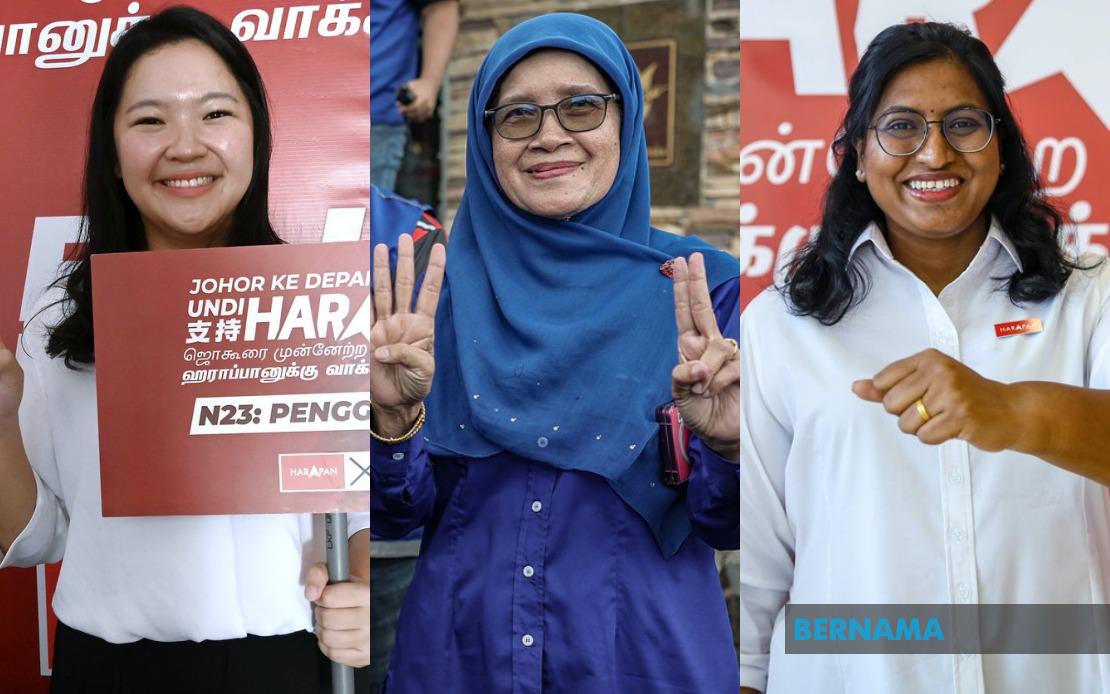
The 16th Johor State Election has underscored an expanding role for women in the state's political arena, with ten female candidates successfully securing legislative seats despite representing less than a fifth of the overall candidate pool. This outcome reflects both progress and persistent challenges in gender representation within Malaysia's electoral landscape, where women comprised approximately 20 per cent of the 172 candidates who contested across the state's 56 constituencies.
Barisan Nasional demonstrated particular strength among its female representatives, with seven women winning seats under the coalition's banner. Nadhirah Afiqah Abdull Rahim's victory in Serom proved especially noteworthy as the Ledang Puteri UMNO chief made her electoral debut, capturing the constituency with a commanding majority of 9,406 votes against opponents from Perikatan Nasional and Pakatan Harapan. This result signals that newly entered female candidates can translate organizational support into decisive electoral performance, a pattern that may encourage further recruitment of women into formal candidacies across major political parties.
Among the BN cohort, Nor Rashidah Ramli's triumph in Parit Raja illustrated expanding electoral confidence in women leaders within the coalition. Her winning margin of 13,576 votes represented a tripling of the constituency's majority compared to the 2022 state election, suggesting a genuine shift in voter preference rather than mere incumbency advantage. Similarly, Alwiyah Talib's retention of Endau for a third consecutive term demonstrated that women candidates can build sustained electoral franchises when given opportunity and party support. The three-way contest that produced her 3,041-vote victory included challengers from Perikatan Nasional, the Malaysian Orang Asli Party, and Pakatan Harapan, indicating that her appeal transcends a single opponent scenario.
Norlizah Noh's decisive performance in Johor Lama, where she secured a 16,344-vote majority against both Perikatan Nasional and Pakatan Harapan candidates, cemented the pattern of dominant victories for BN's female candidates in this election cycle. The significance deepened when considering that one opponent fielded by Pakatan Harapan was Danish Hossman Abd Rahman, described as the election's youngest candidate, yet the experienced incumbent still achieved a landslide result. Fauziah Misri's 15,776-vote majority in Penawar further demonstrated that female BN candidates are not merely competitive but can dominate contests featuring multiple opponents vying for voter support.
Chan San San's upset victory in Johor Jaya marked perhaps the most surprising result among female candidates, as her 35,971 votes successfully wrested the constituency from Pakatan Harapan and their traditional Democratic Action Party base. This traditionally DAP-stronghold seat's loss to a female BN representative suggests that factional shifts and incumbent performance matter more than historical party dominance, a lesson potentially significant for election planning in subsequent contests. Hasrunizah Hassan's successful defense of Pulai Sebatang, achieved with a 13,590-vote majority that improved by 6,325 votes compared to 2022, further substantiated that women candidates under BN's banner experienced not merely retention but expansion of their electoral support.
Pakatan Harapan's three victorious female candidates demonstrated that opposition coalition politics continue to support female candidacy, though with notably smaller winning margins than their BN counterparts. Felicia Poh Rui Ling, at just 28 years old, recorded her maiden victory in Penggaram with a 4,137-vote majority in a direct contest against her Barisan Nasional opponent, suggesting that youth combined with party organization can overcome experienced challengers. Her success also indicates that Pakatan Harapan perceives young female candidates as strategically viable, a development that may influence candidate selection across the coalition's component parties.
Chu Poh Yee's retention of Mengkibol with a 4,213-vote majority represents continuity for Pakatan Harapan in this constituency, though the closer margin compared to some BN victories suggests the seat remains competitive. Kartiyaini Jeyapalan's performance in Skudai proved more impressive, with the lawyer-turned-legislator securing a 15,280-vote majority in a four-way contest featuring opponents from Barisan Nasional, Parti Bersama Malaysia, and Parti Sosialis Malaysia. Her substantial margin in a crowded field demonstrates that professional credentials and sustained constituency engagement can translate into robust electoral performance even when opposition candidates multiply.
The overall gender composition of candidates reflects persistent structural barriers to female political participation at the electoral level. While ten women won seats, the fact that 34 female candidates contested against 138 male counterparts means women represented a relatively modest proportion of the overall field. This disparity suggests that party nomination processes, candidate recruitment mechanisms, and organizational gatekeeping continue to disadvantage women seeking electoral opportunity. Malaysia's political landscape has yet to achieve meaningful parity in candidate selection, despite growing evidence that female candidates perform competitively when actually fielded.
The geographical distribution of winning female candidates warrants consideration. Barisan Nasional's seven successes were geographically dispersed across the state, encompassing constituencies from Serom in the north to Pulai Sebatang in metropolitan areas, suggesting that female representation under the coalition is increasingly normalized across diverse electoral contexts. Pakatan Harapan's three winning female candidates occupied more concentrated geographical space, raising questions about whether opposition coalitions maintain female candidacy primarily in specific stronghold constituencies rather than pursuing broader representational distribution.
These results must be contextualized within the broader Johor election outcome, where Barisan Nasional achieved overwhelming dominance by winning 48 of 56 seats while Pakatan Harapan secured the remaining eight. The coalition's landslide creates an environment where BN's female representatives will likely exercise greater legislative influence and visibility, potentially shaping public perception of women's political role in the state. The concentration of female success within the dominant coalition may inadvertently reinforce perceptions that women candidates perform better under establishment party structures, though alternative explanations involving greater resource allocation and candidate support cannot be excluded.
For Malaysian observers and regional analysts, these patterns suggest that women's electoral advancement remains contingent upon major party commitment to candidate recruitment and resource allocation rather than reflecting fundamental voter resistance to female leadership. The decisive victories achieved by numerous female candidates, particularly those winning by margins exceeding 13,000 votes, demonstrate that gender-based voter discrimination appears minimal in contemporary Johor politics. Rather, persistent challenges stem from nomination processes and strategic decisions by party leadership regarding candidate selection, resource distribution, and campaign support allocation.
Looking forward, the Johor results provide data suggesting that political parties potentially underutilize female candidates by restricting their recruitment and nomination rates. The performance differential between the ten winning female candidates and their male counterparts does not reveal systematic underperformance based on gender. Instead, the pattern indicates that when parties select and support female candidates competitively, electoral outcomes align with broader party performance trends. This observation carries implications for gender equality advocacy within Malaysian politics, suggesting that arguments focused on candidate capability rather than voter acceptance may prove most persuasive in driving increased female representation in future electoral cycles.

