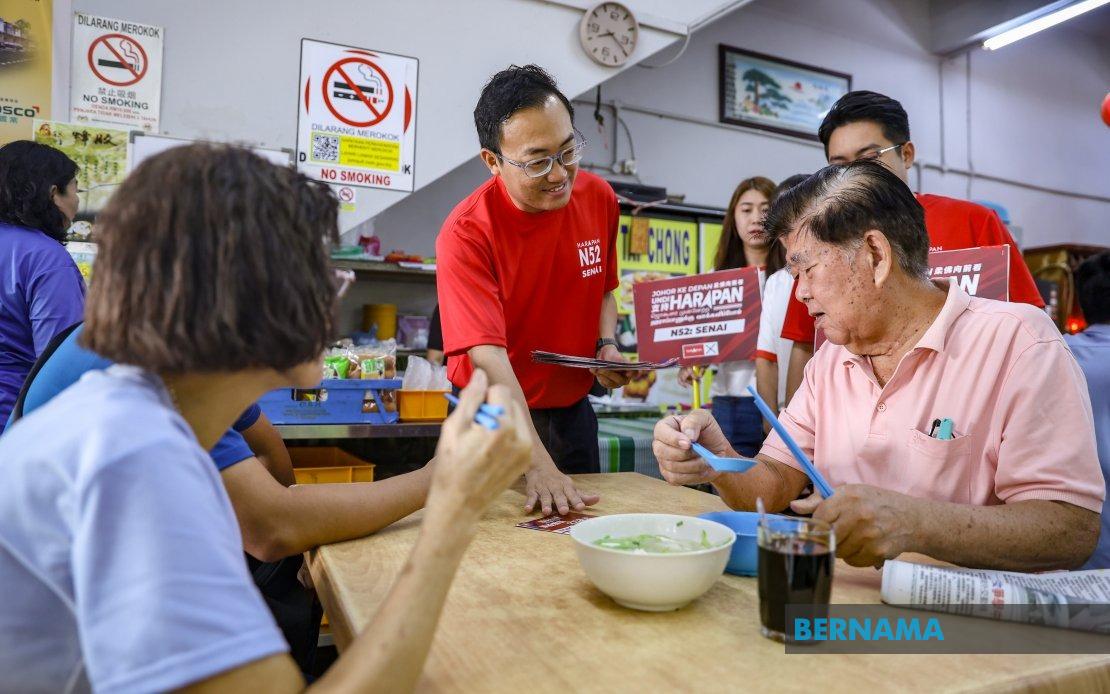
Wong Bor Yang, the incumbent assemblyman for Senai, is confident that Pakatan Harapan will hold onto the state seat during the 16th Johor state election scheduled for July 11. The former journalist is framing his re-election campaign around what he characterizes as tangible accomplishments from his previous term, particularly his efforts to address the constituency's recurring flood problems and boost community facilities.
Wong's political journey reflects the complex landscape of Malaysian politics over the past decade. Since 2014, he has navigated multiple political configurations—beginning as a special officer in the Kulai Member of Parliament's office, serving as a local councillor from 2018, and eventually securing the Senai state assembly mandate. This varied experience has shaped his approach to leadership, he argues, making him less ideologically rigid and more pragmatically focused on solving constituent problems rather than pursuing partisan agendas.
The Senai assemblyman points to his persistent campaign against chronic flooding as evidence of his effectiveness. Although he was serving in opposition during his previous term, Wong says he leveraged assembly debates and formal petitions to pressure relevant government agencies into approving flood mitigation projects. His breakthrough came when the state government approved RM1 million to upgrade the drainage system in Taman Aman, channeling stormwater into Sungai Skudai. In partnership with Kulai MP Teo Nie Ching, he also secured an additional RM3 million for drainage upgrades in Peladang Kulai Besar and Saleng, successfully removing both areas from the district's list of flash flood hotspots.
Beyond infrastructure, Wong has positioned himself as a custodian of Senai's heritage. The constituency possesses more than a century of historical significance, which Wong has attempted to activate through community projects. A defunct cinema was converted into a community operations centre, while a two-decade-old badminton court was upgraded into a recreational facility called Tiny Lake as part of the government's Sejati MADANI programme. These initiatives reflect an understanding that voters increasingly value quality-of-life improvements alongside basic services.
Healthcare emerges as the central plank of Wong's platform for a potential second term. With a background in journalism from Shih Hsin University in Taiwan, he brings an outsider's perspective to public administration. Wong argues that Kulai Hospital's current capacity of 93 beds is severely inadequate for a district projected to house 500,000 residents by 2030. This demographic expansion, driven by urban development and industrial growth in the Johor southern corridor, will place unprecedented strain on medical services unless capacity is expanded now.
A specific healthcare grievance illustrates Wong's administrative approach. The planned construction of a new health clinic in Taman Mewah, Senai, has been delayed by land-related bureaucratic obstacles at the state level. Wong has committed to prioritizing the resolution of these procedural bottlenecks in his next term, arguing that the Health Ministry cannot proceed with construction until state-level property issues are cleared. This focus on removing administrative friction represents a subtle but important political positioning—not radical reform, but competent problem-solving within existing frameworks.
The Senai constituency presents a battleground that reflects broader Johor political dynamics. With 66,635 registered voters, the seat is contested by Wong representing Pakatan Harapan, Tai Chee Chee from Barisan Nasional, and Tew Chien How from Bersama. The three-way contest introduces unpredictability, as vote distribution across three significant candidates could produce unexpected outcomes. Wong's strategy of emphasizing proven performance is designed to appeal to pragmatic voters who may be fatigued by ideological messaging.
Wong's framing of his experience as spanning Malaysia's distinct political eras carries implicit messaging about adaptability. The journey from opposition politics during the Najib years, through the Pakatan Harapan government, and into the current configuration demonstrates an ability to remain effective across different political dispensations. For voters concerned about disruption or radical change, this narrative suggests stability and continuity. Conversely, critics might interpret it as political flexibility bordering on opportunism.
The timing of the election poses particular significance for Johor's political trajectory. The state has emerged as increasingly important in national politics following the 2022 general election, with Johor's status as a kingmaker state amplified by its large electorate and diverse demographics. Individual seats like Senai, though seemingly local, contribute to broader state-level outcomes that have national implications for coalition stability and government formation.
Wong's invocation of the "politically mature and dynamic Bangsa Johor electorate" reflects an attempt to reframe the election around performance metrics rather than party loyalty or ideological positioning. By suggesting that voters will judge candidates based on "proven track record" rather than "empty promises," he implicitly challenges both his Barisan Nasional and Bersama opponents to demonstrate equivalent accomplishments. This rhetorical strategy works only if voters genuinely perceive his achievements as substantial and relevant to their concerns.
The flood management narrative particularly resonates in Johor's context. Climate change has intensified rainfall intensity across Southeast Asia, making flood management an increasingly salient electoral issue. Constituencies that experience regular inundation prioritize leaders demonstrating concrete mitigation outcomes. Wong's documentation of specific projects and funding secured positions him as having translated constituent grievances into tangible government action, a valuable credential in constituencies where seasonal flooding remains a persistent livelihood threat.
Looking forward, Wong's campaign suggests a broader repositioning within Pakatan Harapan toward emphasizing administrative competence and local problem-solving rather than broad ideological platforms. This approach acknowledges that despite Pakatan Harapan's national-level messaging, state and local elections often hinge on micro-level issues—drainage systems, clinic locations, hospital beds—that directly affect daily life. By elevating these concerns to campaign centerpieces, Wong attempts to translate local service delivery into electoral advantage.
The early voting scheduled for July 7 and main polling on July 11 will determine whether Wong's strategy succeeds. The outcome will signal whether Johor voters reward incremental improvements and administrative continuity or whether appetite for political change remains strong. More broadly, the Senai result will contribute to mapping Johor's political realignment, an outcome with ramifications extending well beyond the state's borders.

