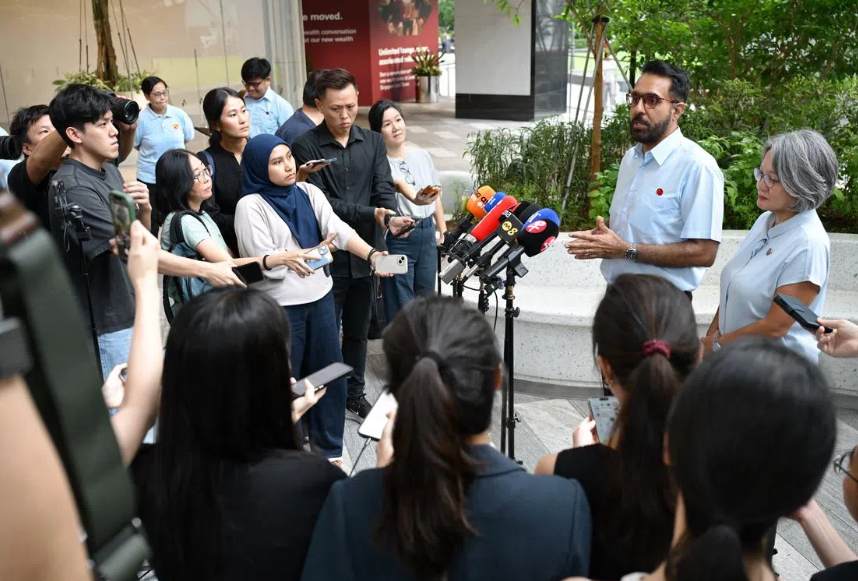
Pritam Singh emerged from six hours of gruelling party meetings on June 28 with his position intact and his authority reaffirmed. The Workers Party secretary-general had faced the most serious challenge to his leadership since taking the helm in 2018, yet walked out to reporters with a relaxed demeanor and confident smile. His message was unambiguous: the party stood unified behind him. The cadre vote that preceded this moment—82 of 106members backing Singh's continued leadership—represented a decisive show of support that effectively neutralised months of internal turbulence threatening to fracture Singapore's main opposition force.
The challenge Singh faced stemmed directly from his conviction over deliberately misleading Parliament about former Sengkang GRC MP Raeesah Khan's fabricated account of alleged police mistreatment. Khan had initially lied to the House about an incident involving a sexual assault victim, and subsequent investigations by Parliament's Committee of Privileges determined that Singh had played a role in encouraging her to perpetuate the falsehood. After being convicted in the lower court and seeing that verdict upheld by the High Court in December 2025, Singh found himself removed from the post of Leader of the Opposition by Prime Minister Lawrence Wong following a parliamentary motion deeming him unsuitable for the role.
A faction of dissatisfied party cadres seized this moment to force accountability, triggering a special cadres conference through their collective petition. They hoped to extract meaningful consequences for Singh's actions and potentially draft an alternative leader to challenge him. The meetings on Sunday June 28 presented what should have been a vulnerable moment for any political leader, yet the inquisition many expected never materialised with the ferocity anticipated. While Singh did face questioning from members, several cadres who spoke during the proceedings actually voiced their support for him, effectively blunting the dissident momentum. Crucially, those seeking to field a challenger found themselves unable to convince any credible alternative candidate to step forward, even as they lobbied intensively in the days leading up to the conferences.
The outcome represents a remarkable consolidation of power for Singh and suggests the party's membership has absorbed, if not necessarily forgiven, his legal troubles. What makes this particularly significant is the visible endorsement from the party's veteran former chief Low Thia Khiang, the architect of the modern Workers Party who retains enormous symbolic weight within the organisation. His public declaration of continued support for Singh carried unmistakable significance, demonstrating that even the party's founding generation viewed the conviction saga as ultimately manageable. The party's formal response had already signalled a measured approach—its disciplinary panel found Singh had violated the party Constitution, but the leadership body issued merely a formal letter of reprimand rather than imposing harsher sanctions.
This unified stance has eliminated what could have been catastrophic for an opposition party: public internal rifts and leadership instability. Political history across Asia demonstrates how opposition movements frequently crumble under the weight of internal warfare, with periodic upheavals and infighting that alienate voters and diminish parliamentary effectiveness. By decisively resolving the succession question and restoring forward momentum, the Workers Party has avoided becoming another cautionary tale. The party's chair Sylvia Lim signalled during her post-election remarks that the organisation is now turning attention toward leadership renewal and succession planning, suggesting an institutional acknowledgment that the Singh chapter, however it concludes, represents a transitional phase rather than the party's permanent trajectory.
Yet the victory carries troubling implications for political principle and democratic accountability. The Workers Party faced a genuine dilemma: how to maintain internal cohesion while responding appropriately to a member's conviction for misleading Parliament. The outcome suggests that institutional survival and solidarity ultimately prevailed over the harder questions about whether a party could maintain credibility while retaining a leader convicted of dishonesty. Singh's response when asked about concerns that the Workers Party is now run by a "convicted liar" was notably terse—he directed questioners to his website and stated his position remained unchanged from his parliamentary statements. This avoidance of direct engagement with the substance of the accusation left a rhetorical gap that opponents and sceptics have readily exploited.
The Workers Party's leadership is clearly betting that the May 2025 general election results provide proof of voter forgiveness. Held while Singh remained a convicted defendant in the lower court, that election saw the party not merely hold its existing constituencies but expand its parliamentary presence through two Non-Constituency MP seats. The party interprets this performance as evidence that the public has already rendered its judgment, moving beyond the conviction to assess the Workers Party on its parliamentary work and policy offerings. For core party supporters, Singh's legal troubles are evaluated primarily through a political lens—acknowledging his miscalculation while believing him fundamentally sound as a leader. This interpretation may hold true for the party's existing base.
However, the harder challenge facing Singh and the Workers Party concerns precisely those voters the party needs to attract to broaden its appeal: the middle-ground, politically moderate Singaporeans who have gradually shifted from unquestioning support for the ruling People's Action Party. These voters, typically older, more affluent, and socially conservative, represent the untapped potential that would transform the Workers Party from a respectable opposition force into a genuine alternative government. For this demographic, character and trustworthiness remain paramount political criteria. The conviction for misleading Parliament, regardless of the specific context or the party's internal unity, creates a significant credibility barrier that enthusiasm for parliamentary performance cannot entirely overcome.
The Workers Party enters this next political phase with considerable institutional assets. The party retains its traditional underdog status, which generates sympathy among certain voter cohorts and shelters it from the intense scrutiny directed at governing parties. Its parliamentary presence has genuinely expanded, providing platforms for scrutiny and alternative policy voices. Sylvia Lim and other Workers Party MPs have demonstrated competence and seriousness in legislative committees. These factors position the party to continue growing its representation incrementally with each electoral cycle. Yet the Singh conviction remains a complicating factor in this growth trajectory, particularly among voters who view opposition politics as a way to restore meritocratic governance and ethical standards.
The real test of whether the Workers Party's internal solidarity translates into electoral gains will emerge in the lead-up to the next general election. Can the party, with Singh at the helm, articulate a sufficiently compelling vision for middle-ground voters to overcome their reservations about his conviction? Will the party's parliamentary work and policy contributions prove substantial enough to shift perceptions? These questions will define whether Sunday's vote of confidence represents a turning point toward renewed party strength, or merely a temporary reprieve before deeper questions about leadership and trustworthiness resurface. For now, the Workers Party has bought time and restored internal unity—significant achievements for any opposition movement. Whether that buys sufficient space for the party to rebuild broader voter confidence remains the larger, still-unanswered question.

