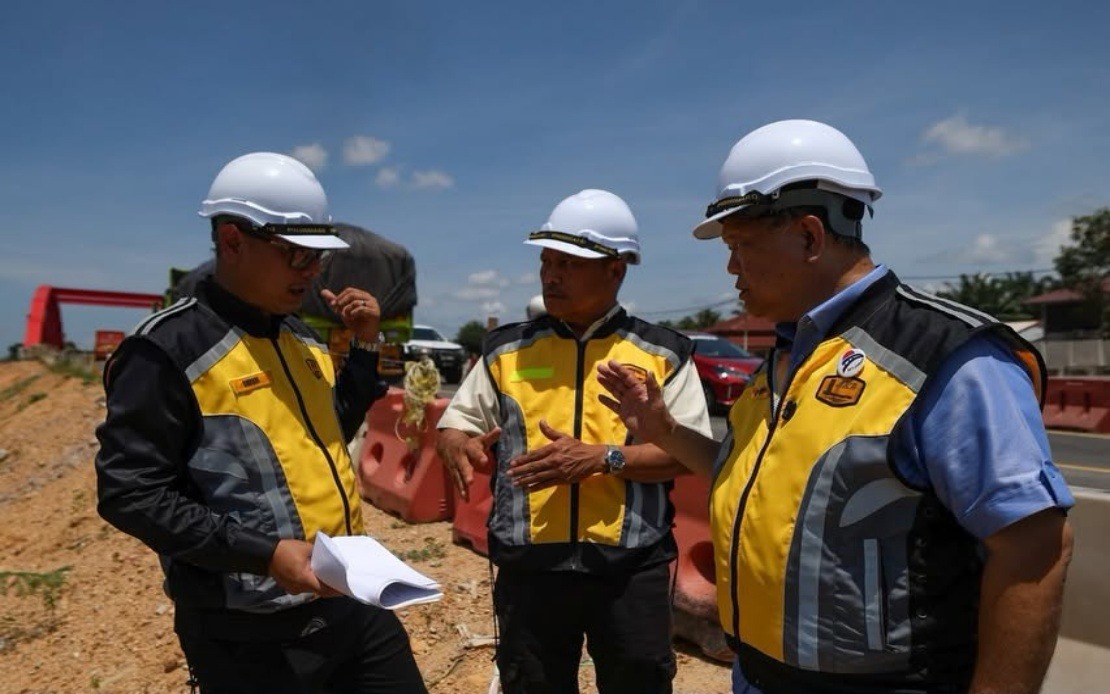
Works Minister Datuk Seri Alexander Nanta Linggi has issued a firm directive to accelerate construction on the Sungai Durian Bridge Replacement Project in Kuala Krai, signalling growing impatience with persistent delays on the infrastructure initiative. The announcement came following an unannounced inspection of the work site where Nanta conducted a personal assessment of progress and found the project continues to slip behind its committed timeline, notwithstanding six previous extensions that have already been approved.
The delays undermining this Kelantan-based infrastructure initiative stem from multiple technical complications that have proved more intractable than initially anticipated. Installation of borepiles—foundational elements critical to the structure's integrity—has encountered unexpected obstacles created by existing utility pipelines threading through the project area. Beyond underground challenges, the temporary support framework designed to stabilize the steel bridge components during assembly has generated additional complications requiring collaborative problem-solving between the contractor and the Public Works Department.
Nanta's surprise site visit represents an escalation in ministerial oversight, reflecting frustration that the project has consumed considerably more time than budgeted despite previous accommodations. The decision to visit unannounced suggests the ministry wanted an unconstrained view of actual site conditions rather than a sanitized presentation. His subsequent directive mandates deployment of supplementary resources, intensified work schedules, and rapid resolution of outstanding technical matters—effectively communicating that further delays will face ministerial disapproval.
The minister's public statements underscore the political dimension of this infrastructure project, which has become a symbol of government responsiveness to constituents in Kuala Krai. Nanta emphasised that communities in the area have endured unreasonably prolonged waiting periods and that patience has reached exhaustion point. This framing suggests the project carries electoral significance and that continued slippage carries reputational costs for both the ministry and the governing administration.
The Sungai Durian Bridge replacement represents a category of critical infrastructure projects that Southeast Asian governments routinely undertake but frequently struggle to execute within original timelines. Construction complications in Malaysia—particularly those involving coordination between private contractors and public utilities—often reveal structural coordination gaps within the bureaucratic system. This project exemplifies how utility conflicts, despite being predictable, frequently derail schedules because of inadequate pre-construction planning or poor inter-departmental communication.
For Malaysian readers and regional observers, this situation illustrates broader patterns in infrastructure delivery across Southeast Asia. Government capacity to oversee complex construction projects remains uneven, and the extension mechanism—while necessary for managing unforeseen circumstances—can inadvertently enable complacency when repeatedly invoked. Six extensions suggest either exceptionally poor initial estimation or inadequate progress management rather than simple bad luck.
The Public Works Department's increased involvement signals ministerial determination to tighten oversight mechanisms. By explicitly committing to continuous monitoring until project completion, Nanta is establishing accountability benchmarks and making clear that further extensions face a higher bar for approval. This represents a shift from reactive problem management toward proactive intervention.
Kuala Krai constituents represent an important political constituency, and delayed infrastructure delivery directly affects their daily mobility and economic connectivity. A bridge replacement project addresses fundamental transportation needs, and delays translate into continued traffic congestion, safety concerns, and economic inefficiency. The replacement component suggests the existing bridge has either reached functional obsolescence or structural safety limits, making completion urgent rather than discretionary.
The contractor faces intensified pressure to reallocate resources and accelerate schedules, which could introduce quality control risks if executed poorly. Nanta's insistence on expedited timelines must be balanced against construction safety and durability standards. The minister's explicit willingness to hold the contractor accountable for implementation quality indicates awareness of this tension, but the practical outcome will depend on whether adequate additional resources can be meaningfully deployed and whether the technical obstacles—particularly the utility pipeline issues—admit of rapid resolution.
Regional development patterns increasingly hinge on infrastructure connectivity, and a single delayed bridge project, while perhaps individually manageable, contributes to accumulated credibility deficits when projects across multiple states and agencies fall behind schedule. Malaysia's competitive position within Southeast Asia depends on reliable transportation networks and predictable infrastructure delivery timelines that attract investment and facilitate commerce.
The ministry's public commitment to resolving this project carries implications for governance credibility beyond the immediate bridge completion. Political leadership increasingly faces constituent expectations for transparent project management and timely delivery, and ministerial intervention—while sometimes necessary—also signals that standard contractual mechanisms and oversight structures proved insufficient initially. Future infrastructure tenders may reflect more conservative timeline assumptions if contractors anticipate greater ministerial scrutiny and lower tolerance for delays.
Nanta's personal involvement and public declaration of zero tolerance for further delays establishes a political marker that will shape how the ministry manages comparable projects moving forward. Success in accelerating this bridge will validate the intervention strategy; failure would undermine ministerial credibility and raise questions about whether bureaucratic obstacles resist even ministerial-level pressure to reform.

