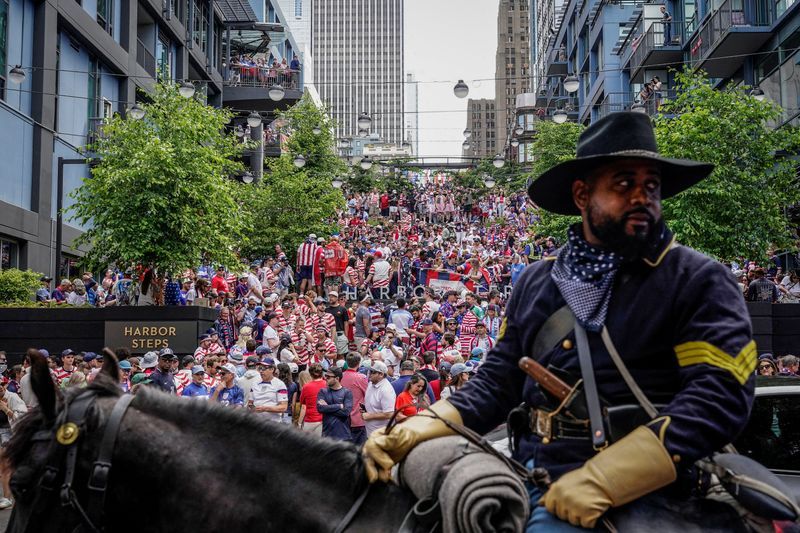
The 2026 FIFA World Cup has drawn football enthusiasts from every corner of the globe to 16 host cities spread across North America, reshaping stadiums and neighbourhoods into vibrant celebrations of the sport. As the tournament unfolds, Reuters photographers embedded at training facilities and matches are documenting not just the action on the pitch, but the profound social impact reverberating through each city. Their observations reveal how this global event has transcended the confines of football grounds, penetrating the daily rhythms and cultural fabric of diverse urban communities.
In Mexico City, the legendary Estadio Azteca continues its storied tradition as a World Cup venue, having staged two finals in its history and hosting several of this tournament's most memorable encounters. Yet the true measure of football's grip on the capital extends far beyond its most famous stadium. Photographer Raquel Cunha discovered that the passion for the sport permeates ordinary neighbourhoods throughout the metropolis, where communities have fundamentally reshaped their physical spaces to accommodate informal football pitches. This adaptation speaks to how deeply football has integrated itself into Mexican urban life, serving as both recreation and cultural expression.
Westward, in Guadalajara, the World Cup has rekindled memories dating back to 1970 when the Brazilian legend Pelé graced the city with his presence. The recent unveiling of a statue honouring the football icon underscores the tournament's role in commemorating historical sporting moments. Photographer Ivan Arias witnessed something equally compelling: a genuine warmth extended toward supporters of visiting teams, particularly striking in the friendship that blossomed between Mexican and Colombian fans. These spontaneous connections, which saw supporters attending each other's gatherings and celebrations with equal enthusiasm, demonstrate how football can dissolve national boundaries and foster authentic human connection.
Monterrey exemplifies how established football traditions shape contemporary fan culture. Daniel Becerril's observations reveal that supporting the game here encompasses cherished social rituals — backyard barbecues accompanied by cold beer, convivial bar gatherings — reflecting how deeply the sport integrates with everyday leisure and community bonding. In Miami, meanwhile, the World Cup has felt less like an imported event and more like an organic extension of the city's existing character. The large Latin American population means the tournament resonates with particular immediacy, though Amanda Perobelli notes that the oppressive heat and humidity exact a physical toll on those spending lengthy hours outdoors following the action.
Texas has embraced the tournament with characteristic grandeur. Photographer Phil Noble observes that everything here exceeds normal proportions — from colossal highway systems to enormous barbecue servings — and this scale extends to the welcome accorded visiting fans. Mexican supporters in particular have maintained visible presence throughout the state, while interestingly, local spectators frequently rally behind visiting nations when their own country isn't competing. Hannah McKay similarly remarks on Texas's supersized infrastructure, from stadium dimensions to merchandise abundance, and recalls the electric atmosphere when Lionel Messi etched his name into history by breaking the men's World Cup goals-scoring record. Such moments highlight how major tournaments crystallise legendary individual achievements within the context of mass celebration.
Atlanta's unconventional stadium design, featuring a retractable roof and setback seating arrangements, initially seems at odds with traditional football architecture. Yet Claudia Greco reports that the Southern city has generated palpable excitement nonetheless, with crowded fan zones, restaurants broadcasting matches, and businesses reporting booming activity. The venue itself becomes secondary to the collective energy surrounding it. Los Angeles presents a different phenomenon: a sprawling metropolis of distinct neighbourhoods typically experienced through the insulation of automobiles. Daniel Cole argues that the World Cup has achieved something remarkable by drawing residents and visitors into the streets in uncommon numbers, fostering unexpected communal experiences. The sight of various diaspora communities — Iranian, South Korean, Mexican — rallying behind their ancestral nations transforms the city into a temporary tableau of global cultural representation.
San Francisco's experience illustrates a particularly poignant dimension of the tournament's social impact. Carlos Barria observes that immigrant communities have used the World Cup as an occasion to publicly celebrate their heritage through flags, traditional food, language, and cultural expression. This visibility carries added significance given the increasingly fraught atmosphere surrounding immigration policy in the United States. Simultaneously, many American citizens encounter cultures and traditions previously unfamiliar to them, creating opportunities for genuine cross-cultural understanding that Barria suggests lies at the heart of football's universal appeal. Kansas City, straddling the Kansas-Missouri border, demonstrates that football thrives alongside established sporting traditions rather than displacing them. Kai Pfaffenbach found that baseball, American football, and soccer coexist harmoniously here, all drawing dedicated followings and generating an overwhelmingly positive atmosphere centred on communal celebration.
Philadelphia presents a contrasting picture. Photographer Siphiwe Sibeko, accustomed to covering football tournaments in South Africa where the sport dominates public discourse and atmosphere throughout the event, notes that the World Cup's presence in Philadelphia feels comparatively subdued. The tournament's energy concentrates primarily on match days and within stadium vicinities, rather than suffusing the entire city. This observation reflects broader differences between football-centric cultures and those where the sport competes alongside multiple other major sporting traditions. New York City simultaneously hosts both the World Cup and, coincidentally, the triumph of the New York Knicks in winning the NBA championship for the first time in over five decades. Dylan Martinez documents how the city accommodates both spectacles, from Norwegian fans performing their Viking chant traditions to Latin American supporters flooding Times Square for pre-match celebrations, reinforcing New York's reputation as perpetually awake and vibrant.
Boston offers a particularly instructive perspective because photographer Brian Snyder covered the 1994 World Cup, the previous occasion when the United States hosted the tournament. Comparing the two eras, Snyder observes a dramatically heightened fan engagement this time, suggesting that American enthusiasm for football has grown substantially over three decades. Beyond the well-publicised support from Scotland's Tartan Army, Snyder has documented grassroots enthusiasm from local communities of Haitians, Moroccans, and Cape Verdeans proudly supporting their respective nations. These observations underscore how football tournaments activate latent diaspora communities and provide legitimate platforms for public cultural expression.
Toronto presented photographer Bernadett Szabo with an entirely unexpected dimension when a falcon nearly collided with her near the stadium. This chance encounter revealed that a family of these raptors — parents and four chicks — inhabit the venue, a reminder that sporting events exist within broader ecological contexts often overlooked in the focus on human celebration. Vancouver, by contrast, has resisted the tournament's immersive pull more successfully than other Canadian host cities. Agustin Marcarian, observing from his usual perspective in Buenos Aires, found the atmosphere decidedly subdued and discovered that visible tournament signage requires deliberate searching through the city's landscape. This muted reception suggests that Canadian enthusiasm for the World Cup may vary considerably by region.
Seattle in the Pacific Northwest, however, has generated conspicuous festive energy in areas surrounding its stadium. Photographer Albert Gea observed that fans made deliberate efforts to dress in patriotic red, white, and blue during American matches, and vendors proliferated to serve the substantial crowds. Gea interprets this phenomenon as reflecting a distinctly American approach to sport as comprehensive entertainment spectacle rather than mere athletic competition. Across these sixteen cities, the 2026 World Cup has functioned not simply as a football tournament but as a powerful lens through which to examine how communities express identity, forge connections, and celebrate shared humanity across national and cultural boundaries. For Malaysian and Southeast Asian observers, these accounts demonstrate how major sporting events can activate dormant community pride, unite divided populations, and create temporary spaces where cultural expression flourishes without constraint.

