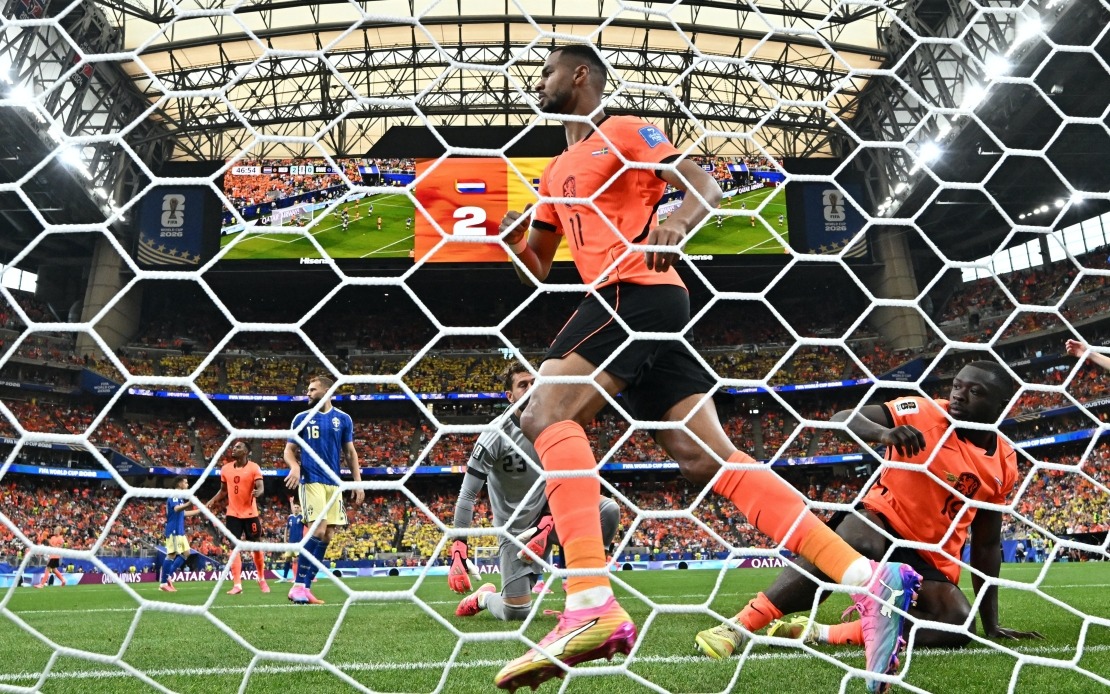
The 2022 World Cup has shattered historical records for offensive productivity, reaching the century mark in goals during its 33rd match when Cody Gakpo converted for the Netherlands in their dominant 5-1 victory over Sweden. This achievement represents a pivotal moment in tournament scoring history, occurring at an average rate of 3.03 goals per match. The milestone underscores a dramatic shift in how the modern World Cup unfolds compared to previous iterations, reflecting fundamental changes in tournament structure, equipment, and playing conditions.
The pace at which the tournament has accumulated goals stands as the fastest since Switzerland hosted the tournament in 1954, when the 100-goal barrier was breached after merely 20 matches played. That earlier record, however, came in an era with only 16 teams competing and different qualifying standards, making direct comparison somewhat complicated. Nevertheless, the current trajectory represents a substantial acceleration compared to more recent tournaments. Brazil 2014 and Spain 1982 each required 36 matches to reach the same milestone, while Argentina 1978 and the United States 1994 took 38 matches respectively. These comparisons reveal a consistent trend toward increased scoring in contemporary World Cup football.
Analysts and observers have identified several interconnected factors contributing to this offensive explosion. The official tournament ball, known as the Trionda, has drawn particular scrutiny from football experts who suggest its aerodynamic properties may disadvantage goalkeepers attempting to read trajectories on long-range shots. Evidence supporting this theory comes from the tallying of 10 goals scored from outside the penalty area during the early stages, a proportion that exceeds historical norms. The ball's specifications represent a significant departure from previous tournament equipment, potentially creating technical challenges for custodians accustomed to different handling characteristics.
The extreme climatic conditions prevalent in the host nation have emerged as another significant variable affecting match dynamics. The intense heat has accelerated physical fatigue among outfield players, particularly in defensive units responsible for maintaining shape and concentration. Football coaches have capitalised on mandatory three-minute cooling breaks inserted into matches, using these intervals to implement tactical reorganisations and provide restorative instructions that might otherwise have been impossible. These breaks effectively extend coaches' ability to manage their teams' tactical positioning and recovery, introducing intervention opportunities unavailable in traditional match formats.
The structural expansion of the tournament from 32 to 48 competing teams constitutes perhaps the most substantial organisational change affecting overall scoring patterns. This enlargement theoretically introduces weaker national sides to the competition, potentially creating mismatches between stronger and developing football nations. The evidence appears partially confirmatory of this hypothesis, with Germany's 7-1 demolition of Curaçao, Canada's 6-0 dismantling of Qatar, and Tunisia's successive defeats to Sweden and Japan (5-1 and 4-0 respectively) suggesting that considerable disparities persist between different competitive tiers.
Yet the expanded format has not simply produced predictable blowouts or one-dimensional contests as some sceptics predicted. Instead, the tournament has generated surprising equilibrium in various matchups, demonstrating that additional teams have not uniformly weakened overall quality. Curaçao extracted a goalless draw against Ecuador, suggesting defensive resilience among smaller nations, whilst Cabo Verde frustratingly held Spain scoreless despite conventional expectations favouring the Spanish side heavily. Qatar's resistance against Canada, where the squad managed to maintain competitive intensity despite losing nine players to either red cards or serious injuries, illustrated that determination and tactical discipline can partially compensate for comparative disadvantages in player quality.
Middling underdog performances further complicate the narrative of straightforward hierarchy. Jordan mounted a credible challenge against Austria before succumbing 3-1, whilst Uzbekistan similarly competed fiercely against Colombia, ultimately losing by the same margin. These encounters suggest that the expanded tournament format, rather than simply introducing cannon-fodder opponents, has produced a more layered and unpredictable competition where established hierarchies face genuine challenge from nations traditionally peripheral to global football's upper echelons.
For Southeast Asian football observers, these scoring patterns and tournament dynamics carry important implications. The increased competitiveness of developing football nations, demonstrated through competitive performances by smaller nations, suggests that regional sides might aspire to similar competitive improvements in future world championships. The technical attributes influencing goal-scoring—modern ball technology, fitness management innovations, and tactical sophistication—represent areas where football federations across the region might invest developmental resources. The visible success of emerging sides in defending against stronger opponents provides templates for how dedicated preparation and strategic organisation can narrow performance gaps.
The high-scoring nature of this tournament also reflects evolution in how modern football balances defensive solidity against attacking freedom. Coaches have increasingly valued dynamic, aggressive approaches rather than purely cautious defensive strategies, suggesting a philosophical shift in global football towards entertainment and spectacular play. This tendency appears to have accelerated throughout this competition, with attacking players and creative midfielders receiving greater licence to operate. The visible rewards for this approach—both in results and in the entertainment value attracting television audiences—may influence coaching philosophies across Asia and beyond.
Looking forward, the 100-goal milestone achieved at record pace establishes a benchmark for future tournaments. Whether this represents a temporary anomaly driven by specific conditions unique to this host nation, or signals a permanent elevation in World Cup scoring rates, remains to be determined. The combination of equipment changes, climatic factors, and structural innovations creates a distinct environment unlikely to be precisely replicated in all subsequent tournaments. Future football authorities will observe whether scoring accelerates similarly once the immediate novelty of expanded team participation normalises, and whether subsequent hosts adopt comparable cooling-break protocols.