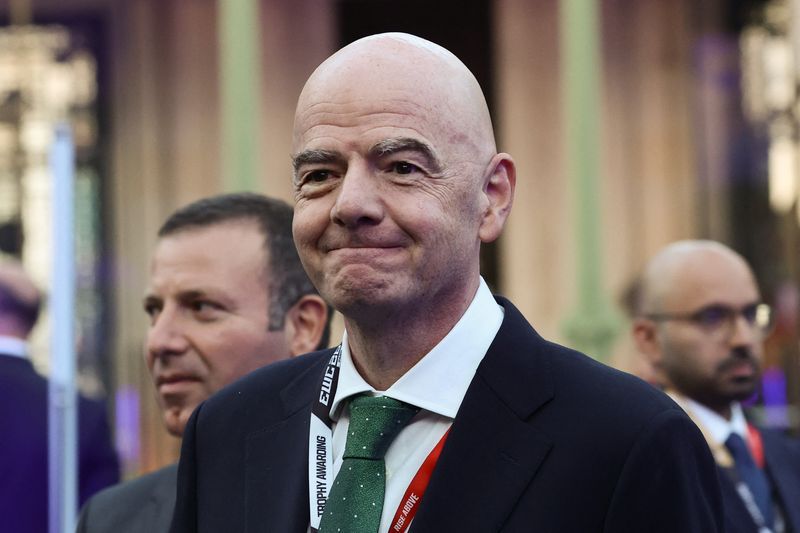
A powerful alliance of former international football stars, spanning World Cup champions and FIFA-recognised legends, has issued a stark call for reform at the sport's governing body, directly challenging President Gianni Infantino's stewardship. The group, which includes France's 1998 World Cup winners Emmanuel Petit, Bixente Lizarazu and Robert Pires, has articulated growing unease over FIFA's current trajectory under Infantino's leadership since 2016, signalling that the mounting internal and external pressure on the Swiss administrator shows little sign of abating.
Infantino's position has deteriorated significantly following his decision to shelve a controversial proposal that would have established a commercial entity to control FIFA tournament rights, with a view to selling a 20 per cent stake to private investors. The proposal, which drew fierce criticism from football's established power structures and grassroots supporters alike, represented a watershed moment in the governance crisis now enveloping world football's apex institution. The fact that Infantino felt compelled to abandon the scheme underscores the scale of opposition he faces, yet the embattled leader has given no indication of stepping aside voluntarily.
The group's statement carries particular weight given the stature of its signatories. Alongside the French triumvirate, the coalition includes American women's football icon Briana Scurry, England international Lucy Bronze, Peru's former forward Claudio Pizarro, Argentina's Juan Sebastian Veron, Togo's Emmanuel Adebayor, and two of Africa and world football's most recognisable figures: Didier Drogba and David James. This diversity of geography, generation and gender reflects a unified concern that transcends individual national interests, suggesting that discontent with FIFA's direction runs deep across the sport's historical guardians.
The former players have framed their intervention in terms of betrayal rather than mere disagreement. Their statement contends that FIFA's current leadership has become so consumed by institutional self-interest that it has lost sight of football's fundamental values and the relationship between the game and those who play and watch it. This accusation cuts to the heart of legitimacy questions that have dogged FIFA for years: the organisation exists ostensibly to serve football and its stakeholders, yet critics argue it has become a self-perpetuating bureaucracy more concerned with commercial expansion and executive prerogatives than with the sport's wellbeing.
Infantino faces resistance not merely from former players but from FIFA's own regional confederations, a fact that distinguishes this crisis from previous episodes of governance discontent. The Union of European Football Associations (UEFA), the Asian Football Confederation (AFC), and CONCACAF have all expressed opposition to the incumbent president. Significantly, these are not marginal voices but representatives of football's three largest continental powers by player population, commercial value and international influence. Their collective stance has lent credibility to whispers of a potential no-confidence vote, though the timing and mechanics of such a move remain uncertain.
The players' group has explicitly called for structural democratisation of FIFA's decision-making processes, arguing that authentic reform requires genuine participation from players and supporters in determining how football is governed. This demand addresses a perennial criticism of FIFA: that its leadership structure concentrates power among national federation officials and FIFA executives, with little meaningful input from the athletes whose talents generate the sport's global appeal or the supporters whose passion funds it. For Malaysian and Southeast Asian stakeholders, this debate carries particular resonance, as regional confederations—including the AFC—have become more assertive in demanding accountability from global football bodies.
Infantino is constitutionally protected until his re-election ballot, scheduled for next year. However, the convergence of player criticism, confederation opposition, and media scrutiny suggests that his path to re-election, once assumed inevitable, is now contested terrain. Senior figures familiar with confederation discussions have indicated that consideration is being given to accelerating a no-confidence vote ahead of the formal electoral calendar, a procedural manoeuvre that would signal extraordinary loss of confidence in the incumbent.
The timing of this intervention by football legends warrants examination. By stepping forward publicly rather than confining criticism to backroom channels, these former players are lending moral authority to reform movements and signalling to supporters worldwide that even those with access to FIFA's inner circles believe change is imperative. Their statement emphasises that silence would constitute complicity and that the stakes—the future legitimacy and direction of world football—justify public advocacy.
For Malaysian football administrators and supporters, the FIFA governance crisis presents both a cautionary tale and an opportunity. The expansion of FIFA's commercial ambitions, exemplified by the abandoned private investment scheme, can affect how tournament revenues are distributed among confederations and national federations, thereby influencing resources available to emerging footballing nations. Conversely, the call from football legends for democratised governance aligned with Asian confederation interests in demanding accountability suggests that medium-sized footballing nations may acquire greater influence if internal FIFA reform genuinely devolves power beyond the traditional hegemonic bloc.
The players' coalition has framed their campaign not as a personalised attack on Infantino but as a defence of football's authentic mission. Their insistence that structural change rather than mere personnel rotation is required implies that even if Infantino departs, the underlying governance pathologies that enabled his tenure must be addressed institutionally. This perspective challenges FIFA to undertake genuine reformation rather than managerial succession, a distinction that will shape global football's evolution for years to come.
The pressure on Infantino will likely intensify as his re-election approaches. The combination of confederation opposition, legendary player criticism, and growing media scrutiny creates an unprecedented convergence of institutional and popular dissent. While Infantino has shown resolve in maintaining his position despite mounting opposition, the breadth and depth of the current challenge appears qualitatively different from previous governance controversies. Whether the incumbent can weather this storm or whether FIFA is entering a genuine leadership transition remains uncertain, but the die has demonstrably shifted against the status quo.

