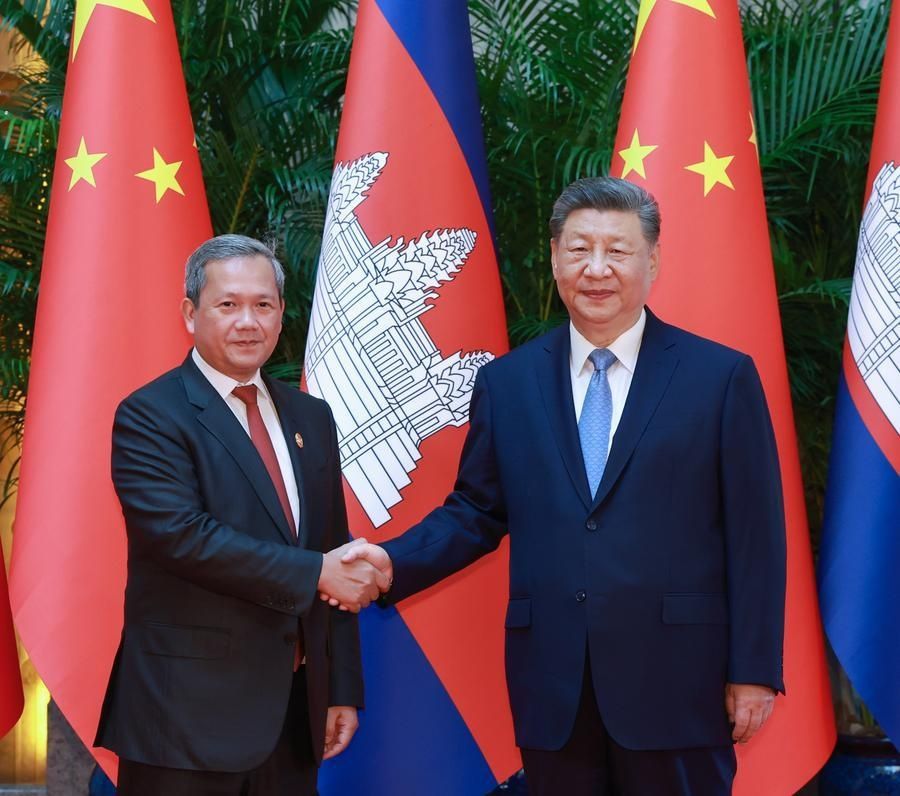
Chinese President Xi Jinping met with Cambodian Prime Minister Hun Manet in Shanghai on Friday, reaffirming the strength of bilateral ties and outlining an ambitious agenda for deepened partnership across economic, technological, and security domains. The encounter, which took place during Hun Manet's participation in the 2026 World Artificial Intelligence Conference and High-Level Meeting on Global AI Governance, underscores Beijing's commitment to maintaining Cambodia as a linchpin in its Southeast Asian strategy at a time of evolving regional geopolitics.
Xi's emphasis on inheriting the "ironclad friendship" built by previous generations of leaders carries particular symbolic weight in the context of China-Cambodia relations, which have weathered significant international scrutiny over the past decade. The language reflects Beijing's confidence in the durability of this relationship despite external pressures and shifting global alignments. By grounding current cooperation in historical bonds, Xi seeks to position the partnership as transcending temporary fluctuations in regional dynamics or changes in international sentiment.
The centerpiece of their discussions was the revival and expansion of the "Diamond Hexagon" cooperation framework, a multilateral mechanism designed to integrate Cambodia more deeply into Chinese economic and strategic networks. This framework encompasses not only bilateral China-Cambodia ties but also their relationship with other neighboring states, creating a hexagonal structure of interconnected partnerships. By elevating this framework, Xi is signaling Beijing's intention to use Cambodia as a nexus point for broader regional integration initiatives that benefit Chinese economic and geopolitical interests.
The two leaders identified several development corridors as priorities for expanded investment and cooperation. The Industrial Development Corridor and the Fish and Rice Corridor represent China's dual strategy of modernizing Cambodia's manufacturing base while securing agricultural supply chains critical to Chinese food security. These projects extend beyond simple commercial transactions; they represent structural integration of Cambodia's economy with Chinese production networks, making the Cambodian economy increasingly interdependent with Beijing's strategic objectives.
Xi's call to upgrade traditional sectors such as electricity and agriculture while simultaneously fostering emerging industries including artificial intelligence and the digital economy reflects a comprehensive vision for Cambodia's economic transformation under Chinese guidance. The emphasis on artificial intelligence is particularly significant, positioning Cambodia as a potential beneficiary of Chinese technological advancement and digital infrastructure development. For Malaysian policymakers and business leaders, this represents a reminder of China's determination to position itself as the dominant technological and infrastructural player throughout Southeast Asia.
The discussion of cross-border crime cooperation addresses a practical irritant in regional relations. Counterfeiting, smuggling, online gambling, and telecom fraud impose genuine costs on multiple Southeast Asian nations, including Malaysia. By positioning this as a shared challenge, China frames security cooperation as mutually beneficial rather than asymmetrical. However, the emphasis on telecom fraud is particularly noteworthy, as this has emerged as a transnational problem affecting multiple countries and creating complex jurisdictional challenges that require coordinated responses.
Xi's diplomatic intervention regarding the Cambodia-Thailand ceasefire and border disputes reveals China's broader role as a regional mediator and peace facilitator. By supporting dialogue-based solutions while emphasizing China's willingness to play a "constructive role," Beijing positions itself as a stabilizing force concerned with long-term regional harmony. This approach contrasts with more heavy-handed interventions and suggests China's preference for diplomatic solutions when possible, particularly in disputes that do not directly threaten Chinese interests. For regional observers, this indicates Beijing's confidence in its ability to influence outcomes through soft power and economic leverage rather than military pressure.
Hun Manet's reciprocal affirmations, including Cambodia's firm commitment to the one-China policy and pledges to deepen cooperation across multiple domains, confirm Cambodia's strategic alignment with Beijing. His specific mention that Cambodia's pro-China policy will not change regardless of international circumstances constitutes a remarkable statement of commitment. This language suggests either Cambodia's deep confidence in the China relationship or perhaps anxiety about maintaining Chinese support in an uncertain environment.
The emphasis on bilateral trade expansion and major infrastructure projects indicates that the economic relationship continues to serve as the foundation for political and strategic alignment. For Southeast Asian nations competing for Chinese investment and technology transfer, Cambodia's success—or lack thereof—in attracting benefits from this partnership offers important lessons about bargaining leverage and strategic positioning. Malaysian companies and investors operating in Cambodia must navigate the reality that Cambodia's economy is increasingly oriented toward Chinese investment and procurement.
Hun Manet's gratitude for China's support in Cambodia's economic and social development acknowledges the tangible benefits Beijing has provided through infrastructure investment, technical assistance, and market access. This framing establishes China as a development partner rather than merely a strategic counterweight to other powers, which resonates throughout Southeast Asia where many nations depend on Chinese investment for infrastructure development.
The meeting's focus on telecommunications fraud combat reflects genuine shared interests in addressing criminal networks that operate across multiple countries. However, this cooperation also enables information sharing and surveillance coordination that may have implications for civil liberties and digital governance in the region. Southeast Asian governments must balance the benefits of transnational law enforcement with concerns about data security and state surveillance expansion.
Broader implications for Southeast Asia emerge from this summit. China is systematically deepening relationships with key regional partners through comprehensive frameworks that integrate economic, technological, and security dimensions. Malaysia, as a fellow Southeast Asian nation with its own complex relationship with China, faces competitive pressure to deepen Chinese engagement or risk relative marginalization in regional economic and technological development. The Diamond Hexagon framework and development corridors exemplify Beijing's strategy of creating structural interdependencies that make regional partners reliant on Chinese markets, investment, and technology.
The Shanghai summit ultimately demonstrates that despite international scrutiny regarding human rights, governance, and sovereignty concerns, China-Cambodia partnership continues strengthening through concrete economic cooperation, technological collaboration, and security coordination. This relationship serves as a model for how Beijing cultivates strategic partners in Southeast Asia, and its continued deepening will likely influence regional dynamics for years to come.

