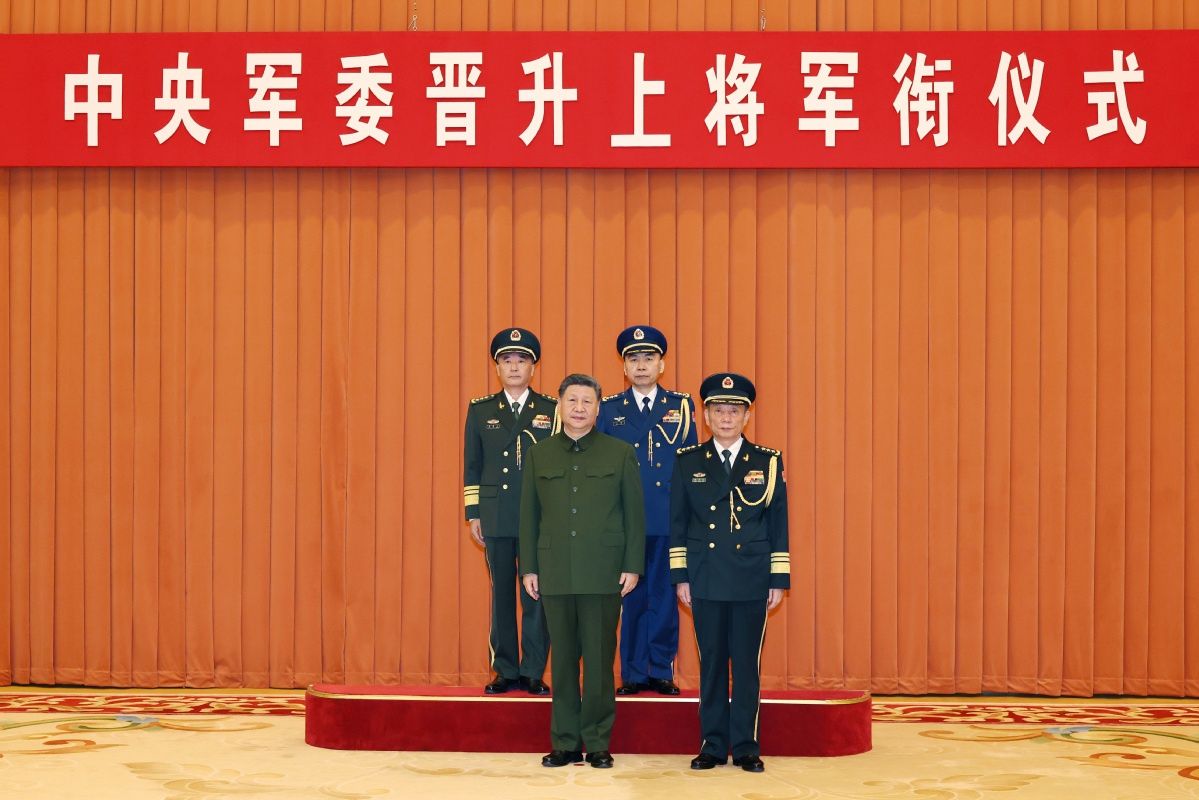
President Xi Jinping has consolidated his grip on China's military apparatus by installing a new leader to oversee anti-corruption investigations within the armed forces, continuing a sweeping campaign to reshape the country's defence establishment. Zhang Shuguang was named secretary of the Central Military Commission's discipline inspection commission in a ceremony presided over by Xi in Beijing on Friday, July 3, according to state media. The appointment signals the Chinese leader's determination to maintain control over the military hierarchy as he pursues what has become the most extensive purge of defence personnel in five decades.
The restructuring extends beyond the anti-corruption apparatus. Wang Gang has assumed command of the People's Liberation Army Air Force, replacing Chang Dingqiu whose next assignment remains undisclosed. Both Zhang Shuguang and Wang Gang received promotions to the rank of general, China's highest active-service officer grade, underscoring the significance Xi places on these command transitions. The cascade of senior appointments reflects the scale of institutional reorganisation sweeping through military structures across the country.
Zhang Shengmin, who previously held the military's top anti-corruption post, has been reassigned to vice chairman of the Central Military Commission, a move that effectively removes him from direct oversight of graft investigations. This lateral shift suggests either a transition to broader strategic responsibilities or a sideways repositioning within the defence hierarchy. The timing of these changes demonstrates that Xi continues to actively reshape the military's senior echelon according to his strategic vision.
The anti-corruption campaign itself began in mid-2023, gaining momentum months after Xi secured an unprecedented third term as China's paramount leader. This campaign has fundamentally altered the composition of the military's top ranks. Since its inception, the purge has resulted in the removal of two vice chairmen of the Central Military Commission, three full commission members, a former defence minister, and at least a dozen senior commanders who led major military formations. The sheer number of high-ranking dismissals suggests systemic issues within the defence establishment, though corruption allegations often serve multiple purposes within Chinese political struggles.
Perhaps the most dramatic development came earlier this year when Xi initiated an investigation into Zhang Youxia, his former ally and one of China's top generals. This move startled observers both domestically and internationally, as it signalled that no senior officer, regardless of past connections to the leadership, remained beyond scrutiny. Zhang Youxia's fall from grace exemplified Xi's willingness to subordinate personal relationships to his broader consolidation strategy within the military hierarchy. The investigation demonstrated that loyalty alone provided no shield against accusations of misconduct.
For Malaysian readers and others in Southeast Asia, these developments carry significant implications. China's military power directly influences regional stability and the balance of forces in contested areas such as the South China Sea. When Beijing undergoes major internal restructuring, it creates periods of uncertainty regarding decision-making processes and foreign policy implementation. The removal of so many senior officers raises questions about continuity in military planning and the potential for shifts in posture towards neighbouring states.
The purge also reveals the degree of central control Xi exercises over all state institutions. Unlike some authoritarian systems where military leaders enjoy autonomous power bases, Xi has systematically subordinated the armed forces to his personal authority. This concentration of power within civilian political leadership ensures more unified policy-making but potentially reduces institutional checks and balance mechanisms that might otherwise counsel restraint in foreign adventures. The intensity of the anti-corruption campaign suggests Xi believes he cannot fully trust existing command structures without radical personnel replacement.
Additionally, the timing of these changes coincides with broader geopolitical tensions involving China, including evolving maritime disputes and strategic competition with the United States. A military leadership in transition may be less inclined to take bold initiatives abroad, or conversely, might feel pressure to demonstrate renewed resolve under new command. The appointment of officers like Wang Gang to prominent positions suggests Xi favours individuals whose loyalty to his vision outweighs considerations of seniority or regional power bases.
For regional observers, the ongoing military restructuring underscores the unpredictable nature of Chinese policy-making during periods of internal reorganisation. New commanders bring different priorities and perspectives, which can influence how China engages with neighbours on diplomatic, economic, and security matters. The anti-corruption framework, while presented as institutional reform, also functions as a political instrument consolidating Xi's authority. The removal of former allies like Zhang Youxia suggests that generational shifts in military leadership favour Xi's chosen cadre over those with independent power bases.
The dismissal of six military lawmakers from parliament seats during the same period further underscores the breadth of Xi's restructuring efforts. Rather than limiting changes to active-duty commanders, the purge extends into legislative bodies where military representatives exercise influence over policy debates. This comprehensive approach ensures that Xi's vision penetrates multiple institutional channels simultaneously. For Southeast Asian nations watching Chinese military policy evolution, these developments warrant close attention to both rhetoric and capability changes that may emerge from the restructured command hierarchy.
Looking forward, the anti-corruption campaign appears likely to continue as Xi consolidates his chosen cadre within senior command positions. The appointment of Zhang Shuguang and similar restructuring moves suggest the process remains incomplete, with Xi still working to replace key positions with individuals whose records and affiliations ensure alignment with his strategic preferences. This ongoing transformation will significantly shape how China's military leadership operates and interacts with regional and global actors in the years ahead, making it a matter of sustained strategic importance for all Southeast Asian states.

