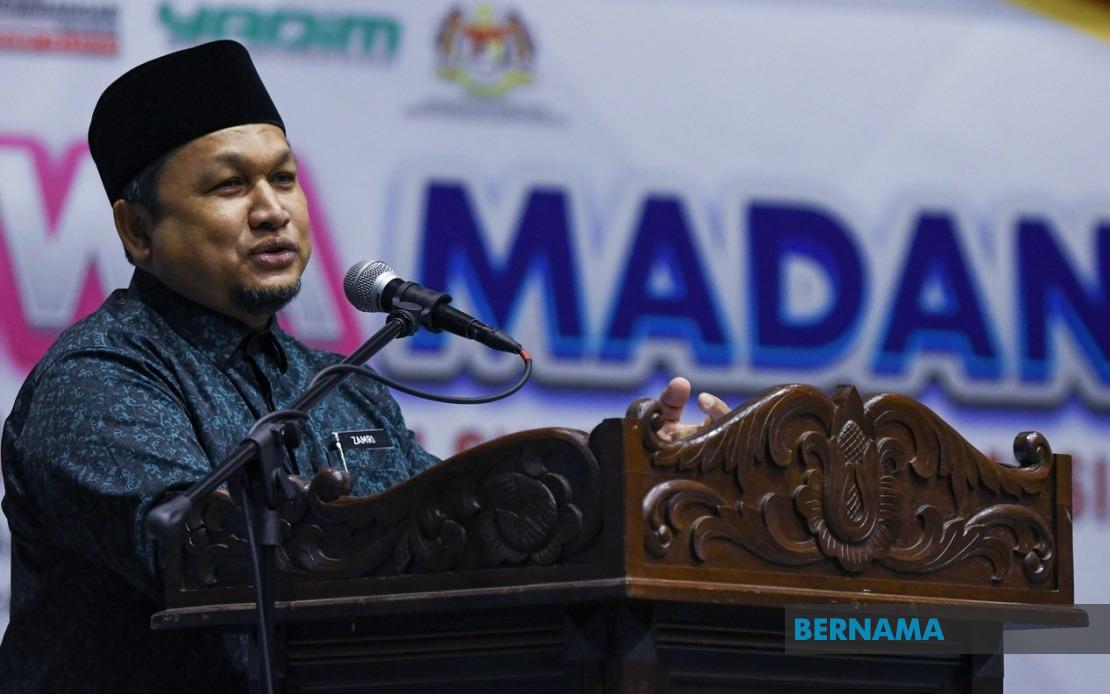
Malaysia's leading Islamic foundation has thrown its weight behind a government proposal to establish an accreditation system for religious speakers operating on social media and online platforms. The endorsement marks an official effort to address growing concerns about the proliferation of unqualified individuals presenting themselves as Islamic teachers in the digital realm, where they command substantial influence over millions of followers seeking religious guidance. The Yayasan Dakwah Islamiah Malaysia (YADIM), a key government agency under the Prime Minister's Department, sees the initiative as a necessary safeguard for the credibility of Islamic teachings in spaces where traditional institutional oversight has traditionally proven difficult to enforce.
Zamri Zainal Abidin, the chief executive officer of YADIM, characterised the proposal as a forward-thinking step rather than a restrictive measure. Speaking in an official capacity, he emphasised that the framework aims to uphold the authenticity of religious references and ensure that those disseminating Islamic knowledge possess genuine scholarly credentials. The initiative responds to a documented phenomenon in which social media has become the primary source of religious information for younger Malaysians and Southeast Asians, many of whom may lack the capacity to discern between authoritative teaching and distorted interpretations of Islamic doctrine. By establishing clear accreditation standards, officials argue, the framework would protect public trust in religious institutions and prevent the exploitation of believers seeking legitimate spiritual guidance.
The concern articulated by YADIM leadership reflects a broader anxiety across Malaysia's religious establishment about the democratisation of Islamic teaching through digital channels. Previously, individuals seeking to teach Islam had to navigate institutional pathways—formal Islamic education, certification from recognised bodies, and approval from state muftis. Social media has circumvented these gatekeeping mechanisms almost entirely, allowing anyone with a smartphone and social media account to position themselves as an authority on religious matters. This accessibility has brought benefits, enabling genuine scholars to reach wider audiences, but it has simultaneously created space for charlatans, theological revisionists, and individuals with little formal grounding in Islamic jurisprudence to accumulate substantial followings.
Zamri stressed that the proposed framework would not function as an instrument of censorship or a barrier discouraging sincere individuals from sharing religious knowledge online. Rather, he characterised it as a means of distinguishing between qualified preachers and those lacking foundational Islamic training. The distinction carries particular weight given the vulnerability of young people to online misinformation and theological confusion. Without standardised accreditation, Zamri argued, the digital religious landscape remains prone to the distortion of Islamic teachings and the proliferation of interpretations that may contradict established Islamic scholarship or serve sectarian interests.
YADIM's support comes following an announcement by Dr Zulkifli Hasan, the Minister in the Prime Minister's Department overseeing religious affairs. The minister's proposal triggered YADIM's formal backing, positioning the foundation as a strategic partner in implementing the initiative. This alignment demonstrates coordination between Malaysia's executive branch and its quasi-governmental religious agencies, suggesting a deliberate policy push to regulate the online Islamic teaching space at the federal level. For Malaysia, where Islam holds a constitutionally protected position and state Islamic institutions exercise considerable authority, such coordination carries institutional weight that may eventually influence how online religious content is governed across the region.
YADIM itself has long operated an accreditation system for preachers within its own programmes. The foundation's trained speakers, particularly those participating in its Daie Muda initiative, receive formal credentials from the Federal Territories Mufti Department. By holding up its own practices as a model, YADIM essentially argues that the proposed framework simply extends an existing, proven system to the broader universe of online preachers. This positions the foundation not as an external enforcer imposing new restrictions, but as an experienced administrator of religious certification capable of lending expertise to a national initiative.
The initiative addresses real challenges that Malaysia's religious authorities have grappled with for years. Social media platforms have hosted sermons and theological discussions that state muftis have subsequently deemed problematic, heterodox, or misleading. In several instances, online preachers have promoted interpretations of Islam that diverge significantly from the mainstream Sunni jurisprudence followed in Malaysia, or have disseminated content later identified as hateful or doctrinally unsound. An accreditation framework would presumably allow religious authorities to identify qualified teachers while discouraging unaccredited individuals from claiming credentials they do not possess.
From a Southeast Asian perspective, Malaysia's approach is notable because it reflects how regional states increasingly recognise the challenge posed by unregulated digital religious content. Indonesia, with its much larger Muslim population, has confronted similar issues regarding online preachers and theological misinformation spreading through WhatsApp, TikTok, and YouTube. Thailand's Muslim communities have likewise experienced the complications of distinguishing legitimate Islamic teaching from distorted or extremist content circulating online. Malaysia's proposed framework potentially offers a model that other Southeast Asian Muslim-majority nations might adapt or adopt.
The framework's potential impact extends beyond purely theological concerns. The proliferation of unqualified online preachers has occasionally coincided with the spread of conspiracy theories, misogynistic interpretations of Islam, and narratives hostile to religious minorities. By establishing accreditation standards, Malaysia's authorities hope to elevate the overall quality of Islamic discourse in digital spaces while reducing the amplification of harmful content. However, the proposal also raises questions about who will determine accreditation standards, how appeals or disputes will be handled, and whether the system might inadvertently marginalise legitimate scholars working outside institutional frameworks.
YADIM's backing signals that Malaysia's religious establishment sees the accreditation proposal as compatible with genuine Islamic scholarship and sincere dakwah efforts. The foundation's positioning of the framework as a credentialing mechanism rather than a censorship tool suggests that authorities are attempting to navigate the delicate balance between protecting Islamic institutional authority and avoiding accusations of suppressing religious speech. Whether the framework ultimately succeeds in elevating online Islamic teaching quality while avoiding overreach remains to be seen, but the announcement reflects a deliberate policy evolution in how Malaysia's government plans to engage with Islam's digital future.

