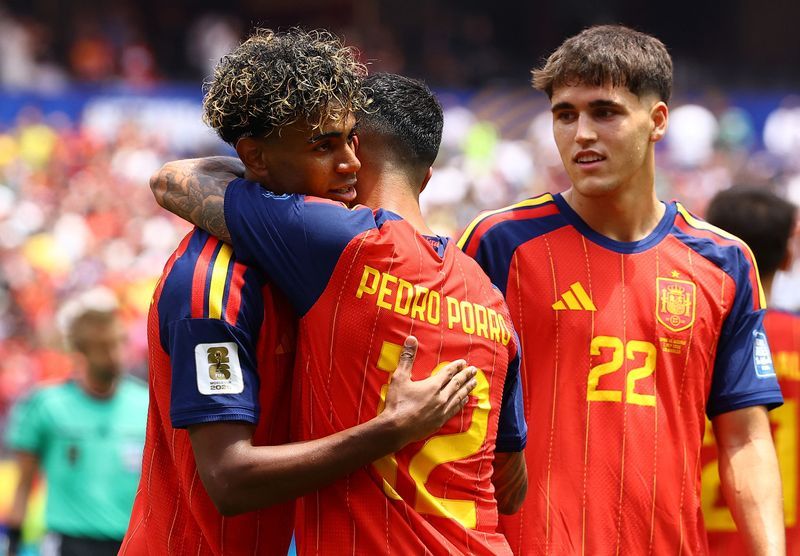
Spain's convincing 3-0 victory over Austria marked a turning point in their World Cup campaign, one defined less by goals than by the quiet authority of an 18-year-old winger who has quietly reshaped how the defending European champions approach the modern game. Lamine Yamal's influence on the pitch revealed a team rediscovering its identity after an uncertain beginning, with the Barcelona talent proving that individual flair and collective excellence need not conflict.
Spain arrived in North America burdened by unexpectedly mediocre form. A goalless stalemate against Cape Verde exposed the limitations of a side built on the principles of possession and positional football that had served them so well during their triumph at Euro 2024 in Germany. That tournament had showcased Spanish football at its most intoxicating—every match won, vibrant attacking patterns woven throughout, a tournament-record goal tally accumulated. The contrast with their stumbling start here could hardly have been starker, and the absence of Lamine Yamal through a troublesome hamstring injury contributed significantly to that early malaise.
The winger's journey to this World Cup had been unconventional. Breaking through from Barcelona's renowned La Masia academy at just 16 years old, Yamal arrived as a prodigy whose rapid ascent defied the conventional timeline of player development. Yet his particular gift extended beyond youthful exuberance: he possessed an almost paradoxical ability to render structured, methodical football spontaneous and unpredictable. This quality had proven invaluable during Spain's European Championship campaign, where his performances hinted at a generational talent emerging precisely when the national team needed regeneration most.
Luis de la Fuente's setup had relied heavily on a familiar midfield architecture anchored by Rodri and Pedri, a system refined through countless matches and tournaments. However, the additional absence of Nico Williams through fitness concerns removed a crucial element of Spain's attacking balance—the pace and directness that complemented the measured build-up play. Without these components functioning in tandem, Spain resembled a watch missing essential gears, capable of ticking but lacking its customary precision and purpose.
Yamal's gradual integration into the tournament coincided precisely with Spain's resurgence in both performance and results. His increasing sharpness on the right flank, combined with Alex Baena's introduction on the left, restored the dual-pronged attacking structure that had characterized their European Championship success. Austria found themselves repeatedly troubled by these twin threats, their defensive architecture repeatedly stretched and contorted by the movement and positioning of these two wide players. Opponents knew exactly what Yamal intended to do, yet possessed insufficient tools to prevent him from accomplishing his objectives.
The teenager's game against Austria transcended traditional statistical measures of impact. Despite neither scoring nor registering an assist, he earned the match's outstanding player designation—a recognition that reflected something more subtle and arguably more valuable. Yamal operated as a magnet for Austrian defenders, consistently drawing multiple opponents toward him before releasing the ball at precisely the right moment. This gravitational effect created space elsewhere, allowing Rodri and Pedri to operate in zones where they could dictate proceedings with the unhurried tempo for which Spanish football has become renowned. When Yamal drifted inside, the geometry of Spain's play shifted entirely, transforming from a wide attack into something more intricate and interlinked.
Spain's full backs, Marc Cucurella and Pedro Porro, complemented the wing play with sustained excellence, while Rodri's second-half performance demonstrated the midfielder's capacity to elevate his contribution when afforded the proper platform. The defensive solidity proved equally impressive: Austria was denied even a single shot on target, a distinction that placed Spain in rarefied historical company. Germany's achievement of the same feat against Argentina in the 2014 World Cup final represented the only comparable precedent in tournament knockout football.
Beyond this single match, Spain's underlying trajectory suggests a team moving toward genuine tournament menace. They have not surrendered a World Cup goal since their 2022 defeat to Japan, an extraordinary span now extended across 34 consecutive matches without defeat. These figures indicate not merely tactical superiority in any single contest but rather systemic dominance built on coherent principles and execution. Yet none of this would have proven possible without Yamal's emergence as a genuine game-changer capable of injecting dynamism into a system historically reliant on metronomic precision.
The broader implication for Spanish football extends beyond this World Cup. The existence of a teenager capable of performing at Yamal's level suggests that the national team's traditional reliance on the principles established by their golden generation need not ossify into predictability. Instead, the template can evolve, incorporating individual brilliance without abandoning collective identity. For Southeast Asian observers watching Spain's unfolding campaign, the lesson resonates: modern football increasingly demands flexibility, the capacity to accommodate star talents within coherent systems rather than constructing rigid frameworks that stifle spontaneity.
Spain's path forward remains incomplete, with work required to sustain midfield control over longer passages and compress the dangerous spaces between defensive and attacking lines. Yet the performance against Austria demonstrated a team beginning to mesh its component parts with genuine coherence. Yamal's presence, his willingness to take risks and embrace individual responsibility within a collective framework, has gifted Spain something their early-tournament struggles had temporarily stripped away: the aura of champions rediscovering their powers with an additional dimension that frightens opponents.

