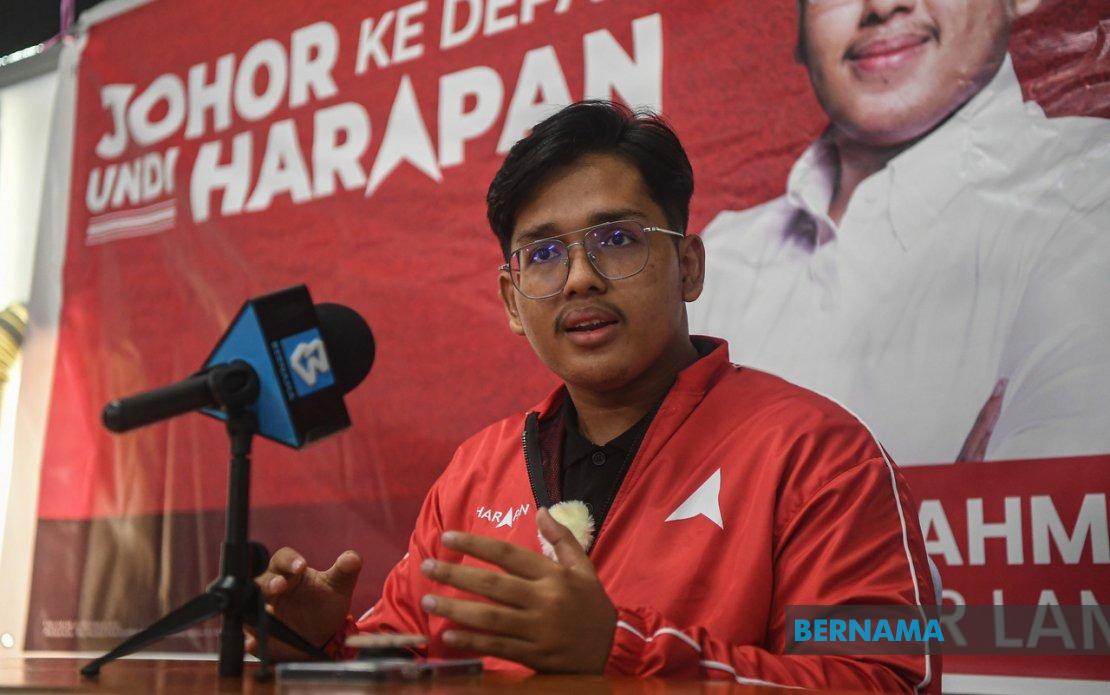
The youngest contender in the 16th Johor state election is leveraging grassroots enthusiasm and an energetic campaign presence to challenge established rivals in the Johor Lama constituency. Danish Hossman Abd Rahman, 23, has described the community's receptiveness to his candidacy as an important morale booster that reinforces his determination to deliver transformative results for the rural area. Representing Pakatan Harapan, he believes his consistent engagement with voters across various social strata has deepened his understanding of local needs and strengthened his competitive position heading into the final campaign phase.
A Master of Information Technology student at Universiti Tun Hussein Onn Malaysia, Hossman has found unexpected backing from older demographics who view his youth as a potential asset rather than a liability. Veterans and senior voters, he explains, have expressed appreciation for his willingness to conduct intensive fieldwork and listen directly to their grievances. This generational bridge reflects a broader frustration among long-serving constituencies who perceive incumbent representatives as increasingly disconnected from ground-level issues. The candidate observes that many elderly voters have grown disillusioned with age-matched or older politicians who, in their estimation, maintain minimal public presence while citizen concerns remain unaddressed.
Rather than framing his candidacy around age alone, Hossman positions himself as an ideological connector between the institutional knowledge of established leaders and the reform impulses of younger voters. He emphasizes that his approach does not dismiss the experience of previous generations but rather seeks to synthesize pragmatic lessons from the past with contemporary aspirations for change. This messaging strategy addresses a potential vulnerability—the perception that youth candidates lack depth—by explicitly acknowledging the value of seasoned judgment while arguing that new thinking is essential to break entrenched patterns of governance.
With voting scheduled for Saturday, Hossman has intensified his outreach schedule across urban centres, rural settlements, and Felda-developed communities, with particular emphasis on mobilizing younger voters, women, and small business operators. He has deliberately conducted multiple engagement rounds with communities to build familiarity and cultivate personal connections that transcend transactional politics. His core plea to voters focuses on merit-based evaluation of candidates rather than tribal political attachments or personality-driven attacks. This appeal to substance-oriented politics carries particular resonance in constituencies where previous electoral cycles have been defined by inflammatory rhetoric.
The candidate has identified affordable housing shortages and job creation deficits as the primary drivers of youth outmigration from Johor Lama. Young people, particularly those with education or skills, have increasingly migrated to urban centres seeking economic opportunities unavailable in their home communities. This pattern reflects broader structural challenges across rural Malaysia, where economic opportunities remain concentrated in metropolitan regions despite government initiatives promoting decentralized development. Hossman's diagnosis of these problems demonstrates awareness of the underlying demographic shifts reshaping Johor's political landscape.
His policy platform emphasizes attracting capital investment and developing downstream industrial capacity aligned with Johor Lama's agricultural foundations and natural endowments. Rather than proposing wholesale economic transformation, he advocates for value-added development in agribusiness and livestock production that leverages existing competitive advantages. This strategy recognizes that rural constituencies cannot compete with cities in attracting high-tech manufacturing or service industries, but may develop profitable niches in food production, processing, and export-oriented agriculture. Such targeted sectoral development could create intermediate employment categories suited to workers with vocational or tertiary qualifications.
The constituency contest presents a three-way competition pitting Hossman against incumbent Norlizah Noh of Barisan Nasional and Aisah Esa representing Perikatan Nasional. This triangular configuration emerged from a broader pattern of political fragmentation at the state level, where no single coalition commands overwhelming dominance. The presence of multiple competitive candidates may elevate campaign intensity and force all contestants to articulate detailed policy platforms rather than relying on party machinery or incumbency advantage. For voters, the enlarged choice set theoretically strengthens accountability pressures, though it may also fragment support in ways that favour candidates with distinct demographic bases.
The broader Johor state election involves 172 candidates contesting 56 assembly seats, creating a dispersed competitive environment where local factors and individual candidate attributes carry amplified significance. State elections in Malaysia increasingly function as mid-term assessments of federal government performance, yet they remain fundamentally territorial contests where local governance capacity and responsiveness to constituent needs matter substantially. Johor's electoral context has proven volatile in recent cycles, with voters demonstrating willingness to shift allegiances when dissatisfied with incumbent performance or drawn to alternative visions.
Hossman's campaign narrative emphasizes retention of talented youth within their communities by creating plausible pathways to careers, family formation, and prosperity in village settings rather than requiring migration to urban centres. This vision addresses a genuine concern animating rural politics throughout Southeast Asia, where demographic decline and economic stagnation have triggered social anxiety. By framing development through the lens of enabling young people to build meaningful lives locally rather than imposing external development models, he taps into aspirations for development that respects existing community bonds while improving material conditions.
The candidate's emphasis on meeting voters multiple times reflects sophisticated understanding that electoral choice involves relationship-building and trust cultivation rather than one-time message transmission. Repeated personal contact allows candidates to demonstrate consistency and commitment while permitting voters to form independent judgments about character and sincerity. This labour-intensive approach proves particularly valuable for younger candidates lacking party machinery advantages, as it substitutes organizational infrastructure with personal energy and authentic community presence.
As campaigning enters its final intensive week before Saturday's polling, Hossman's strategy centers on expanding his footprint among youth cohorts and small business constituencies who may feel underserved by traditional politicians. His appeal to younger demographics reflects calculation that this group's electoral participation remains below potential levels, representing a latent constituency whose mobilization could shift outcome dynamics. Whether voters ultimately reward his generational positioning and promise of focused economic development against the organizational resources and incumbency advantages of established competitors will determine whether Johor Lama elects a parliament member who represents a genuine generational shift in Malaysian politics.

