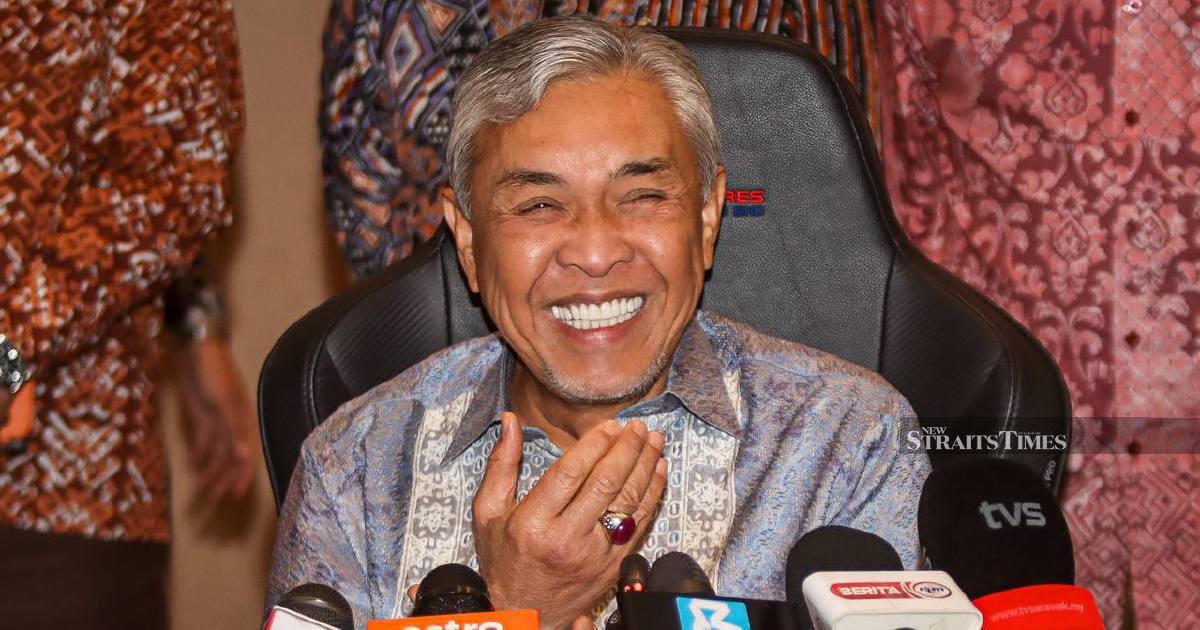
Deputy Prime Minister Datuk Seri Dr Ahmad Zahid Hamidi deployed traditional Malay poetry to engage Prime Minister Datuk Seri Anwar Ibrahim's earlier unity message, exchanging a four-line pantun during what appears to be an unfolding dialogue between two of Malaysia's highest-ranking leaders. The exchange, which took place in George Town, represents a notably civilised mode of political communication in a nation where tensions between coalition partners occasionally surface in more abrasive public statements.
The use of pantun as a vehicle for high-level political messaging reflects a distinctly Malaysian approach to leadership discourse. Rather than issuing press statements or engaging in direct rebuttals, both leaders chose a form deeply embedded in Malay and Malaysian culture—a classical poetic structure that requires wit, cultural fluency, and careful composition. This approach suggests both men are conscious of appealing to traditional sensibilities whilst maintaining the dignity expected at their level of governance. The pantun tradition, with its emphasis on metaphor and indirect expression, allows political figures to communicate nuanced positions without the appearance of confrontation.
Zahid's poetic response, structured around themes of roofs and storms, carries layered significance for Malaysian observers. The imagery likely references questions of stability, protection, and leadership during turbulent periods—symbols that resonate within the context of Malaysia's complex political landscape. By choosing weather-related metaphors, the Deputy Prime Minister appears to address broader concerns about the nation's trajectory whilst framing his position in language that emphasises resilience rather than conflict. This represents a sophisticated form of political communication that elevates discourse beyond typical partisan exchanges.
The exchange occurs within Malaysia's ongoing coalition government framework, where maintaining unity between the ruling Pakatan Harapan alliance and other political partners remains crucial for stable governance. Zahid's participation in this poetic dialogue signals his willingness to engage constructively with the Prime Minister despite the inevitable tensions that arise within any governing coalition. For observers tracking intra-coalition dynamics, such symbolic exchanges often provide insight into the temperature of relationships between key personalities—in this case, suggesting communication channels remain open and cordial.
Anwar Ibrahim's initial unity-themed pantun set the conversational tone, framing Malaysia's political moment around concepts of togetherness and shared purpose. By responding in kind, Zahid demonstrates respect for the Prime Minister's leadership whilst simultaneously asserting his own voice and perspective. The pantun format allows both leaders to contribute meaningfully to national discourse without triggering the kind of headline-grabbing confrontations that could unsettle financial markets or international observers monitoring Malaysia's political stability.
Malaysian political culture has long incorporated traditional artistic forms into high-level communication. The pantun, with its ABAB rhyme scheme and requirement for clever couplets, represents a test of linguistic and cultural competence. That both the Prime Minister and Deputy Prime Minister engage in this form speaks to their investment in cultural authenticity and their understanding that certain audiences respond more positively to messages framed in traditional rather than purely contemporary language. For Malay-speaking Malaysians, particularly those in rural constituencies or traditional communities, such exchanges carry particular weight.
The imagery deployed in Zahid's roof-and-storm pantun invites interpretation across multiple registers. In the context of Malaysia's macroeconomic challenges, infrastructure development priorities, and the nation's need to navigate global uncertainties, metaphors about protective structures and weather systems carry practical resonance alongside their poetic dimensions. Citizens concerned about governance, economic stability, and the government's capacity to manage crises might interpret such messaging as reassurances about leadership preparedness.
This form of political expression contrasts sharply with more contentious communication patterns observed elsewhere in global politics. Rather than trading accusations or engaging in social media warfare, Malaysia's top leaders choose a medium that requires sophistication, cultural knowledge, and careful thought. The pantun exchange thereby sets a tone for governance that emphasises courtesy and intellectual engagement, qualities that can influence broader political culture and citizen expectations of leadership conduct.
For regional observers, the Zahid-Anwar pantun exchange carries significance beyond its literary merit. It demonstrates Malaysia's ability to manage elite disagreements through culturally appropriate channels whilst maintaining the appearance and substance of governmental coherence. Investors and international partners monitoring Malaysia's political stability will likely interpret such exchanges as positive signals that leadership disputes remain manageable and that coalition partners prioritise national interest over personal confrontation.
The question of what specific substantive positions Zahid's pantun communicates remains partially opaque to those unfamiliar with the full verses and their metaphorical implications. However, the willingness to engage through this traditional medium itself constitutes a message—one suggesting the Deputy Prime Minister remains committed to participating constructively in governance despite any policy disagreements with the Prime Minister. This commitment to working within established cultural and constitutional frameworks provides reassurance about the continuity of Malaysia's institutional structures.
Moving forward, observers should monitor whether this pantun exchange initiates a broader pattern of poetic dialogue between top leaders, or whether it remains a singular moment of cultural expression. Either way, it exemplifies a distinctly Malaysian approach to managing political plurality—one that accommodates multiple voices and perspectives whilst maintaining the formal structures necessary for effective governance.

