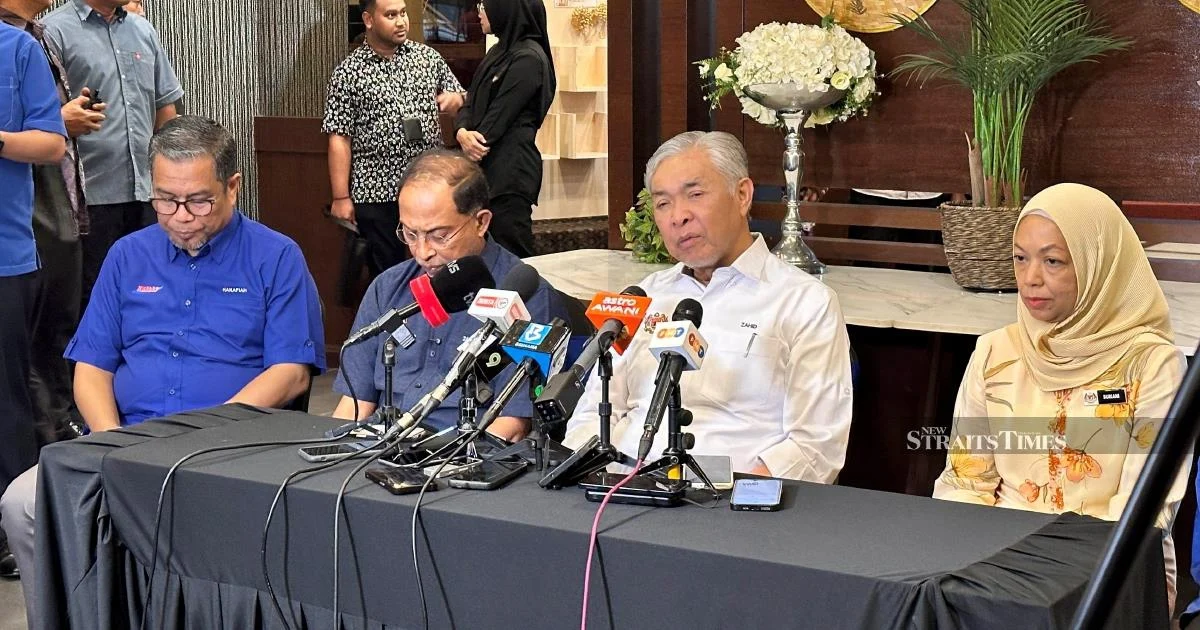
Barisan Nasional chairman Datuk Seri Dr Ahmad Zahid Hamidi has made clear his irritation with coalition allies who have incorporated Datin Seri Rosmah Mansor into the Johor state election campaign, effectively rebuking what appears to be a provocative campaign tactic within the unity government framework. Zahid's comments in Kluang signal mounting tension beneath the surface of Malaysia's governing coalition as various factions pursue divergent campaign strategies ahead of crucial electoral contests.
The friction centres on the continued political relevance of figures associated with the previous Barisan Nasional administration, particularly the former premier Datuk Seri Najib Tun Razak and his wife. Rather than allowing these personalities to fade from political discourse, some coalition partners have chosen to reactivate their public profiles as campaign tools, a decision that contradicts the broader coalition's stated direction. Zahid's intervention suggests that the current BN leadership views such strategies as counterproductive and potentially damaging to the government's electoral prospects.
The deployment of Rosmah's image in campaigning represents a calculated political manoeuvre by elements within the unity government, though their exact motivations remain ambiguous. Some observers speculate that certain factions within the coalition retain genuine loyalty to the Najib-Rosmah era and view their political rehabilitation as beneficial for party fortunes. Others argue that invoking their names and images is designed to energise a particular voter demographic that remains nostalgic for the previous administration's approach to governance and patronage networks.
For Zahid and the current BN hierarchy, however, such moves complicate the government's narrative around accountability and renewal. The BN has sought to rebuild its credibility following the Najib-Rosmah period, which was marked by numerous corruption allegations and the controversial 1Malaysia Development Berhad scandal. Allowing these figures to maintain prominence in campaign materials appears to undermine that carefully constructed rehabilitation effort and risks reminding voters of controversies the government would prefer to consign to history.
The unity government framework, which brings together the BN, Pakatan Harapan, and other parties in an unprecedented governing coalition, has proven fragile on numerous occasions. Each component party pursues its own electoral interests while nominally supporting collective governance, creating frequent contradictions. Zahid's rebuke illustrates how these inherent tensions emerge most visibly during campaign periods, when individual parties prioritise their own survival over broader coalition discipline.
Johor, Malaysia's second-largest state by population, represents critical electoral territory for both the BN and its rivals. The state's political complexion carries implications for federal stability, as strong state-level performance influences party morale and fundraising capacity. A successful Johor campaign is essential for the BN to demonstrate that it remains a viable electoral force capable of winning competitive contests without relying solely on the unity government framework.
The Najib-Rosmah factor in Malaysian politics remains complex and potentially divisive. While the couple faces numerous legal challenges and public opprobrium in urban centres, they retain supporters in traditional constituencies and among voters who benefited from earlier patronage systems. This creates genuine tension within coalition ranks: some believe the past should be definitively buried, whilst others sense electoral opportunity in reviving associations with a period when the BN's patronage machine functioned at peak efficiency.
Zahid's intervention carries implicit risks alongside its apparent benefits. By explicitly rejecting allies' campaign choices, he emphasises his authority over coalition decision-making but also highlights internal disunity at a sensitive moment. Voters observing open disagreement among government partners may question the coalition's ability to govern coherently or execute unified policy directions. Conversely, failing to address the issue risks appearing weak to those who view the Najib-Rosmah legacy as politically damaging that requires active suppression.
The broader context involves Malaysia's ongoing reckoning with recent history and questions about institutional accountability. The courts continue processing legal matters related to the Najib-Rosmah era, suggesting that political resolution remains incomplete and potentially destabilising. Until these institutional processes conclude, the couple's status as political figures remains unsettled, complicating their deployment in campaigns by whichever coalition factions view them sympathetically.
Zahid's position as BN chairman gives him considerable influence over party messaging, yet his ability to impose discipline across the entire unity government remains limited. Individual coalition partners retain substantial autonomy, particularly during campaign periods when they prioritise local electoral calculations over federal coalition harmony. This structural reality means Zahid's rebuke, however pointed, may struggle to constrain determined allies genuinely committed to reviving the Najib-Rosmah brand.
The Johor election ultimately reflects broader questions about Malaysia's political direction: whether the country is consolidating democratic reforms initiated after 2018 or reverting toward the patronage-based systems of the previous era. Zahid's pushback against Rosmah's deployment in campaigning suggests he favours emphasising forward momentum over nostalgic appeals, positioning the BN as a reformed party rather than one attempting to resurrect discredited figures. However, the receptiveness of voters and fellow coalition members to this approach remains decidedly uncertain as the campaign intensifies.

