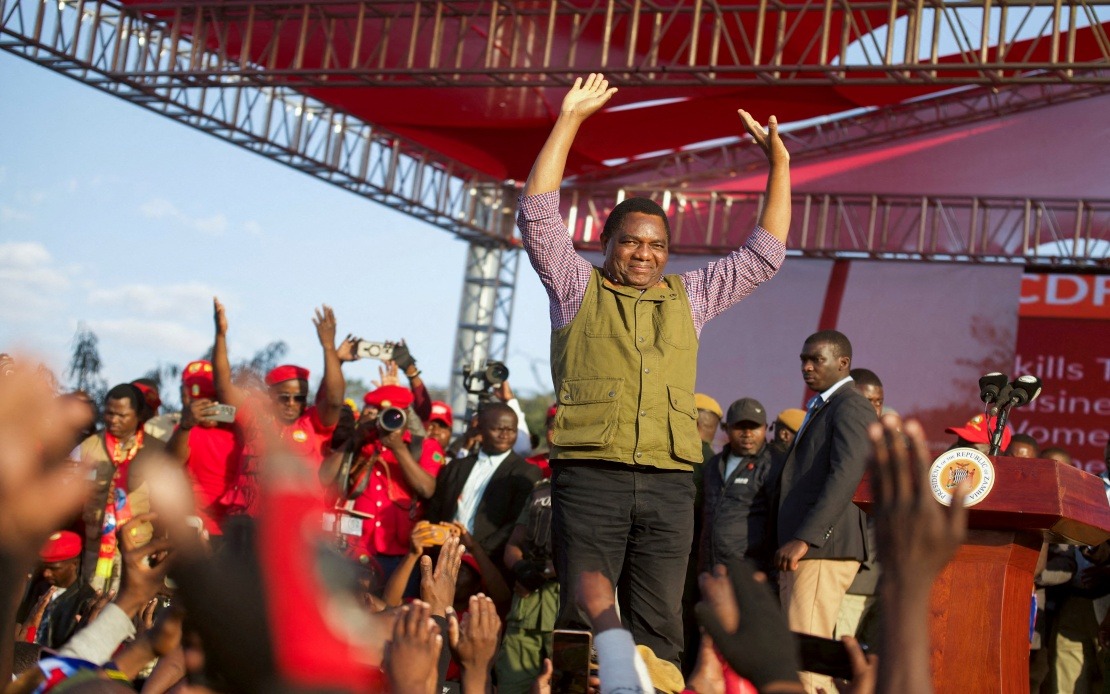
Zambian President Hakainde Hichilema has secured a decisive victory in his bid for a second term, according to results announced by the Electoral Commission of Zambia in the early hours of Tuesday. The 64-year-old leader accumulated more than 2.9 million votes, a commanding performance that comfortably exceeded the constitutional requirement of 50 per cent plus one vote needed to retain the presidency.
Hichilema's victory margins proved so substantial that Electoral Commission of Zambia chairperson Mwanagala Zaloumis declared the outcome virtually insurmountable despite outstanding tallies from selected polling stations across five of the country's 226 constituencies. The official indicated that even if those remaining results were counted in full, they would not materially alter the final outcome, underscoring the magnitude of Hichilema's mandate from Zambian voters.
The president's main challenger, Brian Mundubile representing the National Restoration Party for Unity and Progress (NRPUP), garnered approximately 1.8 million votes in the contest held last Thursday. The gap of over one million votes between the top two candidates reflects a significant endorsement of Hichilema's leadership and policy direction over the alternative vision presented by the opposition.
In a statement posted on Facebook shortly after the official declaration, Hichilema expressed gratitude to the Zambian electorate for placing their confidence in his administration once again. His message emphasised humility and a commitment to serve the nation's interests, framing his re-election as a renewed mandate to continue pursuing his political agenda during his second five-year term.
The victory announcement triggered spontaneous celebrations across Zambia's capital, with residents from diverse backgrounds congregating in Lusaka's streets to mark the occasion. Despite the early morning hour and cold weather conditions typical of Zambian winter, crowds gathered to express their enthusiasm for the election outcome, creating an atmosphere of civic participation and democratic engagement.
Collins Maoma, national chairperson of Hichilema's ruling United Party for National Development (UPND), seized the moment to appeal for continued public support. Addressing reporters, Maoma highlighted what he characterised as Zambians' demonstrated confidence in Hichilema's stewardship, calling on the president to maintain the leadership standards that have apparently earned him renewed popular endorsement.
For Malaysian observers, Hichilema's re-election carries significance within the broader African democratic context. As a regional economic powerhouse with substantial mineral wealth, Zambia's political stability and governance trajectory influence broader Southern African development patterns and investment climates. The decisive nature of this electoral outcome suggests institutional frameworks capable of managing transitions of power peacefully, a characteristic increasingly important for continental economic cooperation.
Hichilema's first term, beginning in 2021, followed his previous unsuccessful campaigns and represented a significant political realignment in Zambian politics. His victory then ended nearly two decades of rule by his predecessor, signalling voter appetite for leadership change. The current re-election indicates that Hichilema has either consolidated support among his original coalition or expanded it, affirming the legitimacy of his administration's direction.
The electoral commission's handling of results announcements and its confidence in the outcome's finality despite incomplete official tallies demonstrates institutional capacity that can matter significantly for post-election stability. When electoral bodies project outcomes with authority while acknowledging outstanding matters, they establish frameworks within which losers can concede gracefully and society can transition toward governing rather than contesting legitimacy.
For Southeast Asian policymakers and analysts monitoring democratic resilience in the Global South, the Zambian example offers instructive material. Large-scale popular mobilisation around electoral processes, as evidenced by Lusaka's spontaneous celebrations, reflects democratic cultures that survive institutional manipulation or decline. The geographic scale of Zambia and its relatively dispersed population across 226 constituencies present logistical electoral challenges comparable to those facing some Southeast Asian nations.
Hichilema's second-term pathway now requires translating electoral capital into tangible policy outcomes. Zambia faces persistent economic challenges including debt restructuring, inflation management, and agricultural productivity improvement—issues where governance performance becomes concretely measurable. The president's re-election provides political space to pursue potentially unpopular but necessary reforms without immediate fear of electoral punishment, a window that competent leadership typically exploits strategically.
Looking ahead, Hichilema's administration faces the complex task of managing diverse stakeholder expectations that helped construct his winning coalition. UPND leadership will need to balance developmental priorities against fiscal constraints while maintaining the political cohesion that delivered electoral victory. The size of his mandate suggests flexibility in pursuing substantive policy agendas, though sustained governance performance will ultimately determine whether this electoral endorsement translates into improved living standards for ordinary Zambians across the country.

