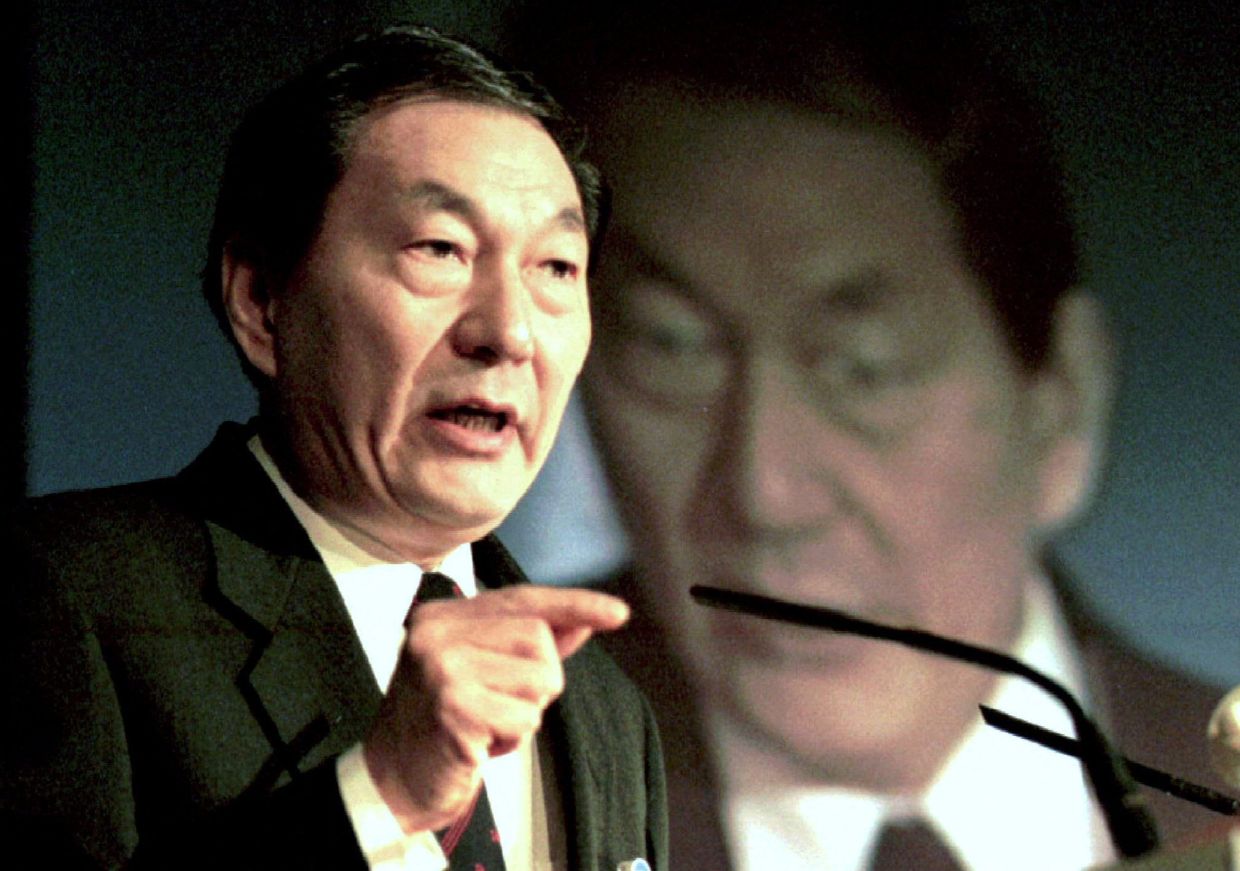
Zhu Rongji, the architect of China's market-oriented economic transformation who steered the nation through the 1997 Asian financial crisis and engineered its admission into the World Trade Organization, has died in Beijing at age 98. The former premier passed away on Wednesday (Aug 12) morning following unsuccessful medical treatment for an unspecified condition, according to the official Xinhua News Agency. His death marks the end of an era defined by bold structural reforms that fundamentally altered China's economic landscape, even as subsequent administrations have taken markedly different policy directions.
Zhu's tenure as premier between 1998 and 2003 represented one of the most consequential periods of economic reorganization in modern Chinese history. Before ascending to the premiership, he served as the country's chief economic planner, navigating twin challenges of runaway double-digit inflation and regional financial instability. His approach was characterised by decisive action against what he viewed as structural inefficiencies within the state apparatus. The scope of his industrial restructuring was vast: tens of thousands of underperforming state-owned enterprises across telecommunications, banking, petroleum, and other sectors were shuttered or consolidated as part of a broader strategy to reduce mounting debt and stimulate growth through expanded private sector participation.
The human cost of these reforms was substantial. Tens of millions of workers lost their positions as bloated state companies were downsized or eliminated entirely. This transition represented a significant departure from the iron rice bowl system that had guaranteed employment under socialist planning. Yet Zhu and his supporters argued that without such painful adjustments, China's economy would stagnate under the burden of inefficient enterprises consuming state resources while generating minimal returns. The trade-off between short-term social disruption and long-term economic dynamism became a defining feature of his policy agenda.
Contemporary Chinese leadership under President Xi Jinping has adopted a contrasting philosophy, advocating for a "stronger, better, and bigger" state-controlled economy designed to serve overarching national strategic priorities. This represents a partial reversal of the privatization momentum that Zhu championed, though the comparison is complex given China's continued reliance on market mechanisms. Where Zhu emphasised retrenchment of state presence to improve efficiency, Xi's doctrine reasserts state control to align economic activity with political objectives. For Malaysian and Southeast Asian observers, this ideological divergence illuminates ongoing debates within the Chinese leadership about the appropriate balance between market forces and state direction.
Zhu's most internationally visible achievement was facilitating China's 1997 Hong Kong share sale of what would become China Mobile Ltd., then known as China Telecom (Hong Kong). Working with John Thornton, former co-president of Goldman Sachs Group Inc., Zhu demonstrated an unusual level of engagement with corporate mechanics. He assembled China Mobile executives on the island of Hainan and imported expertise from Deutsche Telekom AG to establish functional departments in finance and marketing. Zhu's meticulous questioning of executives on technical matters struck Thornton as extraordinary—such granular economic literacy at the premier level was unusual internationally. The entire exercise served a symbolic purpose: convincing the world that Hong Kong would retain its capitalist character and flourish under mainland Chinese sovereignty just months after the territory's handover.
During his earlier tenure as governor of the People's Bank of China from 1993 to 1995, Zhu had already begun systematically opening Chinese financial markets to foreign participants through pilot programmes and landmark overseas bond issuances. This liberalisation created pathways for international capital inflows and established China as an emerging player in global finance. His 1999 creation of asset-management companies to absorb 1.4 trillion yuan (US$220 billion) in non-performing loans from China's four largest banks proved instrumental in stabilising the financial system. By purchasing bad debts from state lenders burdened by years of directed lending to unprofitable enterprises, these entities permitted the banks to rehabilitate their balance sheets and subsequently list publicly beginning in 2005, transforming them into more commercially oriented institutions.
Zhu's role in bringing China into the World Trade Organization represented perhaps his most consequential international contribution. In 2000, he met with then-European Union Trade Commissioner Pascal Lamy in Beijing to resolve negotiating deadlocks that had stalled China's accession. Within a year, China formally joined the WTO, an outcome that accelerated its integration into global commerce and investment networks. Since then, China's GDP has expanded elevenfold to establish the country as the world's second-largest economy. Yet this integration has generated persistent international friction. Trading partners have repeatedly accused Beijing of violating WTO principles through subsidisation of domestic industries, erection of informal import barriers, and systematic intellectual property violations—tensions that remain central to contemporary geopolitical disputes.
Beyond economic policy, Zhu cultivated a reputation for administrative efficiency and personal integrity. His anti-corruption campaign and efforts to streamline governmental bureaucracy earned him the colloquial nickname "one-chop Zhu," referencing the official seals or "chops" required for document authorisation in China. He became renowned among foreign leaders for his fluent English and quick wit. During a 1999 press conference alongside US President Bill Clinton, when queried about alleged Chinese political contributions to the Democratic Party, Zhu delivered a witty riposte: with US$146 billion in foreign exchange reserves, he quipped, China could certainly afford more significant contributions if they were effective—making US$300,000 donations seem absurdly insufficient. The comment drew appreciative laughter and exemplified his disarming public persona.
Zhu was born in October 1928 in Hunan province, the same birthplace as Chairman Mao Zedong. He attended Tsinghua University from 1947 to 1951, majoring in electrical engineering and joining the Communist Party in October 1949, the month Mao proclaimed the People's Republic's founding. His early career involved work at the state planning agency from 1952 onwards. During the Hundred Flowers Campaign, when Mao temporarily encouraged open criticism, Zhu voiced skepticism about official economic policies, arguing they produced irrational hyperinflation. This candour resulted in his designation as a "rightist" and demotion. The Cultural Revolution brought further hardship: he spent five years on a farm raising pigs and cultivating rice before rehabilitation in 1978. These experiences of persecution seemingly reinforced his conviction that pragmatic economic management mattered more than ideological purity.
Following his rehabilitation, Zhu ascended through successive governmental positions with remarkable velocity. He became Shanghai's mayor in 1987 and achieved vice-premier rank in 1991 before joining the Politburo Standing Committee in 1992. His elevation to premier in 1998 placed him at the apex of executive authority during a pivotal developmental moment. When relinquishing the premiership to Wen Jiabao in 2003, Zhu channelled his remaining decades into enhancing Tsinghua University's international standing and funding rural schools through book royalties. During a 2000 legislative session, he articulated his personal measure of success: "I only hope that after I leave office, the Chinese people will say that he was a clean official, not a corrupt one. I would be very satisfied. If they are more generous and say that Zhu Rongji got some real things done, then I'd thank heaven and Earth."
Zhu's family maintained prominence in China's financial sector. His son, Levin Zhu, directed China International Capital Corp, a Beijing-based investment bank, from the early 2000s until 2014. His daughter, Zhu Yanlai, occupied senior management roles at Bank of China (Hong Kong). He is survived by his wife, Lao An. His death concludes a remarkable trajectory from Cultural Revolution persecution to becoming one of modern China's most consequential economic architects—a legacy that continues shaping contemporary debates over the state's appropriate role in economic management across Asia.

