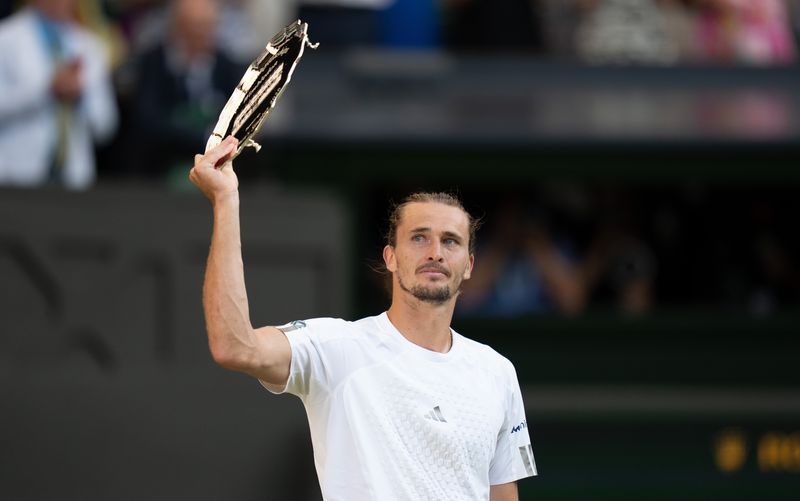
Alexander Zverev will occupy the number two position in the ATP world rankings from Monday, cementing his status among tennis's elite. Yet the German remains acutely aware of the gulf separating him from the sport's current dominant figures. Following his loss to world number one Jannik Sinner in the Wimbledon final on Sunday, Zverev is convinced that the attacking game style he has embraced this season offers a genuine pathway to competing for the game's most prestigious titles alongside Sinner and Spanish challenger Carlos Alcaraz.
The 29-year-old contested Sunday's final with remarkable tenacity against Sinner, delivering the kind of aggressive performance that appeared beyond his reach just months earlier. Zverev surrendered the match 6-7(7) 7-6(2) 6-3 6-4, but the scoreline scarcely captures the intensity of their encounter. This marked his tenth consecutive defeat to the Italian, though crucially it bore little resemblance to previous encounters. Zverev had snapped a damaging streak of 14 consecutive sets lost to Sinner, signaling a tangible shift in his competitive standing. Cruelly, a fall when Zverev held his sole break point opportunity at 3-3 in the third set may have altered the trajectory of the match entirely. Had he navigated past this moment, he could have become the first German male player to claim the Wimbledon singles crown since Michael Stich in 1991.
Zverev's trajectory through 2024 has been marked by a philosophical recalibration of his tennis identity. His breakthrough Grand Slam victory at the French Open last month represented his maiden major title after 41 previous attempts. Notably, both Sinner and Alcaraz were compromised at Roland Garros, with the Italian eliminated in the second round and the Spanish seven-time Grand Slam champion sidelined by a wrist injury. While skeptics might cite these circumstances, the psychological impact on Zverev proved undeniable. The confidence derived from finally capturing a Grand Slam manifested strikingly at the All England Club, where his embrace of an assertive forehand-led approach propelled him to the best Grand Slam performance of his career on grass.
The technical foundation of Zverev's evolved approach centers on proactive shot-making rather than the reactive baseline defense that characterized his earlier career. Throughout the Wimbledon final, his first serve percentage maintained approximately 80 percent efficiency, a critical foundation for an attacking strategy. More conspicuously, his forehand—historically criticized as overly passive—became a weapon of genuine destructiveness against Sinner. Rather than seeking opportunities to construct points methodically, Zverev now commits to aggressive strokes whenever openings present themselves, accepting the inevitable misses as the necessary price of elevated play.
Zverev articulated this philosophical shift with clarity when addressing reporters following his defeat. He emphasized that his commitment to this attacking methodology remained unwavering throughout the year, despite encountering struggles during the campaign's early stages. The consistent application of this strategy, he argued, would yield improving results as familiarity deepened. His Parisian triumph and Wimbledon final appearance provided concrete validation of this approach's efficacy. Zverev rejected any notion of merely grinding out competitive matches, instead asserting his intention to construct a career predicated on offense and controlled aggression.
The statistical reality of contemporary tennis underscores the magnitude of Zverev's challenge. Sinner and Alcaraz have accumulated 12 Grand Slam titles between them, establishing themselves as the sport's generational standard-bearers. Zverev possesses just a single major, acquired under circumstances that invited external scrutiny. Yet the German demonstrated genuine conviction regarding his capacity to bridge this divide. He highlighted his competitive encounters with both rivals in 2024—pushing Alcaraz to the limits in Australia and taking Sinner to four intensely competitive sets at Wimbledon. These matches, Zverev insisted, represented something qualitatively different from his previous encounters with these elite competitors.
The discourse surrounding tennis's hierarchy has long fixated upon identifying the mystical "third man" capable of sustaining competition with Sinner and Alcaraz. For several years, Zverev occupied this unofficial position, yet the separation in quality remained pronounced. His recent performances suggest a meaningful narrowing of this gap. Should Zverev continue narrowing this distance through consistent application of his attacking methodology, he genuinely could enter the conversation as a routine contender for the sport's largest prizes rather than a perpetual bridesmaids candidate.
Physical resilience will prove critical to Zverev's aspirations. His fall during Sunday's third set caused a recurrence of an old knee concern, forcing him to modify his service delivery. The subsequent decline in serve velocity contributed to his performance deterioration in that set, though he recovered his intensity in the fourth. Zverev acknowledged this injury's impact while noting that his overall performance level remained elevated throughout the contest. Managing the physical demands of aggressive tennis while avoiding serious injury will represent an ongoing challenge as he pursues his competitive objectives.
For Malaysian and Southeast Asian tennis observers, Zverev's evolution carries particular significance. His rise toward sport's elite tier demonstrates that even late bloomers can achieve breakthrough success through tactical innovation and psychological resilience. The German's emphasis on aggressive, modernized approach contrasts with purely defensive grinding strategies, reflecting broader trends in contemporary professional tennis toward faster, more attacking patterns of play. Zverev's competitive trajectory suggests that the Sinner-Alcaraz duopoly, while currently formidable, may face sustained challenges from practitioners of evolving methodologies. His commitment to this attacking philosophy, validated through major championship success and Wimbledon's grandest stage, positions him as a genuinely credible threat to tennis's current power structure for the remainder of his career.

