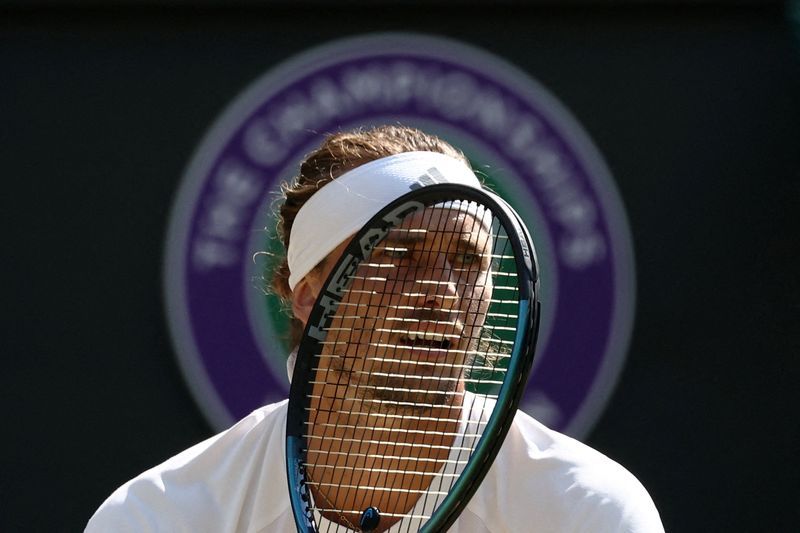
Alexander Zverev has moved into the semi-finals of Wimbledon following a commanding straight-sets victory over Taylor Fritz, in what represents a significant psychological breakthrough for the German second seed. The 6-4 6-4 6-2 scoreline belies the importance of the result for Zverev, who had endured a frustrating run of seven consecutive defeats against Fritz stretching back over two years, including a loss at the All England Club just twelve months earlier. By breaking through against his American tormentor, Zverev has cleared a major psychological barrier in his pursuit of consecutive Grand Slam titles, having won the French Open crown earlier this season.
Zverev's passage into the last four marks a historic milestone for German men's tennis in the professional era. By reaching his first Wimbledon semi-final, he has joined an exclusive cohort that includes Boris Becker, Michael Stich, Rainer Schuettler and Tommy Haas—only five German men have achieved the feat since the modern professional era began in 1968. This distinction underscores both the rarity of sustained success at Wimbledon and the renewed prominence of German players in the upper echelons of professional tennis following a period of relative decline.
The match itself unfolded along predictable lines once Zverev established early control on Court One in sweltering conditions. The German broke Fritz's serve to forge a 5-4 advantage in the opening set, then weathered a determined late rally from his opponent before closing out the first set with a mixture of precision and relief. Zverev's superiority in the second set became even more pronounced following a medical timeout taken by Fritz for a right knee complaint in the third game. The American's physical vulnerability provided the opening Zverev required, and the German capitalised ruthlessly by engineering the crucial break that placed Fritz in an increasingly untenable position.
Zverev's intensity mounted as the match progressed into its final stages. A striking backhand winner down the line at 4-1 in the third set exemplified the quality of his ball-striking and his apparent immunity to the pressure that typically accompanies breaking a lengthy losing streak. The remainder of the third set proved merely a formality, with Zverev closing out the match with professional efficiency to claim his 12th Grand Slam semi-final appearance.
For Malaysian and Southeast Asian tennis enthusiasts, Zverev's progress carries particular significance given the global reach of Wimbledon and the tournament's cultural resonance across the region. The German's resurgence at the grass-court championships demonstrates the unpredictable nature of tennis, where long-established matchup dynamics can shift dramatically with a single decisive performance. His pairing with Arthur Fery in the semi-final sets up a compelling narrative, with both players experiencing their maiden Wimbledon last-four appearance.
Zverev's post-match commentary revealed the mental fortitude required to overcome extended periods of underperformance against a specific opponent. The German explicitly acknowledged the psychological weight of his two-year losing streak, noting that awareness of past failures had weighed heavily throughout the contest. He described the victory as nearly flawless, observing that he had needed to execute an "almost perfect match" to secure the breakthrough. Such candour offers insight into the mental dimensions of professional tennis, where objective quality of play must be married with psychological resilience.
The German's light-hearted interactions with the crowd demonstrated the confidence flowing through him following the triumph. His reference to Fery's semi-final appearance as a "Fery-tale story"—accompanied by acknowledgment that the home crowd would inevitably favour the British player—revealed an athlete comfortable with his position and secure enough to embrace rather than resent potential crowd bias. This demeanour contrasts sharply with the tension evident during the match itself, suggesting Zverev possesses the emotional intelligence to compartmentalise pressure during competition while maintaining equanimity in calmer moments.
Zverev's pursuit of consecutive Grand Slam titles remains realistic following this breakthrough performance. His earlier success at the French Open established his capability to perform at the highest level across different court surfaces, though grass remains the most demanding and least predictable of major championship environments. The upcoming semi-final against Fery will present a different tactical puzzle compared to the Fritz encounter, as the British player's grass-court credentials and home advantage could prove more formidable obstacles than any psychological baggage.
The broader implications of Zverev's progress extend beyond individual glory to encompass the competitive structure of men's professional tennis. The emergence of multiple contenders at this stage of a Grand Slam tournament underscores the depth of talent currently competing at the elite level. While Novak Djokovic's earlier retirement from the tournament reduced the traditional hierarchy of elite performers, the quality of play demonstrated by remaining contenders suggests the competition remains fiercely contested across all remaining positions.
For Zverev personally, the semi-final appearance at Wimbledon completes a remarkable rehabilitation of his status at grass-court tournaments. His previous achievements at the All England Club have been modest relative to his accomplishments elsewhere, making this breakthrough particularly redemptive. Should he progress further, Wimbledon could become a significant arena for cementing his legacy as one of his generation's most successful players across multiple surfaces and competitive environments.

