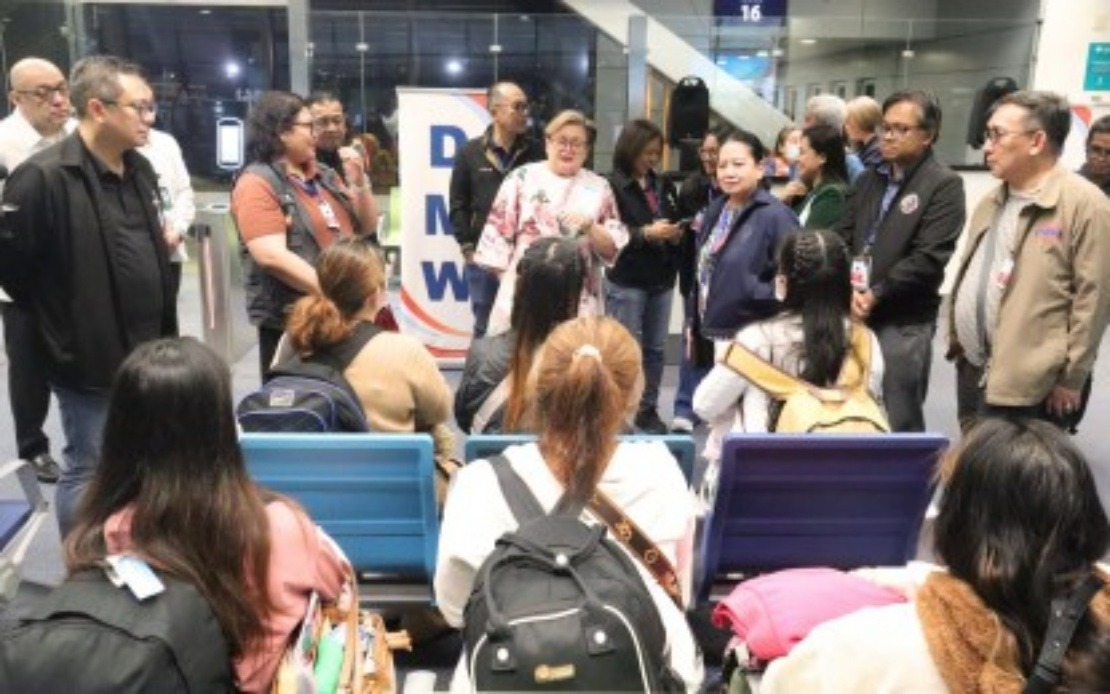
The return of 24 Filipino workers to Manila marks a significant diplomatic victory for the Philippines, achieved through personal intervention by President Ferdinand R. Marcos Jr. at the highest levels of bilateral engagement. The detainees, who had languished in custody in the Russian city of Irkutsk for approximately nine months, arrived at Ninoy Aquino International Airport early Sunday morning in two separate flights from Bangkok, Thailand. Their homecoming came just days after Marcos raised their situation directly with Russian President Vladimir Putin during a bilateral meeting held on the sidelines of the ASEAN-Russia Commemorative Summit in Kazan, underscoring the value of face-to-face diplomatic engagement in resolving cases involving overseas Filipino workers.
The repatriation operation unfolded in two waves, with six workers landing shortly after midnight aboard Philippine Airlines Flight PR737, followed by the remaining eighteen passengers on PAL Flight PR733 in the early morning hours. This phased arrival reflected careful coordination between multiple government agencies, demonstrating the operational complexity required to bring such dispersed individuals home. The Department of Foreign Affairs worked in tandem with the Department of Migrant Workers and the Overseas Workers Welfare Administration to orchestrate the movement, with Foreign Affairs Secretary Maria Theresa Lazaro and Migrant Workers Secretary Hans Cacdac personally greeting the returnees at the airport—a symbolic gesture of government commitment to worker welfare.
The circumstances surrounding the detention reveal a disturbing pattern of vulnerability that extends across the entire Southeast Asian migrant worker ecosystem. These 24 individuals had been held in custody in Irkutsk, a major city in southeastern Siberia, without the benefit of formal charges being filed against them. Philippine officials indicated that available evidence suggested the workers had become victims of illegal recruitment schemes, a phenomenon that continues to plague overseas employment markets despite regional efforts to combat trafficking and fraudulent labour brokers. Once in Russia, their legal status became precarious when they were taken into custody for alleged immigration-related violations, leaving them in a jurisdiction where they lacked linguistic proficiency and legal representation.
The nine-month ordeal represents both a personal tragedy for the affected individuals and families, and a systemic challenge for the Philippine government. Each month of detention without formal charges raises serious questions about due process protections and consular access in host countries. For Malaysian readers, this case carries particular resonance given the significant population of Malaysian overseas workers, many of whom operate in similar legal grey zones across the Middle East, Northeast Asia, and other destinations. The vulnerability demonstrated by these Filipinos illustrates why strengthening bilateral agreements on worker protections and consular access remains a critical priority for all Southeast Asian labour-sending nations.
President Marcos publicly thanked Putin and the Russian government for their cooperation in resolving the case, framing the release as evidence of productive diplomatic relations between Manila and Moscow. This diplomatic framing serves multiple purposes: it acknowledges Russian willingness to respond to presidential-level requests, maintains constructive bilateral channels, and demonstrates to the Filipino public that executive-level engagement can produce tangible results for imperilled citizens abroad. The timing and venue of the intervention—at an ASEAN-Russia summit—also reflects the broader context of regional diplomacy and the value of multilateral forums in creating opportunities for bilateral problem-solving.
The government's commitment to the returning workers extends beyond their physical repatriation. Philippine authorities have pledged to provide comprehensive assistance and reintegration support to help the detainees rebuild their lives after nearly a year of confinement and psychological trauma. Simultaneously, investigators are examining the full circumstances of how these individuals were recruited, what promises were made to them, and which intermediaries or brokers facilitated their movement to Russia. This investigative angle is crucial, as identifying and prosecuting the criminal networks behind illegal recruitment schemes represents the only viable long-term deterrent to similar cases recurring.
The case highlights a vulnerability in the global migration system that affects workers across Southeast Asia and beyond. Even as the Philippines maintains diplomatic relations with major destination countries and invests in overseas worker programmes, individual workers remain susceptible to exploitation at recruitment and transit stages. The involvement of illegal recruitment networks suggests coordination across multiple jurisdictions, with brokers based in the Philippines or other transit countries working with counterparts in Russia to place workers in undisclosed circumstances. Until such networks are systematically dismantled through coordinated law enforcement action, similar situations will continue to emerge.
For Malaysia, which hosts approximately 1.9 million migrant workers according to government estimates, while simultaneously sending hundreds of thousands of citizens to work abroad, this case underscores the necessity of robust protection mechanisms. The Philippines' experience demonstrates that even reasonably strong consular capacity and political will at the highest levels cannot guarantee rapid resolutions. Workers may still find themselves detained, charged, or held in adverse conditions for extended periods. This reality argues for enhanced pre-departure training, clearer employer verification systems, and potentially bilateral agreements that specify minimum standards for consular access and communication with detained nationals.
The reintegration phase will test the Philippine government's commitment beyond the headline victory of bringing workers home. Many detainees likely suffer from trauma, having endured months of uncertainty about their legal status and fate. Some may have experienced harsh detention conditions, language barriers, and emotional distress from separation from families. The promised assistance programme will need to encompass psychological counselling, livelihood support, and in some cases, skills retraining if workers have decided against seeking further overseas employment. Government agencies will also need to maintain sustained attention to the investigative component, ensuring that perpetrators of the illegal recruitment schemes face accountability rather than simply moving on to target other vulnerable workers.
Looking forward, this case may catalyse broader regional discussions about harmonising worker protection standards and establishing clearer protocols for crisis response. The success achieved through Marcos's direct engagement with Putin, while welcome, also exposes a systemic problem: that individual workers' fates may depend on whether their cases gain sufficient political prominence to warrant presidential attention. Establishing more systematic, institutional mechanisms for rapid identification, verification, and recovery of detained workers would distribute the burden of protection more equitably across all overseas Filipinos, rather than concentrating outcomes on those cases that reach the highest political levels. For all Southeast Asian nations with significant migrant workforces, the underlying lesson is that worker protection requires continuous investment in consular capacity, intelligence gathering on trafficking networks, and bilateral agreements that go beyond rhetorical commitment to establish enforceable minimum standards.