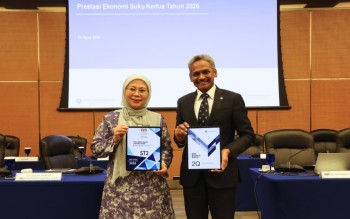
Bank Negara Malaysia has held firm on its 2026 gross domestic product growth projection of five per cent, signalling confidence in Malaysia's economic trajectory despite mounting global headwinds. Governor Datuk Seri Abdul Rasheed Ghaffour made the declaration during a press conference following the release of second-quarter GDP data, stating that the central bank sees no pressing need to adjust its forecast at this stage. The monetary authority's steadfast outlook suggests policymakers believe current momentum will sustain the growth target, though acknowledgment of external risks indicates cautious optimism rather than unbridled confidence.
The decision to maintain the five per cent forecast comes against the backdrop of Malaysia's second-quarter economic performance, which clocked 6.0 per cent growth—exceeding the Department of Statistics Malaysia's preliminary estimate of 5.8 per cent. This outperformance represents the latest in a sequence of three consecutive quarters wherein actual growth has surpassed initial expectations, suggesting economic resilience and the presence of hidden momentum not immediately apparent in advance estimates. Such repeated upside surprises provide the empirical foundation for Bank Negara's unwavering confidence, though the governor cautioned that revisions typically occur during the annual Budget announcement, implying that forecasts may be updated once more comprehensive data materialises.
Domestic demand has emerged as the principal engine propelling Malaysia's economic expansion, according to Governor Abdul Rasheed's assessment. Household consumption specifically demonstrated exceptional resilience, expanding at 4.8 per cent during the second quarter, underpinned by three distinct yet mutually reinforcing factors: rising household incomes, accumulated savings among consumers, and supportive fiscal measures implemented by the government. Notably, the governor emphasised that household borrowing remains a marginal contributor to consumption growth, suggesting that the current consumption boom is not being artificially inflated by unsustainable debt accumulation. This composition of consumption drivers carries significant implications for the sustainability of growth, as income-driven and savings-backed spending typically proves more durable than credit-fuelled consumption during economic downturns.
Export performance has provided essential ballast to Malaysia's growth trajectory, particularly through diversification across multiple sectors rather than concentration in any single industry. Both electrical and electronics products—traditionally Malaysia's export mainstay—and non-E&E goods have recorded expansion, broadening the base of external demand support. The information and communications technology services sector has exhibited particular dynamism, reflecting structural shifts in Malaysia's export composition toward higher-value service provision rather than reliance on commodity-dependent manufacturing. This sectoral diversification reduces vulnerability to demand shocks in individual markets and product categories, a structural improvement relevant for longer-term sustainability of Malaysia's external competitiveness in an increasingly fragmented global trading environment.
The external sector's contribution to growth has been significant, particularly in the prior quarter, though Governor Abdul Rasheed acknowledged that forward-looking external conditions present genuine uncertainty. Geopolitical tensions and broader global economic instability represent non-negligible headwinds that could constrain export growth and investment sentiment in coming quarters. The governor's frank recognition of these risks, while maintaining the five per cent growth target, reflects a nuanced assessment: current momentum remains robust enough to withstand moderate external headwinds, but deteriorating global conditions could force a reassessment. This balancing act between confidence and caution encapsulates the challenge facing Malaysian policymakers in navigating an unpredictable external environment.
Investment dynamics have also contributed positively to the growth picture, with both domestic and foreign investment activity supporting expansion across the economy. The governor noted that investment remains among the growth drivers alongside consumption and exports, though he provided limited granular detail regarding sectoral composition or trends in foreign direct investment flows. For Malaysian readers, investment trends carry particular significance given the economy's ongoing structural transformation and the importance of capital inflows for advancing higher-value manufacturing and digital economy development. Sustained investment momentum would strengthen the case for maintaining the five per cent growth target throughout 2026.
El Niño weather patterns present an emerging risk to Malaysia's economic outlook, though Governor Abdul Rasheed characterised the direct economic impact as likely confined primarily to agriculture. Agricultural exposure remains meaningful for rural economies and commodity-dependent regions within Malaysia, and severe weather-induced crop failures could generate ripple effects through rural incomes and food price inflation. The governor advised businesses and households to prepare for potential adverse impacts and adapt operations accordingly, suggesting that while aggregate economic damage might prove manageable, targeted sectors and demographics could experience meaningful disruption. This precautionary messaging, despite modest expected direct economic impact, reflects institutional awareness of tail risks and the importance of preparedness.
The timing of forecast revisions remains an important institutional consideration for Bank Negara, with the governor indicating that substantial adjustments to growth projections typically occur during the government's Budget announcement rather than through impromptu updates. This cyclical revision schedule aligns monetary and fiscal policy signalling around a common calendar event, providing consistency and clarity to markets and economic stakeholders. However, it also implies that forecasts may drift somewhat from evolving economic reality in the interim period, a trade-off inherent to maintaining predictable policy calendars. The next opportunity for material forecast revision would thus coincide with Budget deliberations, affording policymakers several months to accumulate additional data before making adjustments.
Looking forward, Bank Negara's maintained forecast implies an expectation that Malaysia's economic growth will moderate from the exceptional 6.0 per cent second-quarter pace toward the five per cent full-year target. Such moderation would represent a normalisation rather than a deterioration, bringing growth into alignment with the central bank's medium-term expectations for a maturing economy. Achievement of the five per cent target would position Malaysia favourably among regional peers, supporting continued employment creation and income growth for Malaysian households. However, realisation of this scenario depends on external conditions stabilising and domestic demand remaining resilient through potential global turbulence.

