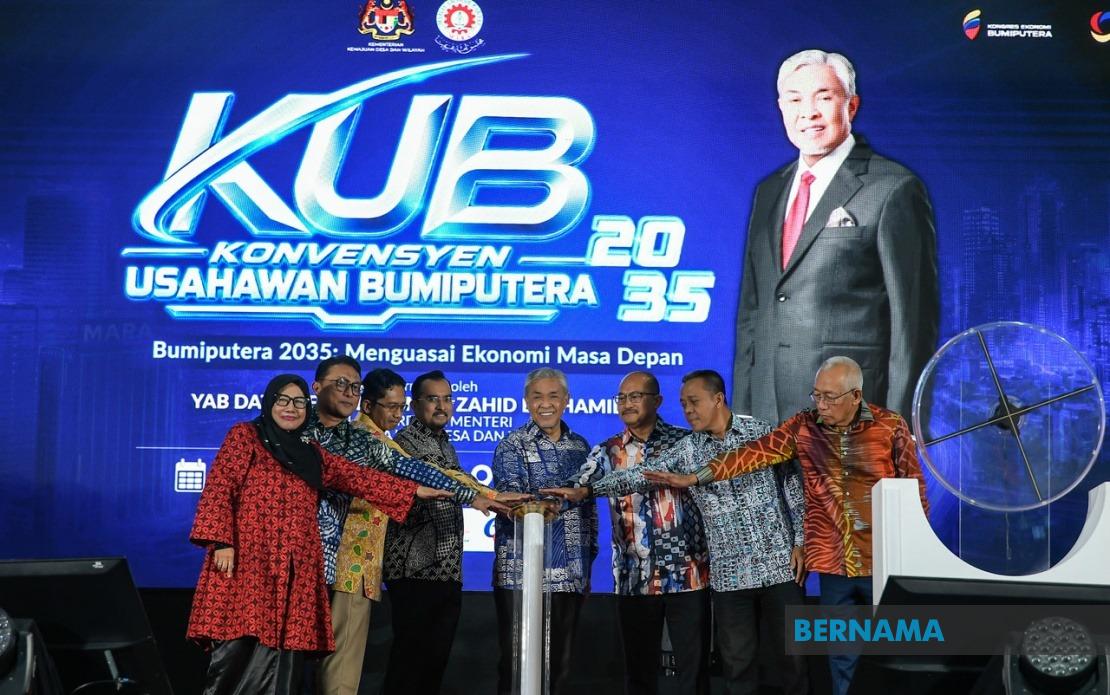
Deputy Prime Minister Datuk Seri Dr Ahmad Zahid Hamidi has issued a call for Malaysia's Bumiputera entrepreneurs to transcend the current model of passive economic involvement and instead pursue meaningful ownership stakes and expanded market control. Speaking at the closing ceremony of the Bumiputera Entrepreneurs Convention (KUB) 2035 Declaration in Alor Setar, Ahmad Zahid articulated a vision that repositions Bumiputera participation from the margins of economic activity towards positions of substantive influence and competitive strength. The shift represents a fundamental reassessment of how government policy supports indigenous business communities, moving away from tokenistic inclusion towards strategic empowerment.
The Deputy Prime Minister, who also holds the Rural and Regional Development portfolio, framed this evolution as the natural progression of Malaysia's Bumiputera economic framework. Over decades, successive administrations have invested considerable resources in ensuring indigenous entrepreneurs maintain access to economic participation through reserved quotas, preferential procurement, and designated licensing arrangements. However, Ahmad Zahid's commentary suggests that this foundational work, while important, has created a plateau in Bumiputera business development. Entrepreneurs remain concentrated in lower-value segments of value chains rather than controlling entire sectors or commanding significant equity positions within major industries. This structural limitation has persisted despite multiple initiatives, revealing that mere participation without ownership fails to generate the wealth accumulation and economic leverage necessary for sustained business growth.
Central to Ahmad Zahid's prescription is the notion of courage and competitive ambition among Bumiputera business owners themselves. While the government commits to sustaining support mechanisms, expanding financing pathways, and nurturing talent, entrepreneurs must simultaneously demonstrate the willingness to undertake calculated risks, engage in robust market competition, and invest in value creation rather than relying on protective arrangements. This reciprocal framework places responsibility on both government and private actors. The Deputy Prime Minister's framing acknowledges that government support, though necessary, cannot be the sole driver of transformation. Bumiputera entrepreneurs must internalize the discipline of competitive markets, develop scalable business models, and create distinctive value propositions that extend beyond reliance on preferential policies.
Ahmad Zahid identified three critical transformations required within Malaysia's Bumiputera entrepreneurship ecosystem to achieve meaningful progress by 2035. The first involves integrating fragmented support structures that currently operate in isolation. Financing mechanisms, technical training programmes, and market access initiatives function through disparate government agencies, financial institutions, and private intermediaries with minimal coordination. This fragmentation imposes substantial transaction costs on entrepreneurs seeking comprehensive support. An entrepreneur might access capital from one channel, training from another, and market connections through a third, requiring parallel navigation of different application processes, eligibility criteria, and reporting requirements. Integration would theoretically reduce friction and enable entrepreneurs to access holistic support packages tailored to their development stage and business model.
The second transformation requires shifting the ecosystem's orientation from generating large numbers of entrepreneurs to systematically developing existing entrepreneurs into larger, more competitive enterprises. Malaysia has historically emphasized entrepreneur creation through subsidized training, licensing schemes, and venture capital instruments intended to increase the sheer volume of Bumiputera business owners. Quantitative expansion, however, has not necessarily translated into qualitative improvement in business performance or economic impact. Many ventures remain micro-enterprises with limited growth trajectories and minimal employment generation. Reorienting policy towards consolidation and scaling would concentrate support on entrepreneurs demonstrating viability and growth potential, intensifying investment in those likely to achieve substantial scale and sectoral influence rather than distributing resources thinly across numerous small operations.
The third pillar focuses on aligning national economic growth with the strengthening of domestically-owned enterprises. Malaysia's development strategy has periodically emphasized foreign direct investment and multinational enterprise participation as primary growth engines. While such approaches have delivered short-term GDP expansion and employment, they have sometimes occurred at the expense of local ownership and indigenous business development. Ahmad Zahid's framework suggests that sustainable economic advancement requires deliberate integration of local company growth objectives within broader development planning. This might involve procurement preferences for locally-owned firms in government contracts, incentives for technology transfer and supply chain integration with Bumiputera enterprises, and regulatory frameworks that encourage domestic competition rather than foreign consolidation.
The Deputy Prime Minister's emphasis on building ownership carries significant implications for Malaysian economic policy going forward. The current approach, while maintaining political utility through its inclusive framing, has demonstrably failed to generate competitive Bumiputera conglomerates comparable to those in neighboring economies. Thailand, Indonesia, and the Philippines have fostered indigenous business empires controlling substantial equity positions across multiple sectors. Malaysia's Bumiputera businesses, despite policy advantages, remain disproportionately represented in retail, trading, and services rather than commanding positions in manufacturing, technology, or strategic infrastructure. This disparity suggests that participation-focused policies, absent scaling mechanisms, create structural ceilings on Bumiputera business development.
The practical implementation of Ahmad Zahid's vision will test government commitment to systematic reform. Integrating support ecosystems requires consolidating overlapping agency functions and rationalizing bureaucratic structures, involving potential resistance from incumbent institutions. Shifting towards selective development rather than universal entrepreneur creation demands politically difficult decisions about which enterprises warrant intensive government support, potentially generating accusations of favoritism or exclusion. The requirement that local company growth be centered within national economic planning may conflict with trade agreements and investment commitments favoring foreign participation. These implementation challenges suggest that translating the Deputy Prime Minister's strategic vision into operational reality will require sustained political will and sustained coordination across multiple government levels.
For Bumiputera entrepreneurs, the Alor Setar declaration represents both opportunity and elevated expectation. The government is signaling its intention to move beyond historical support models toward more sophisticated ecosystem development. Simultaneously, entrepreneurs face implicit pressure to demonstrate greater entrepreneurial sophistication, competitive capability, and strategic ambition. This reframing reflects broader regional trends wherein Southeast Asian governments increasingly emphasize quality over quantity in business development policy. The declaration's focus on 2035 suggests a fifteen-year transformation timeline, providing sufficient horizon for substantial structural change in the Bumiputera entrepreneurship landscape. Whether Malaysia's policy apparatus and entrepreneurial community can collectively execute this vision will significantly influence the trajectory of indigenous business development and, by extension, the economic distribution of ownership and control within Malaysia's broader economy.

